this post was submitted on 25 Feb 2026
378 points (99.2% liked)
History Memes
2064 readers
1649 users here now
A place to share history memes!
Rules:
-
No sexism, racism, homophobia, transphobia, assorted bigotry, etc.
-
No fascism (including tankies/red fash), atrocity denial or apologia, etc.
-
Tag NSFW pics as NSFW.
-
Follow all Piefed.social rules.
-
History referenced must be 20+ years old.
Banner courtesy of @setsneedtofeed@lemmy.world
OTHER COMMS IN THE HISTORYVERSE:
- !historymusic@quokk.au
- !historygallery@quokk.au
- !historyruins@piefed.social
- !historyart@piefed.social
- !historyartifacts@piefed.social
- !historyphotos@piefed.social
founded 9 months ago
MODERATORS
you are viewing a single comment's thread
view the rest of the comments
view the rest of the comments
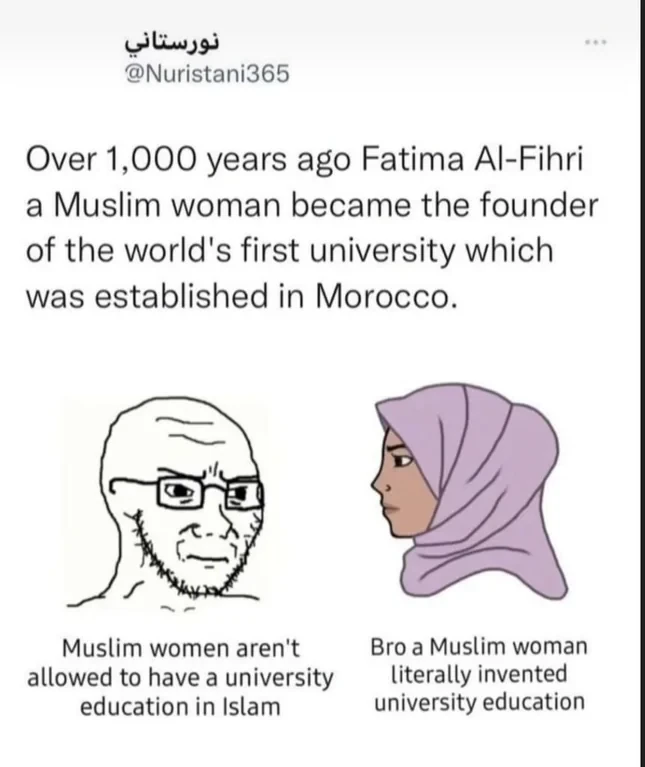
My point was, and is, that you should always be skeptical of feel-good facts shared in image format on social media. The worlds oldest continuously operating university being founded by a Muslim woman is pretty cool - so why have I not heard it before? If you told me it was actually founded by [random European guy], I would probably just believe you because there isn't really any reason for misrepresent or make up that story. However, there is a pretty clear incentive to distort or embellish the story of Fatima because it pushes back against the narrative of Islam being misogynistic and anti-science. I'm not really trying to be pedantic here, just skeptical of the whole story in general. If a black inventor did something... at least we can agree they did it, and I don't really care about semantic arguments. I agree that people disputing black people being inventors based on pedantic arguments may be motivated by racism, but that's not what I'm trying to do here. If there was clear evidence that
a) Fatima was a real person, and
b) There was any evidence that, at the time of its founding, al-Qarawiyyin mosque was a center of learning,
I wouldn't really care about whether or not you could really consider it a "university" or not, and would be happy to consider her the founder of the oldest continuously operating university. However, the reality is that there aren't any historical records of Fatima until 500 years after her death, which makes her seem more like Dido of Carthage or Romulus than a real person. (Also, they literally found an inscription, believed to be 9th-century, within the mosque that says it was founded by someone else). Also, while madrasas were definitely centers of learning, all the sources I could find say the transition to a madrasa happened after the mosque was founded.
So idk man. It's not outright misinformation but it is disputed by historians for several reasons.
Because it's a minor piece of trivia? Because we're undoing some ~200 years of Eurocentric history-as-a-discipline here in the West?
... that's exactly what I mean when I reference prejudices coloring our interpretations of institutions. If it was a European guy, you wouldn't even question it.
Islam gained a reputation as exceptionally misogynistic and anti-scientific only in the last 200-300 years.
That's fair.
A is the part most open to dispute - while generally it's considered that figures mentioned in historical sources are based on real people, there is always a question of the reliability of transmission, and the source in question is not the most reliable.
B is more reliable - major mosques of the period that were founded by a patron are deeply connected with learning and education, due to the emphasis in Islam on interpretation of holy texts and decentralized religious authority (even under the Caliphate), and it's clear from a very early point that it was engaged in higher scholarship. You could separate the two - that just because mosques were created as centers of (religious) learning and textual transmission doesn't mean that it deserves the association with higher scholarship, but I feel like that's splitting hairs.
That's a fair rebuttal. Thank you for engaging with me civilly, it makes these discussions a lot more productive and enjoyable.