this post was submitted on 20 Feb 2026
5 points (64.7% liked)
Conservatives
140 readers
1 users here now
Pro-conservative discussions
Rules
- Pro-conservative or crazy liberal post.
- We are a discussion forum. No low effort, trolling comments.
- Everyone is welcome to opine, but be civil.
- Attack the topic, not the person
- Report violations of the rules
- Serial downvoting earns you a ban.
founded 1 year ago
MODERATORS
you are viewing a single comment's thread
view the rest of the comments
view the rest of the comments
Their culture isn't any more homogenous than US culture. What you probably mean is they are racially homogenous, but it would be bad to imply that is superior.
Japanese trains were state owned until 1987. Once the majority of the tracks were laid (the expensive part), they handed it over for private management.
Another important element to Japans succes is that after WW2 they were banned from building a military which freed up a lot of money for social programs.
This is not accurate. Of course, regional differences are pronounced - it is not just the Kanzai that are distinct from greater Japan, but even within Kanzai the people of Kyoto represent a more traditional culture that is honor and prestige based while the people of Osaka tend to be direct, forthright, more hot-blooded and more expressive. Many say this is due to the traditional character of the cities - Osaka being highly mercantile and Kyoto being the traditional capital.
Yet, they are all Japanese, they have the same reference points, they have the same greater interests and cultural values, the same strange mix of Buddhism and Shintoism into a sort of national religion, and they have the same reference points within their political philosophies.
They are highly homogeneous.
I could talk all day about the regional differences and the socioeconomic classes within Korea, but still, there is cultural homogeneity.
Oddly enough, here it would be the center left that is even more inclined than the center right towards preserving this homogeneity and more expressive of a quiet ethnonationalism. Even the hard left seems inclined towards these views in the classic sense due to the influence of the North Korean communist narrative.
Sure, and half of the Seoul metro train tracks - or a bit more, IDK - are privately operated.
But yeah, the military spending is not a factor, but this is certainly true. The Europeans have tremendous welfare states because they have neglectedl military spending, and now they are FINDING OUT.
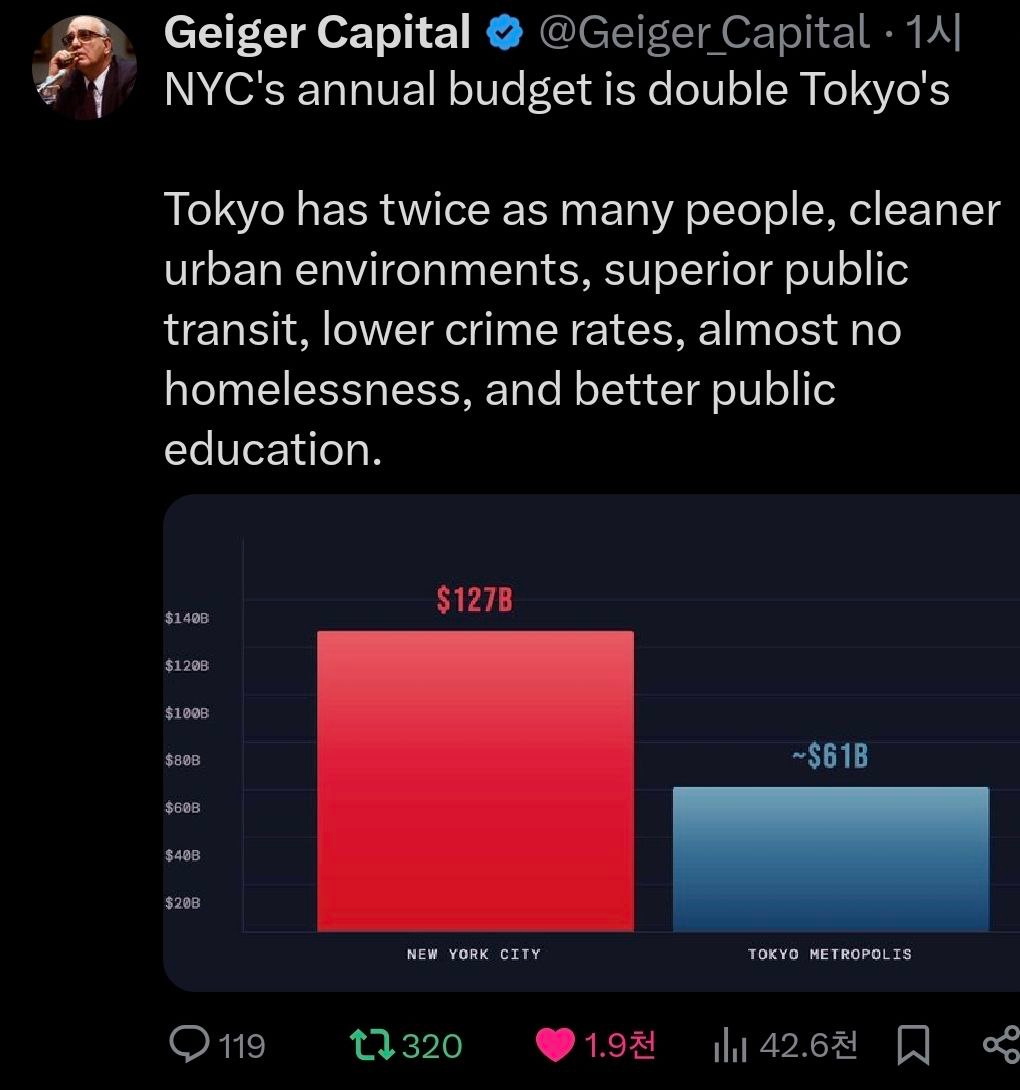
However, this is irrelevant to the NYC/Tokyo dichotomy.
Japan does have a military and they spend 2% of their GDP on it. That is more than most European nations.
.,.. That is a really wild stat!
To put it in perspective. We allocate about 3% of our GDP to the military.