this post was submitted on 17 Feb 2026
1061 points (99.8% liked)
memes
22819 readers
2475 users here now
Community rules
1. Be civil
No trolling, bigotry or other insulting / annoying behaviour
2. No politics
This is non-politics community. For political memes please go to !politicalmemes@lemmy.world
3. No recent reposts
Check for reposts when posting a meme, you can only repost after 1 month
4. No bots
No bots without the express approval of the mods or the admins
5. No Spam/Ads/AI Slop
No advertisements or spam. This is an instance rule and the only way to live. We also consider AI slop to be spam in this community and is subject to removal.
A collection of some classic Lemmy memes for your enjoyment
Sister communities
- !tenforward@lemmy.world : Star Trek memes, chat and shitposts
- !lemmyshitpost@lemmy.world : Lemmy Shitposts, anything and everything goes.
- !linuxmemes@lemmy.world : Linux themed memes
- !comicstrips@lemmy.world : for those who love comic stories.
founded 3 years ago
MODERATORS
you are viewing a single comment's thread
view the rest of the comments
view the rest of the comments
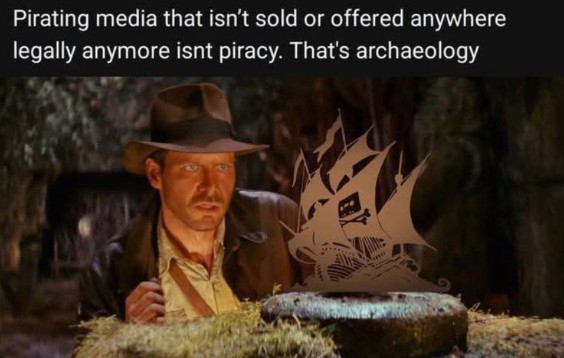
It's conservation. Archeology is digging up what was once lost.
So finding a lost video game is archeology. Keeping it safe is conservation.
Ensuring games can't be lost in the first place and that they continue to work in the future is preservation.
All needed, but different things.
This reminds me of when a couple of lost Doctor Who episodes were found but the owner was nervous to share them with the BBC because he feared confiscation and/or prosecution. I don't know what happened with that story.
My hot take is all abandonware media should legally become file-share friendly after a certain amount of time being out of print, say 15 or 20 years. The original rights holder still maintains copyright, but if they are no longer publishing that work, and therefore no longer making sales, anyone can fileshare it for free in its original form. If the owner then republishes it, it stops being file share friendly. But there have to be caveats, like Nintendo can't publish 2 copies of an old game every 15 years for like $500 a copy and say it's still published. It has to be sold at a reasonable price.
I mean, copyright was supposed to be limited to 20 years, same as patents. I don't think we would need anything else if we went back to that. There is no reason for copyright to last about a century like it does now.
Then how would Disney make money if they didnt continue being able to sell 70 year old movies at full price???? Stop being such a greedy asshole Dreamlsnd!!!! Disney needs to make a reasonable income, and public domain was always a silly idea.
I think lifetime of original creator is fine. I wrote my first manga in 2010 (it's crap but still), I don't think that it should stop being mine in 4 years.
I heard that lifetime + 80 was to stop someone murdering a popular author and, assuming they got away with it, then publishing that work for their own profit. But I don't know if that's true.
That is solved with different degrees of copyright. If done right, the author's works will never stop being theirs, but people will be able to make fanfiction without fear of a bloodthirsty copyright lawyer biting at their necks. They'd just have to clearly indicate it's fanfic, and the original author could get a cut of any earnings past a threshold.
Create a great work that inspires another great work; both authors benefit.
I would go even further, for any media.
The moment a company ends access to a piece of media, it should almost automatically become public domain. With just a reasonable window of time to bring it back once inaccessible, just in case there are things like downtime, blackouts, or restructuring of services.
Disney decides they will no longer let you rent the original Snow White for a local movie theater in your city, or take it out from their streaming services, or creates an alternate edited version with any significant alteration other than a disclaimer or warning at the start but removes access to the original, and no one else has the rights on lease that gives that access instead, boom, public domain. You no longer have to wait until 2032 to make an exploitative low-budget horror movie version of it.
If they make a remaster of a game, they must keep access to the original. Sell only the remaster; the original becomes public domain for use, not the IP, within reason.
Any associated proprietary technologies, like a physics engine, get a limited lease of use with no cost for the original as it was, excepting modifications to allow it to run on other devices and newer devices.
So it wouldn't be all of it becomes public domain, but it becomes something usable and maintainable by the public domain.
Remove access to the game and all versions and remasters, and the IP of that game goes fully public domain.
Ok, truth, but I will still call it preventive archeology...