this post was submitted on 12 Feb 2026
352 points (96.6% liked)

GIMP

531 readers
582 users here now

All about the GNU Image Manipulation Program • Please tag your help-me posts with [Help]. • YouTube Channel spamming will not be tolerated. • Blogspam will not be tolerated.

founded 2 years ago
MODERATORS
 

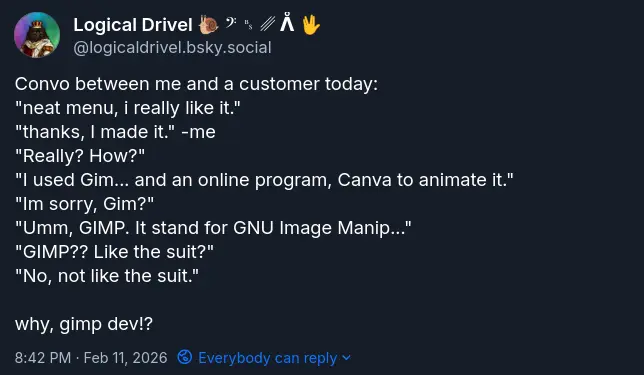
Honest to gods, this conversation happened today, and it may have cost me a job opportunity. The customer was super impressed with my menu design and animation, and wanted to know who we got it from. When I said I did it, their face lit up! Too bad as soon as i said GIMP, they weren't interested anymore. Has anyone else experienced this? What do you say in similar situations?
you are viewing a single comment's thread
view the rest of the comments
[–] darklamer@lemmy.dbzer0.com 4 points 18 hours ago (1 children)

From Wiktionary:

  • A person who is lame due to a crippling of the legs or feet.
  • (slang, derogatory) A name-calling word, generally for a person who is perceived to be inept, deficient or peculiar.
  • (BDSM) A submissive dressed in a full-body suit of latex or a similar material.

I doubt that many people know that word. I just tried looking it up in my Collins Cobuild English Dictionary, which has frequency information and tells you how common or uncommon different words are, but it didn't have any entry for gimp at all. In its own roundabout way, I guess that's also a pretty good indicator of how uncommon that word really is.

[–] tigeruppercut@lemmy.zip 1 points 7 hours ago (1 children)

Merriam has the definition I knew it by before I saw Pulp Fiction, which is a synonym for limp. I think I was also vaguely aware it was an offensive word for someone disabled.

https://www.merriam-webster.com/dictionary/gimp

[–] darklamer@lemmy.dbzer0.com 1 points 5 hours ago

Merriam-Webster has an amazing amount of words in their online dictionary, but no frequency information. I don't have any of their print editions nearby at the moment — do you happen to know if they considered this word common enough to include in any of their print editions? That might be a useful indication, in lieu of frequency statistics.

And it really is quite an unusual word to know. How did you learn it? Did you maybe grow up in an English speaking community, or was it just pure coincidence that you happened to encounter such an unusual word?