this post was submitted on 10 Feb 2026
753 points (98.0% liked)
Curated Tumblr
6948 readers
5 users here now
For preserving the least toxic and most culturally relevant Tumblr heritage posts.
Here are some OCR tools to assist you in transcribing posts:
-
FOSS Android Recs per u/m_f@discuss.online: 1 , 2
Don't be mean. I promise to do my best to judge that fairly.
founded 2 years ago
MODERATORS
you are viewing a single comment's thread
view the rest of the comments
view the rest of the comments
Earth's atmospheric temperature is not what this person is talking about. The temperature outside your door depends on the sun, sure, but it's due to Earth's atmosphere. Go 60 miles towards "up" and the temperature of space is not the 68 degrees it is on the ground.
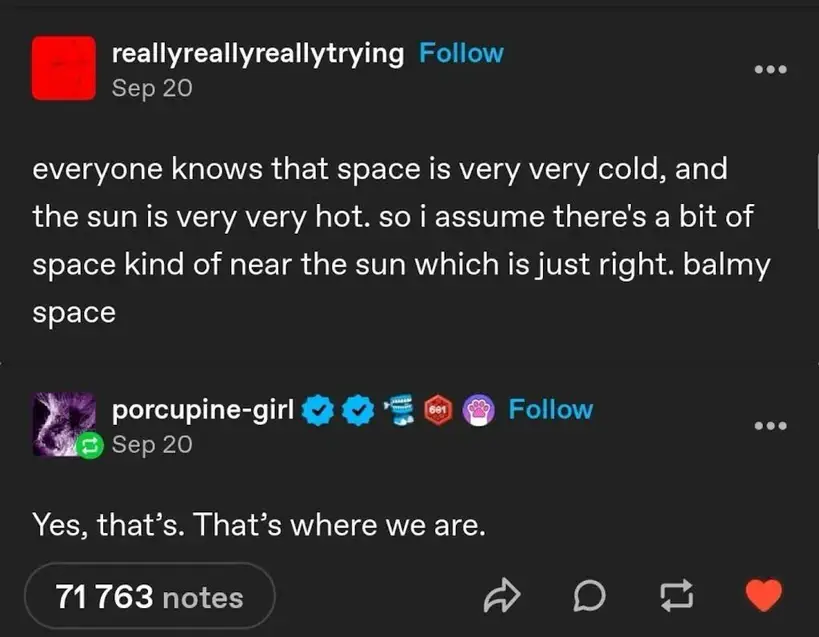
I think OP is questioning the temperature of the vacuum of space near the Sun. It doesn't really work like that though.
To expand on the "doesn't work like that" part: In the vacuum of space there is no air to exchange warmth with your body, or your space suit. You might be comfy on the side of your body facing the sun (if you're at that distance where it provides the right amount of radiative heat) but the side facing away from the sun will get no heat, and therefore be cold. I imagine that would feel very weird... if you could feel it on your skin, without a space suit, without being ripped apart by the vacuum, of course.
Does anyone know whether this "uneven distribution of heat energy" is a problem for space suits or if that little bit of air inside is enough to distribute it?
Why can some objects exist in space without getting ripped apart like a human would. Is that what actually happens to a human anyways?
Ever seen a picture of a blobfish in it's deep ocean habitat vs when it is at the surface? It's body is adapted to the extreme pressure of the deep sea, and when that pressure is no longer there, the forces keeping it's shape are no longer present and thus every bit of it expands. That's what would happen to us in the vacuum of space albeit on a lesser scale. Also, we're like 70% water which boils in a vacuum.
As I understand it, this in fact will not happen. Our circulatory system is a closed loop and strong enough to not expand into vacuum. The water inside our body is kept close to usual pressure by our skin, blood vessels etc.
The main immediate danger in space without a spacesuit would be holding your breath. Your lungs are not built to withstand a whole atmosphere of pressure from the inside, and will get damaged if you hold your breath.
Of course if you don't, you'll have another problem.
Thanks for the clarification. I knew the whole lungs problem and that was really what I had in mind but just kind of assumed there'd be similar dangers to other bodily functions but I see that's not the case.
I do believe the water would still be an issue for your eyes and maybe even mouth but good to know you wouldn't immediately have blood literally boiling in your veins.
I agree that the water exposed to vacuum would evaporate over time, but I'm not sure it would be directly harmful beyond the dehydration.