this post was submitted on 23 Jan 2026
47 points (98.0% liked)
History Memes
2218 readers
593 users here now
A place to share history memes!
Rules:
-
No sexism, racism, homophobia, transphobia, assorted bigotry, etc.
-
No fascism (including tankies/red fash), atrocity denial or apologia, etc.
-
Tag NSFW pics as NSFW.
-
Follow all Piefed.social rules.
-
History referenced must be 20+ years old.
Banner courtesy of @setsneedtofeed@lemmy.world
OTHER COMMS IN THE HISTORYVERSE:
- !historymusic@quokk.au
- !historygallery@quokk.au
- !historyruins@piefed.social
- !historyart@piefed.social
- !historyartifacts@piefed.social
- !historyphotos@piefed.social
founded 10 months ago
MODERATORS
you are viewing a single comment's thread
view the rest of the comments
view the rest of the comments
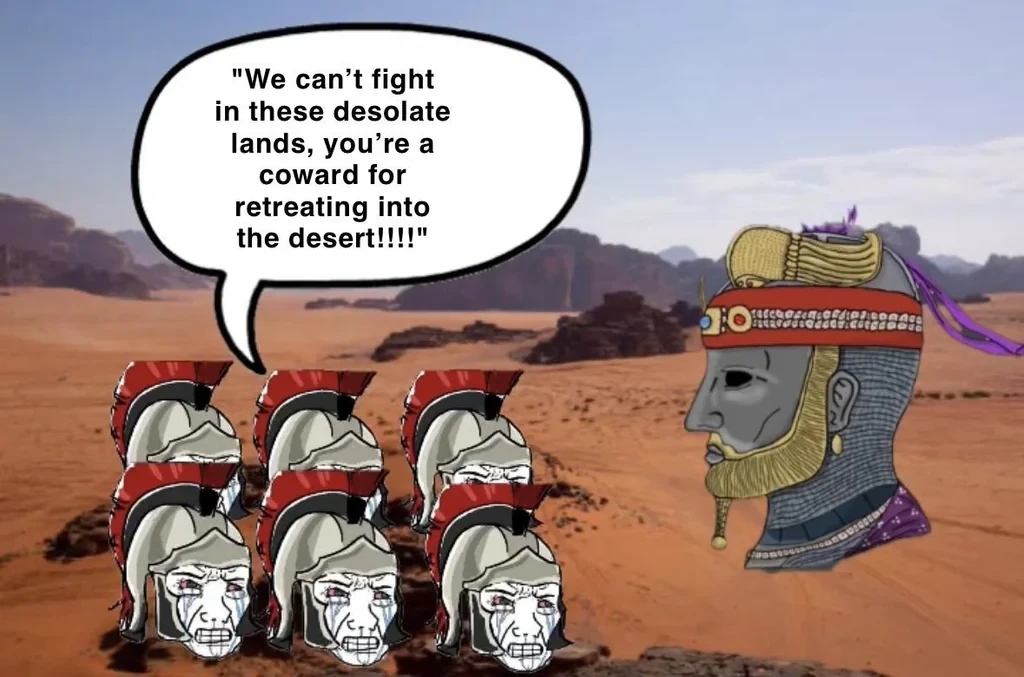
Explanation: One of the recurring tactics of the Persian dynasties which Rome often warred with was simply to withdraw behind natural barriers inside of the Persian Empire. Roman forces would generally be unable to sustainably extend their supply lines, and thus either be forced to offer battle on Persian terms, or to withdraw.
The Roman Emperors Trajan and Septimius Severus both attempted to alleviate this weakness by annexing Mesopotamia, but in both cases, their successors found the expense of garrisoning and defending the province to be not worth the forward position. This was arguably "Penny-wise and pound-foolish", as Persian-owned Mesopotamia is exactly where Roman forces were regularly strung out and exhausted, but grand strategy is something that is not always fully appreciated by decision-makers in government, ironically - in antiquity especially, but in the modern day as well.
Turns out heads of government used to occasionally be bad at strategy. They still do, but they used to, too.