105
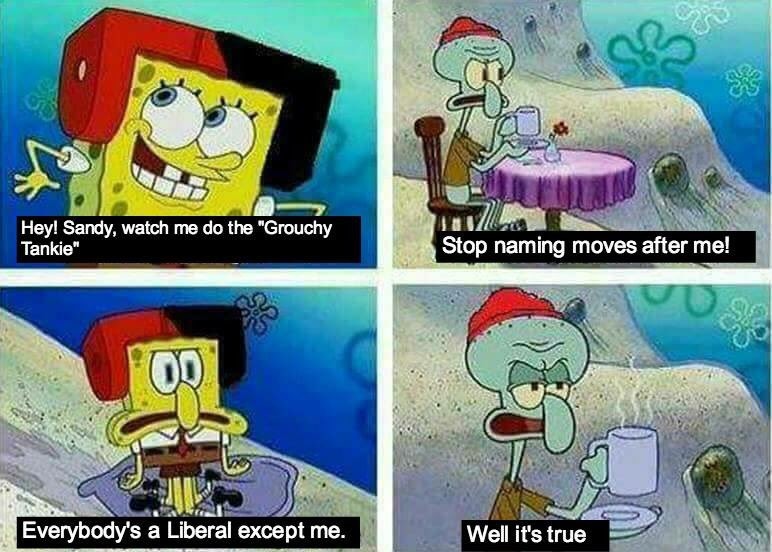
LIBERAL LIBERAL LIBERAL, you are ALL LIBERAL! NONE of you are free from LIBERALISM
(media.piefed.social)
Dunking on Tankies from a leftist, anti-capitalist perspective.
Rules:
We allow posts about tankie behavior, shitposts, and rational, leftist discussion. Please redirect any Fediverse tankie-posts to !MeanwhileOnGrad@sh.itjust.works to avoid bringing drama to Piefed.social
Curious about non-tankie leftism? If you've got a little patience for 19th century academic style, let a little Marx and Kropotkin be your primer!
Marx's Communist Manifesto, short and accessible! Highly recommended if you haven't read it
For a wider variety of leftist memes, see:
!political_memes@piefed.social
What's the difference between bourgeois oligarchy and aristocratic oligarchy?
Bourgeois oligarchy is much more predicated on a division between state power and private power. Bourgeois oligarchs do need the centralized state, to some degree, for contract enforcement, which makes them more vulnerable to that state power. While they often go through great efforts to (successfully) keep state power on their side, the nature of their power means it's much less 'sturdy' and self-reliant than aristocratic power. Bourgeois oligarchs owe their position to the fact that the centralized enforcement apparatus itself acknowledges and backs their claim to private property. Bourgeois oligarchy is reliant on the generation and accumulation of capital. No capital, they have nothing to offer - or threaten - the central government with.
Aristocratic oligarchy is much less predicated on any division between private property and state power. Aristocratic oligarchs are often hostile to the centralized enforcement apparatus precisely because they don't need it for their day-to-day functioning; the central state is more like a 'senior partner' in an alliance against outsiders, not an essential part of their day-to-day functions. Aristocratic oligarchy resembles more a series of states. Aristocrats, effectively, always have something to threaten the centralized state with - power. Each aristocrat holds some form of power in and of himself - the most blatant way would be through private armies, but webs of social connections and clients are also very possible. Aristocracies also tend to concentrate their power geographically, rather than disperse it, since they need to defend it at all times. Bourgeoisie is free to disperse their power geographically precisely because the state is defending it.
The archetypal example is a medieval feudal regime - kings and lords and peasants - but modern states struggling with local unofficial authorities (like 'big men', clan structures, gang leaders, and land magnates) and what we would regard as 'failed states' struggling with warlords both also fit this view, albeit less formalized/codified than the 'classic' medieval example.
One can bleed into another - it's a spectrum rather than a boolean - but generally oligarchic power falls into one of those two categories. There are exceptions - apparatchik oligarchy (like Soviet systems) and military juntas sometimes have a strange mix of features and reliances that make them better examined apart from this dichotomy, but generally speaking, modern industrialized states struggle with bourgeois, and pre-modern or pre-industrialized struggle more with aristocrats.
Grotesqueries like company towns can bleed one into the other - when corporation is enforcement, firms are more like aristocrats than bourgeoisie. Likewise, there is nothing stopping a bourgeois oligarchy from accumulating privileges until it becomes aristocratic, or more aristocratic. Conversely, extremely centralized feudal states (or similar) can reduce an aristocracy to a position of dependence on the central power more akin to the bourgeoisie - like late Absolutist France, just before the French Revolution.
I will read this while I poop at work later today, I appreciate the time you took to explain.
Edit: Very well written, easy to understand explanation!
This guy just had a shit. ^
Lol juvenile jokes aside it was nicely written. I too appreciated it. I'm encountering a whole new sector of politics on Lemmy that I had little knowledge of before.