105
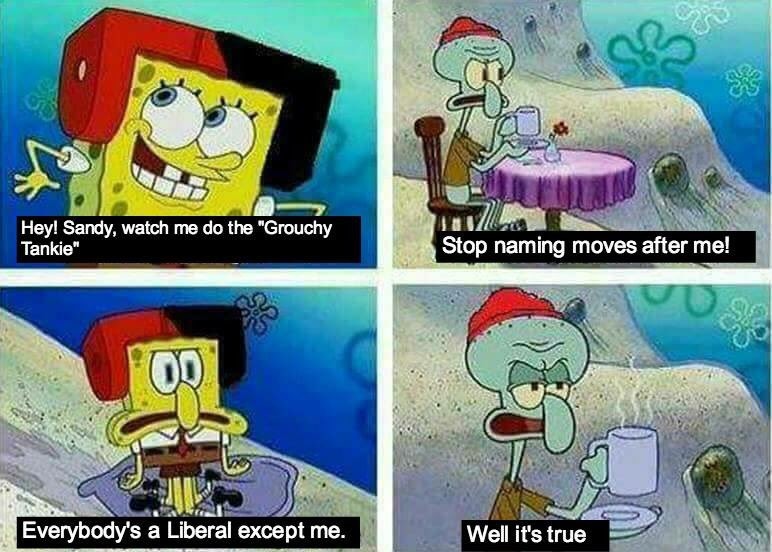
LIBERAL LIBERAL LIBERAL, you are ALL LIBERAL! NONE of you are free from LIBERALISM
(media.piefed.social)
Dunking on Tankies from a leftist, anti-capitalist perspective.
Rules:
We allow posts about tankie behavior, shitposts, and rational, leftist discussion. Please redirect any Fediverse tankie-posts to !MeanwhileOnGrad@sh.itjust.works to avoid bringing drama to Piefed.social
Curious about non-tankie leftism? If you've got a little patience for 19th century academic style, let a little Marx and Kropotkin be your primer!
Marx's Communist Manifesto, short and accessible! Highly recommended if you haven't read it
For a wider variety of leftist memes, see:
!political_memes@piefed.social
The thing is, liberalism, properly defined, generally includes strong protections for private (not just personal) property as a core tenet of the ideology, as formulated in the 17th century, something which it largely retains.
To channel my inner Marxist, this was a necessary development in the destruction of feudalism, but fuels bourgeois (rather than aristocratic) oligarchs in the modern day.
Liberalism has many lessons that should not be tossed aside - but one of its core tenets is pretty damn broken in terms of providing justice to the working man. The hostility towards liberalism, in this sense, is not unwarranted.
I think that due to the industrialization of modern societies, there needs to be reparations for damage to the environment, and that excessive wealth pose a direct threat to the rights and freedoms of the individual, so for a truely liberal society the rich would need to be taxed out of existence. Aside from that, I don't really care what they do with their time or property, and would be happy to protect it as well as my own in equality.
I think you probably mean personal vs private property. We all like our houses cars and various toys, and deserve to have them.
And private manufacturing workshops and commercial kitchens and printing presses and farmlands, I have no qualms with any of it under the assumption that taxes remove any possibility of excessive wealth.
Fair enough, I hate being in charge.
I really love being able to make things, personally. I love making liquid and solid soaps and other emulsions, or fixing old computers. If I had the money I'd start a silicon production facility turning raw minerals such as quarts and sand into crushed silicates, weight separate, melt, cast, crush again, separate again, melt, crystalize with a seed and cast for high purity electronics and photovoltaic grade Silicon. I'd spend 12 hours a day in there. I've got other ideas, too. My little brother drives CDL, I could keep him busy as well.
Could a state run it better than me? Maybe, maybe not. I think they're better off focusing on minimizing suffering than worrying about production output. If anything them being involved might give them incentive to place production over safety or workers rights.
You might be interested in the idea of workers' self-management, like in market socialist Yugoslavia. In that, some small firms are just strictly regulated personal businesses (private business was allowed with up to 5 employees + the owner's family); but most are controlled by democratic elections rather than a top-down state authority. As it's a market socialist system, rather than being given quotas by a central power, each firm essentially acts in a recognizable way to our Western eyes, choosing to buy and sell goods - except that workers have more say in it.
There's a reason socialist Yugoslavia could allow its people to go and visit the rest of the world whenever they liked - they weren't trapped in a complete dystopian hellhole that the outside world would disillusion them of. It was still a dictatorship (or strongman regime, rather), but people enjoyed some control over their own economic output, and that counts for a lot. Not only that, but it's much more efficient than the Soviet system - Yugoslavia enjoyed greater growth from a lower starting point, and had higher living standards than Warsaw Pact states with similar GDP.
I don't think any of us here on tankiejerk would welcome a dictatorship even for a good socialist economy, but I also think it's fair to regard the economic regime of Yugoslavia as not irreducibly welded to the political regime of Yugoslavia, in the same way that there are market capitalist dictators and market capitalist democracies. It's definitely, regardless of agreement or disagreement with the economic system, a fascinating topic of study.
Curiously(?), I would regard its eventual economic failure on Marxist terms - it actually had very good ROI, and as long as the world economy was healthy and Western loans were available, they could accumulate the capital to improve their own economy. When those loans dried up, they began to struggle. Had they been a developed nation first, and then transitioned to a socialist state, it might've worked out well (at least economically - politically, God knows it's the Balkans, and Yugoslavia was always a very artificial construction). Marxism, traditionally, posits that a state needs bourgeois capitalism to accumulate capital first, and only THEN seize it when production heightens to the point where capitalism's internal contradictions begin to destabilize it. At that point, you have all these nice factories built up, workers who are used to fighting The Man and capable of self-organizing, and a general understanding of a modern economy - all necessary things to start building a real socialist state.
MLs, like Soviets and Maoists, believe that you can take the socialist step first, and deal with accumulating capital later - something which, by a Marxist analysis, would lead right back into a feudal regime by not changing the underlying economic relationship of people to the society.
H-ha ha, g-good thing the USSR and PRC didn't devolve into some clientistic system of personal loyalties of the elites where the workers had no input, th-that would be horrifically bad and prove Marx right all along...
What's the difference between bourgeois oligarchy and aristocratic oligarchy?
Bourgeois oligarchy is much more predicated on a division between state power and private power. Bourgeois oligarchs do need the centralized state, to some degree, for contract enforcement, which makes them more vulnerable to that state power. While they often go through great efforts to (successfully) keep state power on their side, the nature of their power means it's much less 'sturdy' and self-reliant than aristocratic power. Bourgeois oligarchs owe their position to the fact that the centralized enforcement apparatus itself acknowledges and backs their claim to private property. Bourgeois oligarchy is reliant on the generation and accumulation of capital. No capital, they have nothing to offer - or threaten - the central government with.
Aristocratic oligarchy is much less predicated on any division between private property and state power. Aristocratic oligarchs are often hostile to the centralized enforcement apparatus precisely because they don't need it for their day-to-day functioning; the central state is more like a 'senior partner' in an alliance against outsiders, not an essential part of their day-to-day functions. Aristocratic oligarchy resembles more a series of states. Aristocrats, effectively, always have something to threaten the centralized state with - power. Each aristocrat holds some form of power in and of himself - the most blatant way would be through private armies, but webs of social connections and clients are also very possible. Aristocracies also tend to concentrate their power geographically, rather than disperse it, since they need to defend it at all times. Bourgeoisie is free to disperse their power geographically precisely because the state is defending it.
The archetypal example is a medieval feudal regime - kings and lords and peasants - but modern states struggling with local unofficial authorities (like 'big men', clan structures, gang leaders, and land magnates) and what we would regard as 'failed states' struggling with warlords both also fit this view, albeit less formalized/codified than the 'classic' medieval example.
One can bleed into another - it's a spectrum rather than a boolean - but generally oligarchic power falls into one of those two categories. There are exceptions - apparatchik oligarchy (like Soviet systems) and military juntas sometimes have a strange mix of features and reliances that make them better examined apart from this dichotomy, but generally speaking, modern industrialized states struggle with bourgeois, and pre-modern or pre-industrialized struggle more with aristocrats.
Grotesqueries like company towns can bleed one into the other - when corporation is enforcement, firms are more like aristocrats than bourgeoisie. Likewise, there is nothing stopping a bourgeois oligarchy from accumulating privileges until it becomes aristocratic, or more aristocratic. Conversely, extremely centralized feudal states (or similar) can reduce an aristocracy to a position of dependence on the central power more akin to the bourgeoisie - like late Absolutist France, just before the French Revolution.
I will read this while I poop at work later today, I appreciate the time you took to explain.
Edit: Very well written, easy to understand explanation!
This guy just had a shit. ^
Lol juvenile jokes aside it was nicely written. I too appreciated it. I'm encountering a whole new sector of politics on Lemmy that I had little knowledge of before.
Like many things in the past: made sense at the time, did some good, is now outdated and ought to be reconsidered and replaced with something better.