this post was submitted on 01 Dec 2025
543 points (98.1% liked)
memes
22867 readers
2672 users here now
Community rules
1. Be civil
No trolling, bigotry or other insulting / annoying behaviour
2. No politics
This is non-politics community. For political memes please go to !politicalmemes@lemmy.world
3. No recent reposts
Check for reposts when posting a meme, you can only repost after 1 month
4. No bots
No bots without the express approval of the mods or the admins
5. No Spam/Ads/AI Slop
No advertisements or spam. This is an instance rule and the only way to live. We also consider AI slop to be spam in this community and is subject to removal.
A collection of some classic Lemmy memes for your enjoyment
Sister communities
- !tenforward@lemmy.world : Star Trek memes, chat and shitposts
- !lemmyshitpost@lemmy.world : Lemmy Shitposts, anything and everything goes.
- !linuxmemes@lemmy.world : Linux themed memes
- !comicstrips@lemmy.world : for those who love comic stories.
founded 3 years ago
MODERATORS
you are viewing a single comment's thread
view the rest of the comments
view the rest of the comments
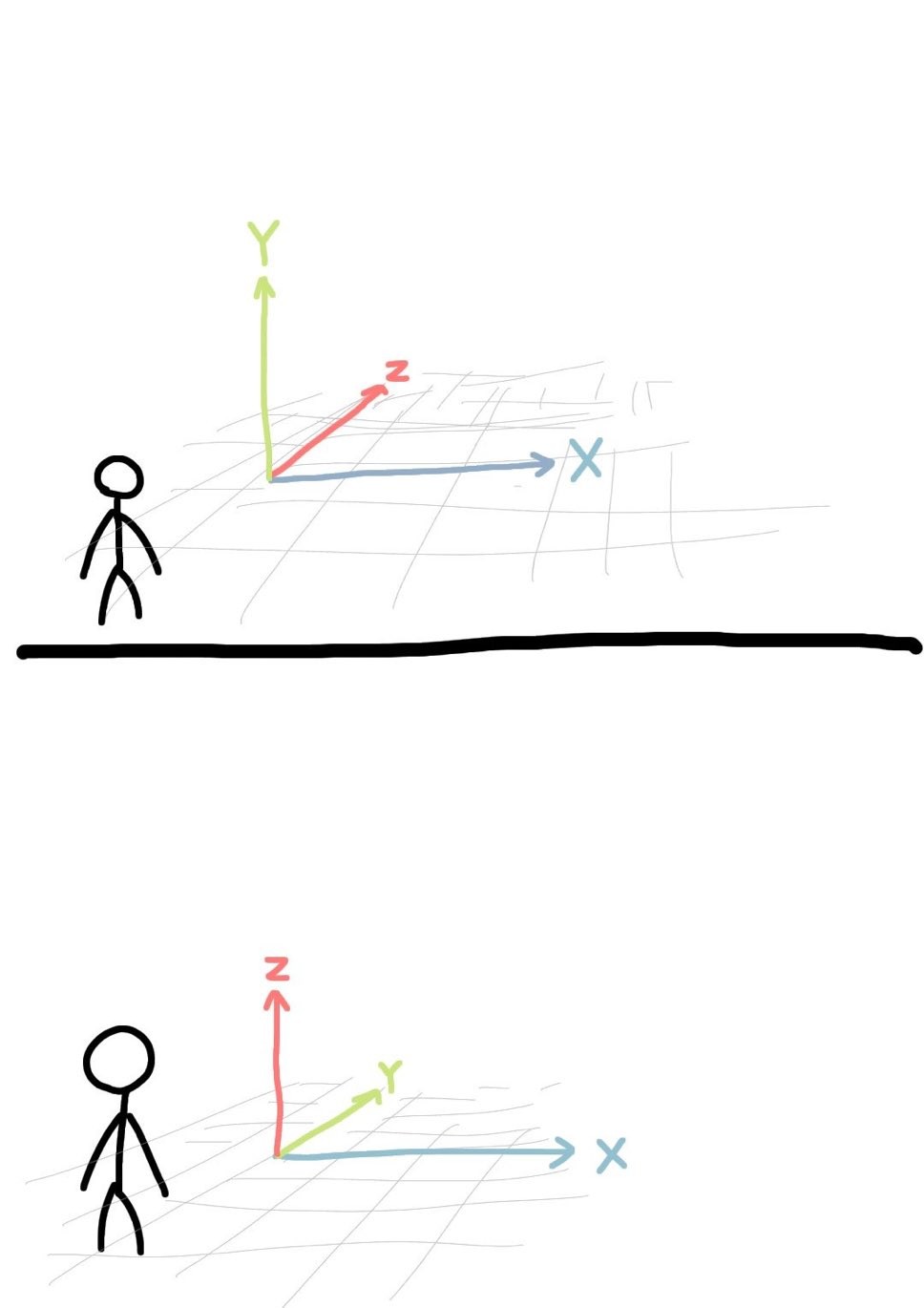
I legit had no idea anybody actually used the upper system until now. I had to read the comments just to see whether the upper system was just some sort of joke. I am horrified.
It depends on how you view 2D->3D.
If you're thinking of a side scroller like the original Super Mario, Y is up/down and X is left/right making the new dimention Z being forward/backward.
However if you think of 2D space like the first LoZ, then Y is North/South and X is East/West making Z up/down
Same with CSS for the same reason.
Almost the entirety of computer graphics uses the z coordinate for depth afaik.
Even Minecraft does it.
Yeah, and for a top-down game depth is up/down. You know, like depth being... Deep down.
As someone who looks at this from a GIS / cartographic view, the top option being possible is horrific to me.
Surely you mean the bottom one
https://help.autodesk.com/view/MAYAUL/2024/ENU/?guid=GUID-FDC58F4E-63B9-4012-B232-5F2FBAC5EAC9
Y-up and Z-up
In animation and visual effects, the tradition is to use Y as the “up” or elevation axis, with X and Z as the “ground” axes. However, some other industries traditionally use Z as the up axis and X and Y as the ground axes.