Latin American Publications!

118 readers
23 users here now

A community for Latin American publications.

NOTE: All the publications in this feed are Latin American in origin; that does not mean they only report on Latin American news.

founded 3 months ago
MODERATORS
1


This article by Obed Rosas originally appeared in the February 5, 2026 edition of Sin Embargo.

Mexico City, On February 20, 2025, the Chihuahua Health Department reported a case of measles in a 9-year-old boy from a Mennonite community in the municipality of Cuauhtémoc who had traveled to Seminole, Texas, a settlement where measles cases had already occurred with one known death at the time of the visit.

The boy’s school in Chihuahua was closed after more cases were detected. A month later, on March 20, the National Institute of Diagnosis and Reference (InDRE) confirmed that the virus isolated in the first patients belonged to the same lineage of measles previously identified in Seminole, Texas.

This is how Irma Leticia de Jesús Ruiz González, from the Chihuahua State Health Department, and Rubén Morales Marín, from the Autonomous University of Chihuahua, describe the reintroduction of measles in the state, in an article published last November in the American Journal of Field Epidemiology. The text warns that the outbreak occurred in “a highly susceptible population, such as the Mennonite community in Chihuahua, where there is low adherence to vaccination for religious or cultural reasons, in addition to close interconnection with other unvaccinated populations.”

Mennonites in Mexico

The outbreak occurred within an adverse regional context. In November 2015, the Pan American Health Organization (PAHO) declared that the Americas had once again lost their measles elimination status. The reintroduction of the virus led Mexico to face its largest outbreak since it interrupted endemic transmission in 1997. Chihuahua became the main epicenter of infections and deaths on the continent, with figures that even surpassed those of the entire United States.

This week, the Pan American Health Organization (PAHO) confirmed that Mexico leads the Americas in COVID-19 infections, with 6,428 cases and 24 deaths. Of that total, Chihuahua accounts for 4,495 cases and 21 deaths; followed by Jalisco, with 1,034 cases and one death; Chiapas, with 432 cases; Michoacán, with 261; and Guerrero, with 257.

Of the total infections, 275 were imported, 4,054 were related to importation, and 2,839 remain with the source of infection under study.

The report in the American Journal of Epidemiology highlights that 10 of the deaths occurred among Indigenous communities in Chihuahua, where 569 cases were recorded. Three deaths were recorded in the rest of the population, in addition to the death of a Wixárika child from Nayarit.

“The Rarámuri indigenous population of Chihuahua had a mortality rate 18 times higher than the rest of the population, and this excess was statistically significant,” the study notes. The age distribution shows especially high rates in children under six months and in infants aged six to 11 months, with levels 41.4 and 82.5 times higher, respectively, than those observed in people aged 50 and over. The second most affected group was the 20-39 age group.

In mid-January, another study conducted by researchers from the University of Guadalajara, with participation from the Tlajomulco de Zúñiga campus and the University Center of Los Altos, identified five key findings. The first: the outbreak was highly concentrated, with 73 percent of the cases in Chihuahua and 76.8 percent in just 45 municipalities.

The second finding was the existence of two independent introductions of the virus: one across the northern border and a separate importation into Oaxaca. Third, the analysis describes a three-stage transmission pattern: introduction through networks of temporary agricultural workers, amplification in under-vaccinated communities, and subsequent spread to marginalized Indigenous populations.

The fourth point highlights that vaccine effectiveness remained high, supporting the theory that the outbreak was due to an accumulation of susceptible individuals rather than vaccination failures. The fifth point identifies age, living conditions in indigenous communities, lack of vaccination, and residence in rural areas as independent risk factors.

The report also documents the concentration of the outbreak in closed communities with persistent immunity gaps, such as the Mennonites of Chihuahua, a pattern similar to that observed in the 2015 outbreak in Texas, which resulted in 762 cases and two deaths. Comparable episodes have been recorded in recent years in Orthodox Jewish communities in New York and Amish communities in Ohio, reinforcing the existence of “hotspots of susceptible individuals” capable of triggering large epidemics even in countries with seemingly high national coverage.

This resurgence is occurring within a complex regional context. In November 2025, the Pan American Health Organization (PAHO) warned that the Americas had once again lost their measles elimination status, just one year after regaining it. The combination of ongoing imports and inequalities in access to vaccination threatens to reestablish endemic transmission.

Although the study acknowledges limitations—such as self-reporting of vaccination status and the partial availability of genomic data—it is the most comprehensive epidemiological analysis conducted to date on a measles outbreak in Latin America. It integrates individual surveillance data, genetic information, and social determinants at the municipal level in all 32 states of the country.

The conclusion is stark: measles did not return due to vaccine ineffectiveness, but rather due to the accumulated neglect of entire communities. Without targeted campaigns, strengthened molecular surveillance, and specific strategies for mobile, Indigenous, and rural populations, Mexico will remain vulnerable to new outbreaks. This major setback in nearly three decades offers an uncomfortable lesson: measles elimination is not lost overnight; it erodes slowly.

The post A Child with Measles Arrived in Mexico from the US, & Then the Virus Was Everywhere appeared first on Mexico Solidarity Media.


From Mexico Solidarity Media via This RSS Feed.
2


Following a discussion centered on national peace, unity, and the defense of sovereignty, Venezuela’s National Assembly has unanimously approved the Amnesty Bill for Democratic Coexistence in Venezuela during its first discussion. Proposed by Acting President Delcy Rodríguez on January 30, the legislation passed its first reading with broad support for the reconciliation efforts.

“In the name of God, unanimously approved,” said the president of the National Assembly Jorge Rodríguez this Thursday, February 5, explaining that the bill will now undergo a public consultation process.

He instructed that the debate should take place across all sectors of society, and asked the deputies to speak not only with those currently in detainment, but also with the victims of political violence promoted over the last 27 years by sectors of the right.

Following the approval of the bill in its first reading, Rodríguez announced that a Special Commission for Public Consultation on the law had been formed.

The session will be chaired by Deputy Jorge Arreaza, who earlier presented the legislative proposal to the speaker’s podium in the Protocol Chamber. Nora Bracho will serve as vice-chair.

The Special Commission will also include the following members of parliament: Pedro Infante, Luis Augusto Romero, Grecia Colmenares, Timoteo Zambrano, Carolina García Carreño, Pablo Pérez, Jacqueline Faria, Antonio Ecarri (who did not attend the session this Thursday), Tania Díaz, Luis Florido, Winston Vallenilla, Yosmaro Jiménez, Iris Varela, Nicolás Maduro Guerra, Roy Daza, América Pérez, and Pedro Carreño.

“Go, members of parliament, and proceed with the consultations,” Rodríguez urged. “One last thing, we don’t have much time; speed must be our motto at this time.”

Acting President Delcy Rodríguez announced on Friday, January 30, a general amnesty law for those who have engaged in political violence since 1999. She made the announcement during the opening of the 2026 judicial year. On that occasion, she instructed the Special Commission for the Judicial Revolution, chaired by the Vice President for Political Affairs, Citizen Security, and Peace, Captain Diosdado Cabello, and the Democratic Coexistence for Peace Program, coordinated by the Minister of Culture, Ernesto Villegas, “to convene urgently and present the law to the National Assembly in the coming hours.”

What did the members of parliament say during the debate?
The first to speak was Jorge Arreaza, deputy of the Homeland bloc and president of the Permanent Commission on Families, Freedom of Religion and Worship, who highlighted the need for peace to reign in the country.

The parliamentarian began his speech by quoting a message that on June 10, 1820, the Father of the Nation, Simón Bolívar, transmitted to Francisco de Paula Santander, in which he explained that the hurricane of Independence had taken him to different corners without his will prevailing and affirmed: “‘I find myself on the high seas looking for a port where I can disembark, peace will be my port, my glory, my reward, my hope, my happiness and all that is precious in this world’.”

“Our victory, as President Nicolás Maduro would say since 2014, is peace,” Arreaza added, to loud applause.

Later he referred to the Treaty of Armistice and Regularization of War signed on November 25 and 26, 1820, in Trujillo, Venezuela, by the Liberator Simón Bolívar and the royalist Pablo Morillo, putting an end to the “war to the death”; as well as the embrace of peace in Santa Ana on November 27 of that year. Arreaza emphasized that the spirit of coexistence and amnesty shown by the Father of the Nation and his son Antonio José de Sucre, even in the worst circumstances of the war to the death, “should inspire us today in the Venezuela of the year 2026.”

“We believe that we should invoke those treaties and that we should create our own Trujillo treaties for the 21st century,” he said.

He stressed that mutual recognition is fundamental. “Not knowing each other has led to demonization, invisibility, contempt, a lack of communication, a failure to meet, and a failure to build bridges. We must, as they did in those treaties, humanize and create true and sincere coexistence with the differences we always have, to work on and define them and continue working together.”

Arreaza recalled that the country has a long history of amnesties, pardons, and dismissals of charges. In that regard, he mentioned that in 1827, the Liberator, to prevent the separation of Gran Colombia, the Bolivarian Republic, granted amnesty to the separatists. A year later, after surviving an assassination attempt, Simón Bolívar pardoned Francisco de Paula Santander and General Obando and continued with his mission.

“In 1864, after the bloody Federal War, the Constituent Assembly, after signing the Treaty of Coche, also granted amnesty to the delegates of both sides,” he explained, and further noted that Antonio Guzmán Blanco and Joaquín Crespo were also granted amnesty. “In 1902, Cipriano Castro, faced with the threat of a blockade against Venezuela, pardoned, for example, José Manuel Hernández. And not only did ‘El Mocho’ Hernández, very bravely, despite being an enemy and a staunch opponent, not only ask for his rifle to defend the homeland from foreign aggression, but he also served as Cipriano Castro’s Minister of Development for a few months,” he continued.

He mentioned that similar measures were also implemented in the 20th century by the dictator Juan Vicente Gómez and Eleazar López Contreras. He added that Rafael Caldera, in 1969, allowed men and women who had joined the guerrillas to return to political life, and mentioned that it was this former president who dismissed the legal case against Hugo Chávez, who led the civic-military rebellion of February 4, 1992.

Arreaza mentioned that Hugo Chávez himself, during the first years of his first government, in 2000, granted amnesty to the participants of the 4-F Rebellion, who had not yet received this measure.

He highlighted the 2007 Amnesty Decree that favored the coup plotters of April 2002, those who promoted the oil sabotage of 2002-2003, and those who promoted violent actions from 2000 to 2007.

Arreaza took note of the fact that the measure was taken on December 31, 2007, when they were celebrating the New Year. At the meeting, he had a pensive mood, and Chávez asked him why. Arreaza replied that he was having trouble processing the Amnesty Decree, and the Commander gave him “a lesson in politics, ethics, leadership, and understanding the circumstances, which lasted from 11:40 at night until 4:00 in the morning. The conciliatory spirit of Commander Chávez was also present,” he recalled amidst applause.

He noted that the constitutional president, Nicolás Maduro, after the violent actions promoted by the Venezuelan far right in 2014, granted a similar political pardon in 2017.

Dialogue and recognition
Arreaza mentioned the bombings carried out by the US empire against Venezuela on Saturday, January 3, as well as the kidnapping of President Maduro and the First Lady and National Assembly Deputy, Cilia Flores, and emphasized that these events force us to work together in defense of the homeland, to recognize each other.

“We have passed January 3rd,” he stated. “Circumstances compel us in the best sense, our homeland compels us to be responsible, to heal wounds, to recognize each other, to understand each other and to build together, the steps, the paths.”

“This bill helps the entire political dialogue process,” he stated. “It aims to reach agreements and establish common ground with all political sectors of the country. This law facilitates those processes that are geared towards bringing us peace and prosperity.”

He said that it is necessary to build trust for the good of the Venezuelan people at this delicate moment for the Republic.

Neither weakness nor impunity
He stated that no one should interpret the law as a sign of weakness, “that no one should use it to fuel hidden agendas, pettiness, or biased political calculations, neither within Chavismo nor in the opposition. We must have the wisdom and political awareness that the people demand of us at this time.”

“Let no one confuse this initiative of the National Executive with impunity and carte blanche,” he added. “Let us be ethically and historically responsible.”

He noted that human rights experts have said “that the military attack is the sum of all evils applied; let us make the Amnesty Law the sum of all good things for Venezuela, which so deserves it.”

He later clarified that this Amnesty Law must not lead to further political violence and conspiracies. “It will not be repeated what Bolívar called criminal clemency; rather, this must be a process of genuine reconciliation among Venezuelans.”

Human rights violations will not be forgiven
Parliamentarian Jorge Arreaza explained to the plenary that the Amnesty Bill states that those who have committed crimes that, by their nature, compromise ethics and human dignity, serious human rights violations, crimes against humanity, war crimes, intentional homicide, corruption, and drug trafficking are excluded from this benefit.

He indicated that the regulation does not require additional budgetary contributions, given its human, social, and political significance, and stated that its implementation falls under the ordinary powers of existing public authorities.

He later indicated that if this law is approved in the first reading, it will go to consultation—real consultations, “in the catacombs, paths, hamlets, neighborhoods, fishing villages, housing developments, urbanizations, community councils, condominiums, communes,” stating that “we have to face the people, we have to explain its necessity, its relevance, its importance. Let us allow ourselves to be challenged by the people, by the real victims of the aggression against the country.”

National reconciliation
Deputy Luis Augusto Romero began his speech by referring to the bombings carried out by the US entity against the country on January 3, 2026, an event that he emphasized was felt with deep sorrow by all Venezuelans.

He later said that the discussion of the Amnesty for Democratic Coexistence Bill should help national reconciliation.

“This bill could be a tremendous opportunity to begin a long, painful, and complex path to national reconciliation,” he stated, “but it is our responsibility to take the initiative and engage in this debate. I welcome the fact that the government, through President Delcy Rodríguez, has raised this issue (…) we, from the opposition, will be there, we will participate, we have observations and arguments.”

“This country cannot endure one more act of revenge, one more act of retaliation,” he continued.

To elevate human greatness
Congresswoman Carolina García asserted that the Amnesty Law strengthens civic virtues.

“It’s not about turning the other cheek, let’s not see it that way,” she said. “It’s about elevating human greatness amidst all differences; it must be placed above all else. It shouldn’t be seen as a weakness, let’s not think that.”

She emphasized that we must rise to the occasion of this historic moment in Venezuela, and that the law “primarily calls for national unity, so that Venezuelans can resolve their differences within our country, but peacefully. With tolerance and coexistence amidst the diversity that certainly exists; of political ideologies, but with respect and dignity.”

The standard should be a source of pride for all Venezuelans
While ignoring the US aggression and bombings against the country, nor the kidnapping of the presidential couple, the right-wing deputy, Tomás Guanipa, stated that the Amnesty Law could be the starting point for the families of imprisoned politicians to reunite with their loved ones.

“From the freedom caucus, we will make all our contributions so that this law becomes a source of pride for all Venezuelans and begins a stage in the national reconstruction that we must all undertake together,” he added.

He called for it to have all the guarantees and international standards.

High politics demands peace
During the debate, opposition member David Uzcátegui pointed out that “high politics demands peace.”

He emphasized that the law is the fuel for the engine of reconciliation, where they will show the world that Venezuela is capable of resolving its differences among Venezuelans through the law, at home and under the open sky. “We voted for peace, which is the only fertile ground where progress grows.”

Justice is not revenge
Opposition deputy Yusmaro Jiménez also celebrated the discussion of the Amnesty Law. “From Vamos Vamos Venezuela, we will support the approval of this law,” he said, referring to its first reading. “No more scores to settle or revenge. Justice is not about retribution.”

He also raised the issue of reviewing the police forces, which in his view have been involved in the violence, “and the actions that have put many behind bars.”

Jiménez proposed eliminating the Law Against Hatred and the Simón Bolívar Law, because according to his view they are “unjust”; as well as “interpretations of the crimes of treason and terrorism” that, in his opinion as a far-right opposition politician, compromise democratic guarantees.

He also suggested that those who left the country for political reasons should be allowed to return.

Politics without hatred, without violence, without missiles
National Assembly Deputy Nicolás Maduro Guerra stated that the proposed law will be effective for national development because it seeks peace and reconciliation.

“Why do we guarantee peace and reconciliation?” he asked. “So that our country can develop, can move forward, so that Venezuelan families have a peaceful environment that allows them to have a quality education and productive forces at work,” adding that we have to work together to unify the country.

“After this law, we have to ensure that politics can be done without violence, without hatred, without missiles, without military invasion, without the kidnapping of the President,” he said.

Reconciliation without impunity
The first vice president of the National Assembly highlighted that more than 95% of Venezuelans are committed to a country of peace and coexistence.

He emphasized that the legislative project on amnesty is not intended as an act of impunity, but as a mechanism to facilitate national reconciliation.

He explained that the regulations will not evaluate people, but rather the facts associated with each case, and that judicial considerations will correspond to established legal procedures.

The congressman maintained that those who benefit must make clear commitments. “That they never again call for bombings of Venezuela, that they never again call for invasions, economic blockades, or unilateral coercive measures. That they never again incite hatred or promote violence.”

Diosdado Cabello at 4F Anniversary: The Bolivarian Revolution is the Only One That Guarantees Peace in Venezuela

Speak to everyone without fear
The debate was closed by the president of the National Assembly, Jorge Rodríguez, who urged that this public consultation process for the legislation should include all sectors. “Let’s not be afraid to talk to everyone,” he said, “to anyone who wants to tell us something, to anyone who has a testimony, to anyone who has a proposal, to anyone who wants to be included in the bill.”

Rodríguez indicated that the bill, fortunately, is not a list of names, as he considered that exclusionary. He proposed that all elements that could be subject to this law, which covers the period from 1999 to 2026, be taken into account.

“So go and talk to the people, go and talk to the families of those deprived of their liberty, talk to the deprived of their liberty. Talk to the victims as well of the crimes that have been committed all these years,” he urged the members of the special commission.

(Diario VEA)

Translation: Orinoco Tribune

OT/JRE/AU


From Orinoco Tribune – News and opinion pieces about Venezuela and beyond via This RSS Feed.

3


This article by Alonso Urrutia originally appeared in the February 5, 2026 edition of La Jornada, Mexico’s premier left wing daily newspaper.

Querétaro, Querétaro. During the commemoration of the 109th anniversary of the Constitution, President Claudia Sheinbaum reaffirmed the defense of national sovereignty and emphasized that under no circumstances will foreign interventions or interference be accepted. “Mexico will not return to being a colony or protectorate of anyone. Mexico will never surrender its natural resources. Therefore, true to our history, we say with conviction: Mexico does not bend, does not kneel, does not surrender, and does not sell out!”

Before representatives of the other branches of government, Sheinbaum also affirmed that the country will not return to the regime of privilege and corruption established during the neoliberal period. In contrast to the reforms promoted under that model, which prioritized private interests over the public interest, she emphasized that now “the social purpose of the Constitution is being restored, the rights of the people are being reclaimed, and it is being reaffirmed that sovereignty is not negotiable, it is to be defended.”

The President criticized the neoliberal model because it returned the country to an exclusionary character similar to that which prevailed during the Porfiriato; it weakened social rights, privatized public resources, and normalized corruption. “They tried to erase the social dimension of the Constitution. Millions were once again marginalized, while a minority accumulated privileges. They tried to convince the country that sovereignty ‘was an obstacle’ and that the nation was an empty word.”

Sheinbaum asserted that, unlike the constitutions of 1824, 1857, and 1917, which emerged from grassroots movements and popular struggles, the 36 years of neoliberal policies saw the passage of reforms that were entirely unpopular, subservient to the people, and contrary to the public interest. “These were changes imposed from above and, in many cases, from abroad.”

Under that logic, essential articles were modified to legislate the sale of public companies, banks, communal lands and mines; concessions were granted in the areas of oil, electricity and telecommunications; railroads, ports, airports and even prisons were privatized, and free education was limited.

Profound Changes to Move Forward

Sheinbaum maintained that from September 2024 to December 2025, profound changes were implemented that restored the social purpose and national sovereignty enshrined in the Constitution. She reviewed the 20 legal and constitutional reforms with the greatest social impact, including the reform of the Judiciary that allows for the election of judges, magistrates, and ministers.

She also cited the incorporation of the National Guard into the Ministry of National Defense; the recognition, for the first time in independent history, of indigenous and Afro-Mexican peoples as subjects of public law, guaranteeing their autonomy and collective rights; the reform of articles 25, 27 and 28, and their secondary laws, which reverse the energy modifications of 2013 and recover Pemex and the CFE as strategic public companies of the people of Mexico; as well as the changes to recognize the Welfare Programs as constitutional rights.

The Preisdent also highlighted the reforms against nepotism and immediate re-election in popularly elected positions, as well as the reform to the National Water Law to guarantee the human right to water as a natural resource of the nation.

Living Expressions of Popular Struggles

Recalling the four transformations the country has undergone, she noted that each left its mark on a Constitution, “not as a dead letter, but as a living expression of the people’s struggle. That is our history. That is our strength and that is our responsibility: to defend the homeland, to safeguard sovereignty, and to make social justice a reality.”

The President asserted that, despite what some might wish, Mexico cannot be understood without its noble, courageous, and hardworking people. Nor can it be understood without their constant struggle for sovereignty and independence, their solidarity with other nations, their love of justice, and their commitment to true democracy—the democracy that truly represents the people of Mexico.


The post Sheinbaum: The Regime of Privileges Will Not Return appeared first on Mexico Solidarity Media.


From Mexico Solidarity Media via This RSS Feed.

4


Caracas (OrinocoTribune.com)—New car sales in Venezuela have grown by more than 120% over the course of 2025, with 38,000 units sold. Three brands captured 80% of the market share, marking an improvement in this sector of the Venezuelan economy. According to analysts, by the end of the first quarter of 2026, the country will have achieved 20 consecutive quarters (five years) of steady economic growth.

Carlos Rondón, president of the National Chamber of Commerce for Auto Parts (Canidra), stated this Wednesday, February 4, in an interview with Unión Radio that the supply of spare parts exceeds demand, ensuring sufficient availability for the national vehicle fleet.

Any significant presence of US and European auto corporations based in Venezuela was dismantled since the US empire launched its illegal sanctions against Venezuela in 2016 and 2018, earlier in some cases, and local manufacturing of cars fell to zero.

In recent years, with Venezuela’s economic recovery, car sales have improved, mostly driven through China’s imported units. Many analysts expect that the return of car factories to the Caribbean nation is a prerequisite to providing a final boost to demand and pushing for a more robust economic recovery.

Automotive sector growth and statistics
Rondón noted that the automotive sector has experienced significant growth over the past three years. He reported that 7,200 units were sold in 2023 and 17,500 in 2024—the latter representing a 140% increase and the highest growth rate in the sector in the region. Sales reached 38,000 units in 2025, and the goal for 2026 is to sell 50,000 units.

He noted that more than $140 million worth of spare parts also entered Venezuela in 2025. China was the largest supplier at $82 million (60%), followed by the US entity at $25 million (17%). Rondón reiterated that China is the main player in the sector, and he, as well as most analysts, agree its leadership and market share will continue to grow.

Acting President Promotes Communal Economy at National Meeting in Caracas

Impact of oil recovery and infrastructure
Rondón explained that the expected oil recovery in Venezuela, bolstered by the easing of illegal US sanctions, will be a determining factor in sustaining this momentum. In a country without a robust railway system, he added, virtually all transportation depends on private and freight vehicles.

Therefore, any improvement in oil activity—and in the economy in general—translates into greater mobility, increased transportation, and a subsequent rise in demand for auto parts and related services.

Special for Orinoco Tribune by staff

OT/JRE/AU


From Orinoco Tribune – News and opinion pieces about Venezuela and beyond via This RSS Feed.

5


By Diario Red – Feb 2, 2026

The ideological and media consensus in global geopolitics has been imposed through moralistic narratives used to justify invasions, abductions, and wars under the cover of a supposed political authority rooted in religious convictions. To that end, they have built an apparatus of thought and storytelling so that the rest of the planet submits through sheer subjugation, but also through fear, in an increasingly insecure and uncertain world.

This closely resembles what the Panama Papers and the Pandora Papers revealed at the time: a way of managing the global economy by political powers entrenched in tax havens—hideouts of the worst mafia networks—shielded by financial and oligarchic groups in nearly every country in Latin America. What happened after the media scandal regarding the Panama Papers? Nothing. In reality, we were left with a spectacle that was immediately blocked by the global media apparatus. No new regulations or controls were implemented to prevent this type of economic—and arguably moral—crime.

Hence, the revelations of the so-called “Epstein Files” expose the true face of these figures of the global right wing. They are not only men with enormous economic and political power but also “moral leaders” who have sought to impose a way of life through supposedly democratic regimes in order to establish models of coexistence based on the market, fame, and spectacle and above the institutions of the state.

Beginning with the man who now seeks to govern the planet, Donald Trump, all those mentioned in the emails released by the US Department of Justice have either denied or remained silent in the face of photographs and emails containing evidence of their participation in acts of pedophilia, business meetings, and parties in mansions and excessively luxurious yachts.

Explosive New Epstein Files Reveal Trump Raped 13-Year-Old Girl

In the case of Latin America, the link between former Colombian president Andrés Pastrana and Jeffrey Epstein is based on flight records and recently declassified testimonies confirming that there was a personal and logistical relationship between the two. Pastrana has denied this. The former president appears on Epstein’s flight manifests on several occasions in the early 2000s. Pastrana admitted to having traveled to Havana, Cuba, in March 2003 at the invitation of Fidel Castro, using Epstein’s transport for the Nassau–Havana leg of the trip. But there is more: the 2025 and 2026 files include a photograph of Pastrana alongside Ghislaine Maxwell (Epstein’s accomplice), both wearing Colombian Air Force uniforms. Maxwell testified before the courts that they became friends due to their shared passion for piloting helicopters and that she even flew a Black Hawk helicopter in Colombia.

From Mexico, the files implicate powerful former presidents such as Carlos Salinas de Gortari; the country’s wealthiest man, Carlos Slim; and the owners of the television monopoly, Emilio Azcárraga and Ricardo Salinas Pliego. However, there is an even more revealing detail: the files link Trump to the legendary Sinaloa Cartel.

Regarding Trump, the new files contain thousands of references and emails from Epstein. They show that the US president spent hours in his house with victims, along with records placing him as a passenger on Epstein’s private plane on at least eight occasions during the 1990s. The videos are the most conclusive proof of his participation in acts that constitute crimes without a statute of limitations and they reveal his true moral condition. Trump now maintains that everything “is a hoax” and that it the files are a Democrat conspiracy intended to undermine the “successes” of his government.

Steve Bannon, Trump’s former strategist, is also named numerous times in the files. Bannon exchanged hundreds of friendly text messages with Epstein up until shortly before Epstein’s death in 2019. In one of the messages, they discussed a documentary film intended to help clean up the financier’s reputation and coordinated a political influence campaign in Europe. Is this not also the way the Latin American right has operated, with some of its leaders linked with businesses closely tied to drug trafficking?

Another character who represents this right wing is Howard Lutnick, Trump’s current secretary of commerce. The files contain evidence that Lutnick was invited by Epstein to his private island in 2012. Although Lutnick claims to have cut ties years ago, his wife accepted invitations to family lunches aboard Epstein’s yacht.

The list does not end there. José María Aznar, former prime minister of Spain and a leading figure in training Latin American right-wing movements, is mentioned at least three times in the newly declassified files. Will he now step forward to deny it publicly or claim that there is a supposed conspiracy against him by the left?

The question that arises at this moment is: what other military incursion, bombing, abduction, or invasion will they use to distract us from what the files reveal? If these files had been released in December, the Trump regime surely would have bombed Caracas earlier.

Trump ‘Compromised by Israel,’ New Epstein Files Claim

(Diario Red)

Translation: Orinoco Tribune

OT/CB/SL


From Orinoco Tribune – News and opinion pieces about Venezuela and beyond via This RSS Feed.

6


By International League of Peoples’ Struggle – Feb 3, 2026

Joint Statement on the One-Month Anniversary of the US Kidnapping of President Nicolás Maduro and First Combatant Cilia Flores

For one month, our organizations have joined hundreds of others and millions of people in taking to the streets from Caracas, to New York City, Washington DC, Minneapolis, Chicago, Seattle, Portland, San Francisco, Los Angeles, Ottawa, Montreal, Vancouver, Havana, San Juan, Port of Spain, Mexico City, Guatemala City, Bogotá, La Paz, Buenos Aires, London, Dublin, Paris, Amsterdam, Berlin, Brussels, Barcelona, Rome, Nairobi, Johannesburg, Ramallah, Amman, Tehran, Karachi, Manila, Jakarta, Sydney, Wellington, and many other cities around the world showing the strength and broadness of our shared anti-imperialist united front against US imperialism and all reaction. The International League of Peoples’ Struggle (ILPS), the Resist US-Led War Movement, the International Women’s Alliance (IWA), Bagong Alyansang Makabayan (Bayan) Philippines, and the Philippines-Bolivarian Venezuela Friendship Association stand united in principle and in action in solidarity with the people of Venezuela and against the US imperialist offensive in Latin America and the Caribbean.

US Imperialist Aggression in Latin America and the CaribbeanOne month ago from today, on January 3rd 2026, the US military carried out a military invasion in which over one hundred Venezuelan and Cuban soldiers and civilians were killed as special forces kidnapped Venezuelan President Nicolás Maduro and First Combatant Cilia Flores in a blatant act of aggression. US President Trump then declared that the US will “run Venezuela” and began directing US and other multinational oil companies to begin investing heavily in Venezuela’s oil industry to secure their access to super-profits from the country’s resources. The latest comments on the intention to control Venezuela’s oil industry destroy any remaining myths of the so-called “narco-terrorism” false propaganda campaign that the US used as media cover for its profit-driven invasion and plunder of Venezuela’s economy.

Meanwhile, Trump continues to meddle in Latin American elections to ensure that rightwing pro-US regimes come to power. Existing US-puppet governments continue to railroad policies in which extractive industries and financial institutions have complete control over their people’s agriculture, minerals, coastlines and waterways, and all aspects of industrial production. The US has colluded with these regimes to position more military power in Latin America and the Caribbean than at any time since the end of the Cold War.

A Desperate Empire Overstretched Around the Entire WorldThe US’s imperialist offensive over the past month has not been confined to Latin America and the Caribbean. Following on the publication of the US National Security Strategy (NSS), Trump has continued making provocative comments about annexing Greenland and Canada to secure US complete control over the Western Hemisphere. The White House released a hostile statement against Cuba, calling it “an unusual and extraordinary threat” and pledging harsher sanctions against the country.

Despite Trump’s claim to focus his NSS on the Western Hemisphere, the US continues to flex its war machine and consolidate its economic and political control throughout the world as well. The so-called “Board of Peace,” an initiative created in the ceasefire agreement between the Zionist entity and the Palestinian resistance (an agreement that has been broken every day by the continued Zionist genocide against the Palestinian people), was declared to oversee the future of Gaza. This board of imperialist, neocolonial, and fascist oligarchs promises to turn Gaza into a Big Tech-managed concentration camp for Palestinians while securing massive real estate and military contracts for war and weapons corporations.

January also saw the return of outright regime-change attempts in Iran through a US and Zionist campaign to covertly arm provocateurs inside the country and plan for renewed airstrikes as they did in June 2025. Despite the failure to overthrow Iran’s government and win the people over to installing a US and Zionist backed puppet regime, US provocations continue to this day with a massive military buildup in the Persian Gulf and irregular threats by Trump of invasion.

In the US itself, Trump’s fascist paramilitary troops of Immigration and Customs Enforcement (ICE) not only continue their violent campaign of ethnic cleansing against migrants within the US but have begun openly shooting at both migrants and solidarity protesters, killing a legal observer and a medic during protests in Minneapolis, USA. After a year of Trump returning to the White House, ICE has been drastically enlarged through a massive budget increase, the disappearance of any government oversight, and an openly white supremacist campaign to rapidly recruit anyone willing to arrest, deport, and even kill to enact Trump’s fascist agenda.

These moves around the world are not the sign of an empire at the height of its power, but one in the death throes of its decline. Where once the US relied on a “rules-based order” of neoliberal free trade agreements to capture markets and exploit the working and peasant masses of the world with the help of its allies, it now resorts to tariff wars to flex against its economic competitors and blackmail any state going against its will by passing new arbitrary tariffs until they bow in submission. Where once the US gave high praise to its imperialist military alliances like NATO to put forward a false image of “common defense”, it now bullies its imperialist allies into drastically increasing their own military budgets while doubling down on its control of neocolonial puppet states who wage war on their own people and open their country up to complete US access to military posturing and economic plunder. As US rivals such as China and Russia grow and consolidate their power, the US fears to lose its own.

At the close of the first month of 2026, US imperialism may be more dangerous than ever, but that is because it is weaker and more vulnerable than ever before.

Palestinian and Regional Resistance Organizations and Popular Movements Stand with Venezuela Against US Imperialism

The Peoples of the World Rise and Struggle Against the Imperialist and Fascist OffensiveIn cities, towns, countrysides, and across continents, the peoples of the world have continued to mobilize and organize their ranks to frustrate the US imperialist offensive and the upsurge of fascism in the wake of severe economic crisis.

The Bolivarian Revolution has not been defeated. The communes continue to operate, the government continues to wield sovereign power over its territory, and the effort of the US to overthrow the Bolivarian government has failed. Caracas has seen ongoing mass mobilizations in the millions of people demanding the return of President Maduro and First Combatant Flores. As the US uses the threat of continued attacks to push for economic control of Venezuela’s oil industry and the Bolivarian government under acting President Delcy Rodriguez maneuvers to keep the industry in the hands of the people, the people make it clear in a united voice that their sovereignty is not for sale and they will defend it with their lives.

Demonstrations outside the Metropolitan Detention Center in New York City where Maduro and Flores are being detained have expressed solidarity while taking the demand of the Venezuelan people directly to the belly of the beast itself. These demonstrations and letter writing campaigns to Maduro and Flores inside the detention center have worked to remind the two imprisoned leaders that the Bolivarian Revolution continues to burn in the hearts of the Venezuelan people and those who stand in solidarity with them around the world.

Street actions have been held around the world, carrying anti-imperialist slogans and solidarity calls with Venezuela and the Bolivarian Revolution. Many of these actions have drawn stark connection between the US offensive against Venezuela and its other imperialist and fascist actions in Palestine, Iran, and cities in the US under attack by ICE.

Workers strikes have been held in many different industries, especially shipping, to assert the power of the working class to shut down business as usual and put pressure on companies and governments to cease their support for the imperialist intervention and plunder being waged against the oppressed nations of the world. A planned series of dockworker shutdowns across Mediterranean ports to isolate the Zionist entity continues this trend of workers tying their own calls for better wages, safer work conditions, and guaranteed livelihood to solidarity with Palestine and other oppressed nations of the world.

Militant street actions have also been paired with advocacy and legal campaigns against the human rights violations and violations of international law by the US, such as the case being brought from Trinidad and Tobago against the US for murdering its citizens in cold blood while operating their boats near the coast of Venezuela.

And despite open threats from the world’s most well-armed military in terms of technology, the people refuse to give up their right to armed resistance against the imperialist and fascist offensive. The people’s militias in Venezuela have remained organized and committed to defend their country against continued aggression by the US and its oil corporations. While this past month has seen continued threats against the Palestinian resistance to disarm and surrender, and ongoing strikes, murders and violations of ceasefire terms, the resistance in Palestine and around the world has upheld its promise to continue waging armed struggle against the machinations of the “Board of Peace” and continued Zionist settlement expansion in Palestine. The other forces of the Axis of Resistance, including Iran, have equally refused to disavow their right to armed defense as well.

A Continued Month of Action for Peace, Sovereignty, and the Self-Determination of PeoplesOne month ago today, the US tried to proclaim itself invincible with the kidnapping operation against Venezuelan President Maduro and First Combatant Flores. But every day of this past month has proven the US narrative wrong. Imperialism is not invincible, but vulnerable and desperate; the people are not docile and victimized, but are resolute in their struggle, and it is their power that is truly invincible.

The ILPS, the Resist US-Led War Movement, IWA, Bayan, and the Philippines-Bolivarian Venezuela Friendship Association stand with the people of Venezuela and the world at every stage of their struggles. In continuation of the month of action being waged by our members, we enjoin people of all countries to take to the streets, ports, countrysides, and all spaces with many other organizations taking action this February 3 to 6.

As we have expressed in our Universal Declaration of the Peoples of the World Against US Imperialism and for Peace, Sovereignty, and the Self-Determination of Peoples, “the time has come to collectively assume the defense of our rights through unity, international solidarity, and the construction of our own agenda for anti-imperialist struggle and building a socialist alternative.

(ILPS)


From Orinoco Tribune – News and opinion pieces about Venezuela and beyond via This RSS Feed.

7


Ten thousand producers demonstrate regional capabilities and advance in the pillars of productive independence, territorial identity and state articulation towards the Communal State

The acting president of the Bolivarian Republic of Venezuela, Delcy Rodríguez, led the National Meeting of Communal Economy this Wednesday, February 4th, at the Poliedro de Caracas. The event brought together approximately 10,000 community members from various regions of the country.

The event served as a platform to showcase products derived from regional production and reinforce the pillars of the self-managed economic model.

The meeting highlights the organizational capacity of Socially Owned Enterprises and Family Units, structured under a framework that prioritizes the territorial and strategic vocation of each region of the country.

Rodríguez emphasized that “a new economic model is born here, the people’s economic model,” while also underscoring that “this great popular mobilization demonstrates the productive capacity of Venezuela’s regions.”

The meeting’s central objectives are to achieve productive independence and exports, strengthen regional identity, showcase experiences, consolidate capacities, and generate strategic alliances. One hundred exhibitors presented their progress in five key areas: primary agri-food (planting, livestock, and fishing); agro-industrial processing (mills, sugar mills, processing plants, and packaging facilities); community services (logistics, transportation, telecommunications, and community banks); appropriate technology (artisanal irrigation, alternative energies, and adapted tools); and direct marketing (fairs, fixed points of sale, CLAP deliveries, and digital sales).

#Live | Acting President Delcy Rodriguez participates in communal economy meeting https://t.co/crq10rBwfc

— teleSUR English (@telesurenglish) February 4, 2026

The acting president announced a strategic plan to substitute products destined directly for the Venezuelan people’s food basket, reaffirming the institutional support for self-managed economic models as the cornerstone of national productive development.

The event was supported by the Ministry of Popular Power for Communes, Social Movements, and Urban Agriculture, and involved the entire National Government in the process of transformation toward a Communal State.

Mass Demonstration in Venezuela for Release of President Maduro and Cilia Flores 1 Month After Their Abduction

During her address, Rodríguez reiterated Venezuela’s call for the release of President Nicolás Maduro and First Lady Cilia Flores, linking political resistance with the strengthening of the people’s economy.

(teleSUR)


From Orinoco Tribune – News and opinion pieces about Venezuela and beyond via This RSS Feed.

8


This article by Zosimo Camacho originally appeared in the February 5, 2026 edition of Luces Del Siglo. We thank Zosimo for the permission to translate and re-publish the article here, and encourage you to visit Luces Del Sigle: Periodismo Verdad.

The United States will know exactly which minerals of interest to it are located in Mexico: probable and proven reserves, and their exact locations. Furthermore, it will ensure that its southern neighbor and “partner” makes changes to its mining regulations. And if that weren’t enough, it will be able to mandate the establishment of “strategic reserves.”

What are these deposits that are the object of US ambition? “Certain select critical minerals yet to be determined.” We can anticipate that their list will include lithium, cobalt, nickel, vanadium, platinum, rare earth elements…

The Monroe Doctrine (relaunched a few weeks ago as the “Donroe Doctrine”) takes shape in documents such as the United States-Mexico Critical Minerals Action Plan, signed by Jamieson Lee Greer, head of the United States Trade Representative, and Marcelo Ebrard Casaubón, Mexico’s Secretary of Economy.

By force, Latin America will prop up the United States in its final economic battle against China. From what we can see, the region has already burned its bridges. One by one, in isolation, each country is directing its “sovereign” policies toward the flow of resources northward. With varying degrees of violence, the resistance that nations like Venezuela, Colombia, or Mexico could have offered has faded.

The Joint Plan of Action between the United States and Mexico on Critical Minerals—as the agreement, revealed yesterday by the U.S. government, can be translated—is cloaked in diplomatic language of resilience and shared security. However, a careful reading of the document reveals the contours of a geoeconomic strategy that, under the premise of correcting “distortions” and vulnerabilities, proposes a regulatory and commercial integration that could mean the complete subordination of Mexico’s strategic resources to the national and economic security interests of its northern neighbor.

The implementation of “adjusted minimum border prices” and their eventual inclusion in a plurilateral agreement will establish a price floor for Mexican exports. The goal is to shield the U.S. supply chain from global market fluctuations and—consequently—from competition.

This scheme, presented as “mutually beneficial,” will ensure the United States industry has access to Mexican deposits. Meanwhile, it compromises Mexico’s ability to negotiate in the open market and makes any negotiations with other mineral-hungry countries like China and Russia impossible. Furthermore, it could set prices that do not reflect future conditions or the true strategic value of the resources.

The plan’s ambition extends beyond trade. By proposing the harmonization of regulatory standards for mining and processing, coordination in geological mapping, coordinated stockpiling of reserves, and even the promotion and planning of investments, the United States seeks more than just a reliable supplier: it seeks a politically aligned and regulatorily accessible territory.

The risk is clear: Mexico’s mining, environmental, and investment policies could be progressively shaped to comply with parameters defined by an agenda designed in Washington. The invitation to identify projects in “third countries” also suggests a bloc-like vision that seeks to extend this model of coordinated dependency.

The plan, to be developed within a peremptory deadline of 60 days by the USTR and the Ministry of Economy, evokes a rushed, technical process that leaves little room for public scrutiny and legislative debate. It speaks of “mutual respect for sovereignty,” but the described framework implies a de facto surrender of key elements of economic sovereignty.

The mining industry has been ecstatic over what it regards as President Sheinbaum’s sharp shift towards a pro-mining position.

The question is whether this model of economic relations builds a true partnership between equals or consolidates, with new and sophisticated instruments, a center-periphery relationship where Mexico’s natural resources are primarily mobilized to absorb vulnerabilities and ensure the competitiveness of the U.S. economy. Resilience, in this context, appears to be an asymmetrical concept: while it strengthens the security of one, it could weaken the strategic autonomy of the other.

In the first act of this drama, a month ago Ebrard announced the return of mining “on a larger scale” in Mexico. Then, his department boasted that 110 new permits for mining projects had been granted in just one year. And now it’s revealed that the minerals will flow to the United States.

Mining in Mexico and around the world serves the accumulation of capital, never the people. What is being foreshadowed are more social and environmental problems associated with the dispossession of communities and the destruction of nature.

By force, Latin America will prop up the United States in its final economic battle against China. From what we can see, the region has already burned its bridges. One by one, in isolation, each country is directing its “sovereign” policies toward the flow of resources northward. With varying degrees of violence, the resistance that nations like Venezuela, Colombia, or Mexico could have offered has faded.

Zósimo Camacho Ibarra is a journalist documenting social and armed movements, Indigenous peoples, corruption, national security, drug trafficking and human rights violations. Follow him at @ZosimoCamacho

The post Critical Minerals: Subordination appeared first on Mexico Solidarity Media.


From Mexico Solidarity Media via This RSS Feed.
9


A total of 482 individuals have died in state custody in El Salvador since the implementation of the State of Exception on March 27, 2022, according to records released this Wednesday by the non-governmental organization Socorro Jurídico Humanitario (SJH). The NGO has reported 12 deaths so far in 2026 in El Salvador’s prisons due to deteriorating health conditions and denial of basic rights.

Similar to a “state of emergency,” El Salvador’s State of Exception allows the regime to temporarily suspend certain Constitutional rights and has now been in force almost four years. The alleged aim of the measure is to aid the state in re-establishing order, and many of those arrested since its implementation have not received a proper hearing nor access to legal defense.

SJH, an organization that emerged in the context of this measure and that provides free legal assistance to families of prisoners, reported on the social media network X that “10 people died in January alone” and that “two more have already died in February.” The organization warned that the deaths are occurring “due to deteriorating health under a regime that denies basic rights” and emphasized that “impunity kills; silence does too.”

According to data collected by SJH, 94% of the deceased “did not have a gang-member profile.” The organization also warned that the real number of deaths in state custody “could exceed 1,000,” although it noted that “there is information that is being hidden in the mass trials.”

Salvadorans have taken to the streets to condemn the repressive and neoliberal policies of President Nayib Bukele. The symbolic march took place on the 34th anniversary of the Chapultepec Peace Accords, which officially ended the 12-year Salvadoran Civil War in 1992.

A recent SJH report compiled using testimonies from family members due to the lack of official information—classified as secret—details the causes of death: physical violence accounts for 32% of cases, followed by 31.8% classified as “violent deaths,” and 31.6% attributed to “lack of medical care for illnesses.” In 31.1% of cases, the cause is “unknown,” while 4.7% of deaths occurred due to “terminal illness” and 0.9% to “apparent suicide.”

More than 190 deaths have occurred in the Izalco Prison, in the western part of the country, making it the penitentiary center with the highest number of recorded fatalities. In contrast, at the Terrorism Confinement Center (CECOT), a maximum-security megaprison for gang members, SJH reports four deaths, although security authorities claim that no deaths have occurred at that facility.

The State of Exception was implemented after a surge in violence attributed to gangs that left more than 80 people dead in a single weekend. Salvadoran President Nayib Bukele has defended its continuation with the backing of the Legislative Assembly, dominated by the Nuevas Ideas party, which has renewed the special State of Exception dozens of times since it was first implemented.

CECOT: The Torture Center at the Heart of Trump’s War on Immigrants

(Telesur) with Orinoco Tribune content

Translation: Orinoco Tribune

OT/CB/SL


From Orinoco Tribune – News and opinion pieces about Venezuela and beyond via This RSS Feed.

10


The January 3 US strikes in Caracas have no historical precedent, not only for Venezuela but for all of South America. It was the first US military attack against a capital in this part of the world in our history as independent nations.

To understand the underlying motivations behind such an outrageous bombing of Caracas, and going beyond the professed US interests in the country’s natural resources, we have to understand the position, the ideas, and the role played by elites in shaping key areas of national interest, including the concept of sovereignty, the nation’s resources, the model of state, and Venezuela’s foreign relations – in their own image, over the nineteenth and twentieth centuries. This meant the imposition of a political thought and socioeconomic model that ended up, above all, benefiting the Spanish-descendant or Creole oligarchy, which had been known in colonial times as the mantuanos.

Venezuela emerged from the sixteenth-century Spanish conquest as what is known in Venezuelan historiography as the “colonial-implanted society” (1), that is, a settler formation. At its zenith, it was a Creole elite with ample economic privileges but with a highly restricted political reach, limited to participation in municipal town halls (“cabildos”). This privileged sector was the dominant political class in colonial society for three centuries, with deep Hispanic cultural roots, a notion of superiority towards the popular classes alongside a complex of inferiority towards peninsular Spaniards who controlled the political and administrative affairs of the colony.

Between 1810 and 1816, the Creole elite played a leading role in the national independence struggle. Later, during his Caribbean tour of Jamaica and Haiti, the Liberator Simón Bolívar managed to pierce through his social and ideological class blinders, thus evolving from a mere mantuano military chief to become the revolutionary leader of the process of Venezuelan and South American emancipation. The historic step was taken through the decree issued in July 1816, in Ocumare de la Costa, with the momentous incorporation of enslaved people into the independence struggle, promising freedom, land, and citizenship to all those who answered the patriotic call. This revolutionary act, like many others in Bolívar’s life, would provoke splits and internal conflicts among military leaders and patriotic politicians, which would later lead to the separation of Gran Colombia in 1830 and the creation of Venezuela as an independent state. Likewise, the founding of the new Venezuelan republic in that same year by the Creole elites was essentially based on anti-Bolivarian political and ideological foundations, and it would undergird the model of the state and the socioeconomic system to be maintained until the end of the twentieth century. (2)

The main political positions assumed by Bolívar during his lifetime certainly did not please certain social sectors within independent America. His clear vision of a centralist government in contrast to the federal model adopted in the United States; his desire to grant freedom to enslaved Black people so that they could become citizens with full rights; his ideal of Colombian unity and the creation of a confederation of independent American states under a model of regional integration –all these plans became factors of discord and internal disagreement among the Venezuelan elites who, together with seditious elements in New Granada and Quito, ultimately brought about the disintegration of Gran Colombia.

At the same time, in 1823, a geopolitical doctrine emerged from the United States that would mark the history of US interventionism in the hemisphere to this day. Known as the Monroe Doctrine, it proclaimed US hegemony over political, economic, and military affairs in the hemisphere, against any intervention from outside the region and in favor of US capital, exacting a horrific toll on the peoples of Latin America and the Caribbean over the last two centuries.

In Venezuela, the entire first century of republican life was marked by struggles between liberal and conservative elites. Conservative sectors launched political campaigns against liberal factions with the hidden intention of handing the country over to foreign interests while securing their own economic benefits. Once the republic was established, internal strife prevented the Venezuelan political class from even diplomatically agreeing on the border limits with Colombia, eventually leading the country to lose vast territories due to external interference before the borders with our neighbors were ultimately settled. (3) Later, amid the post-1858 crisis, Conservative Creole elites even promoted the creation of an English protectorate in Venezuela, with Pedro Gual and Manuel Felipe Tovar appealing to the then United Kingdom chargé d’affaires in Venezuela, Edward St. John, for British intervention in order to prevent the Liberal Party from coming to power with the support of the African-descendent masses. It was this ongoing political hostility between these two parties for almost three decades that, over time, inevitably degenerated into the so-called Federal War or Long War, between 1859 and 1864, the last episode of civil war in the country.

Thus, throughout the nineteenth century, Venezuela lost all the political power it had gained during independence, all the accumulated military power that had led it to victory across the continent, and all its productive and economic capacity. It became trapped in a monoculture agricultural dependency based on coffee and cocoa crops. In addition, during these times of neglect, the country became a republic without the material capabilities needed to institutionalize a central state that did not even have its own infrastructure until 1873, when the first part of the Federal Legislative Palace was finally built.

Later, at the end of the nineteenth century, during the government of General Cipriano Castro, a military chief from the southwestern Andean state of Táchira who put an end to the struggles between liberal and conservative elites, the country once again fell victim to imperialist designs on the national wealth. In 1899, in the so-called Paris Arbitration Award, Venezuela was stripped of a significant part of its eastern territory when it lost Guayana Esequiba to the British Empire, thanks to the legal assistance of Russia, acting as judge, and the United States, as the supposed defender of Venezuelan interests before the international courts.

A few years later, in 1902, Venezuela was once again the target of imperialist threats through diplomatic siege and international media campaigns against the government by the UK, Germany, and Italy. Under the pretext of collecting debts acquired by the Venezuelan state, the European powers imposed a naval blockade and took over the ports of La Guaira and Maracaibo. These events were clearly acts of intervention intended to trigger a military invasion of the country, supported by elite sectors in favor of the presence of imperialist forces in the country.

There has thus been a clear continuity in the servility of the Creole oligarchy to imperial powers since the nineteenth century, with the appeal for an English protectorate, followed by whitening immigration policies, territorial dispossession, and a naval blockade. In the twentieth century, the subordination took the form of oil concessions, with petroleum becoming a key battleground for class struggle. Fast forward to the present, over the past 27 years, Venezuela under the Bolivarian Revolution, has been the target of relentless US-led hybrid warfare, with traditional manutano elites like María Corina Machado openly calling for a US military intervention.

These internal and external efforts to dismantle the sovereign national project and seize the country’s vast wealth and resources finally culminated in the January 3 US bombing of Caracas and kidnapping of President Nicolas Maduro, bringing two centuries of republican history full circle.

Notes

  1. The term “colonial-implanted society” was coined by Venezuelan historian Germán Carrera Damas to explain the long and ongoing process of the establishment of Venezuelan society, which began in the 1500s and can be approached theoretically and methodologically as a historical continuity that extends to the present day. By the 19th century, the socioeconomic elites would promote policies to position Venezuela as a mere supplier of raw materials for the global capitalist system, while guaranteeing their economic privileges. This sociopolitical dynamic, institutionalized through national projects, would continue until the end of the twentieth century.
  2. Not only in Venezuela, but the separatist oligarchies of Quito and New Granada, after their separation from Gran Colombia, also imposed political and administrative models contrary to Bolivarian ideas, establishing federal republics in the US style and opposed to Bolívar’s centralist model.
  3. The Pombo-Michelena dispute between the governments of Venezuela and Colombia, which lasted from 1833 to 1840, led to diplomatic conflicts between the two countries that were ultimately settled by Spain in an 1891 arbitration, with Queen Regent Maria Christina of Habsburg as the decision-maker. This award significantly harmed Venezuela, granting extensive territories to Colombia, such as La Guajira, the plains of Casanare, and the regions of the Meta, Guainía, and Vichada rivers.

The Insurgent History column features Venezuelan historians who explore key episodes of the country’s nineteenth and twentieth century history and their relevance for the present.

The views expressed in this article are the author’s own and do not necessarily reflect those of the Venezuelanalysis editorial staff.

Christian E. Flores G. (Caracas, 1974) holds a bachelor’s degree in History from the Central University of Venezuela and MSc. in Venezuelan History from the National Experimental University of the Arts (UNEARTE). He currently serves as Director of Research and Historical Advisory Services for the Venezuelan National Assembly, Professor of Critical History of Puntofijismo (1958-1999) and Critical History of the Bolivarian Revolution at UNEARTE. He’s a researcher with more than 20 years of experience, and some of his published books are: 4F: Collapse of the Puntofijista Parliamentand 1815-2015, bicentennial of the Letter from Jamaica*, in addition to articles and papers in Venezuelan and international publications.*

The post US Imperialism and the Venezuelan Oligarchy appeared first on Venezuelanalysis.


From Venezuelanalysis via This RSS Feed.

11


This article by Yadira Llaven Anzures originally appeared in the February 5, 2026 issue of La Jornada de Oriente, the Puebla edition of Mexico’s most prominent left wing daily newspaper.

Puebla, Puebla. A total of 297 companies were sanctioned during 2025 for dumping excess pollutants into the drainage network and the Atoyac River; however, the Puebla Water and Sewerage Operating System (SOAPAP) applied fines that average only 32,000 pesos per offender (1,836.81 USD), according to data from the agency.

According to the latest report on compliance with the fiscal responsibility agreement, which can be consulted on the state government portal, the SOAPAP program carried out 422 acts of authority (inspections) during the year.

Of these proceedings, 70.3 percent resulted in economic sanctions amounting to 9 million 643 thousand 780 pesos, revealing that seven out of every 10 companies supervised operate outside the environmental standard.

The official document, delivered to the Secretariat of Planning, Finance and Administration, shows a more administrative than ecological background.

The agency has the obligation to strengthen its program for controlling discharges from polluting users, not with the primary goal of cleaning up the Atoyac River, but to achieve an income target of up to 2 million pesos per month.

This resource is specifically earmarked to pay off the debt that SOAPAP owes to the National Bank of Public Works and Services.

Drastic Variations in Supervision & Collection

The intensity of surveillance and penalties showed drastic variations throughout the year.

The period with the highest collection was the last quarter, in which November stands out with 36 fines totaling 1,570,000 pesos; followed by October, with 44 sanctions that reached 1,280,000 pesos.

It highlights that the report presents inconsistencies in its annual start, since in January the agency registered income of 357,339 pesos despite not formally reporting acts of authority, nor sanctioned companies.

On the contrary, May emerged as the month with the greatest punitive effectiveness: with only 18 inspections, 17 fines were obtained, totaling one million 380 thousand pesos.

Other months with significant activity were December, with 41 companies fined after 53 reviews (964 thousand pesos); and September, where 62 inspections resulted in 40 sanctions (957 thousand pesos).

At the opposite end of the spectrum, the first quarter of the year saw the least activity; in March, for example, only 16 fines were issued, totaling just over 214,000 pesos. Despite SOAPAP meeting its enforcement quota, the amount of the penalties has been described by various sectors as “laughable.”

They believe that while the agency uses this money to settle bank obligations, the Atoyac River continues to receive discharges from factories that, in real terms, pay a minimal cost for failing to comply with wastewater discharge regulations.

The post In 2025, 297 Businesses Polluted Mexico’s Atoyac River & Were Only Fined An Average $1,800 USD Per Offender appeared first on Mexico Solidarity Media.


From Mexico Solidarity Media via This RSS Feed.

12


This article originally appeared at Desinformémonos on February 4, 2026.

Mexico City. Members of the ¡Eureka! Committee demanded that the Head of Government of Mexico City, Clara Brugada Molina, halt the project to install an art school in the Tlaxcoaque building, a space identified as one of the main centers of torture and clandestine detention during the period of state political violence, and which is part of an ongoing investigation into forced disappearances and crimes committed by authorities.

The Committee recalled that on October 2, 2022, the property was declared “Tlaxcoaque, Site of Memory,” in a ceremony led by the then Head of Government and current President of the Republic, Claudia Sheinbaum Pardo, as part of the Memory Law initiative sent to the Congress of Mexico City. They pointed out that this declaration implies a commitment to the truth, the recovery of history, and the guarantee of non-repetition, and not a decision subject to political circumstances.

According to the Committee, Tlaxcoaque was secured by the Mexico City Attorney General’s Office after being declared a Tangible and Intangible Cultural Heritage site, with the aim of guaranteeing its preservation and allowing for the necessary forensic investigations. They indicated that the building must be preserved as it operated, since it is part of an active investigation and because it is integrated into the Latin American and Caribbean Network of Sites of Memory, along with other sites in 13 countries, which implies compliance with international protocols.

The Eureka! Committee urged Clara Brugada Molina to halt the cultural project, arguing that it contradicts the 2022 declaration and violates the rights of the victims and those who have demanded truth and justice for 50 years. They stated that intervening in the building is an arbitrary act that disregards the fight against impunity and the historical significance of the Tlaxcoaque Memorial Site.

The post Committee Rejects CDMX Mayor Brugada’s Cultural Project at Tlaxcoaque Memorial appeared first on Mexico Solidarity Media.


From Mexico Solidarity Media via This RSS Feed.
13


This Wednesday marked the first meeting of Venezuela’s Program for Democratic Coexistence and Peace, which was led by the president of the National Assembly and secretary of the National Council for Sovereignty and Peace, Jorge Rodríguez. The initiative was created by Acting President Delcy Rodríguez to foster calm in the country through the participation of various sectors of society.

Through his social media accounts, the head of parliament—who was accompanied by his vice president, Pedro Infante, and the second vice president of the National Assembly, Deputy Grecia Colmenares—stated that the objective of this meeting is to “consolidate a work agenda to strengthen peace, sovereignty, our right to seek common paths toward the future.”

On January 23, Acting President Delcy Rodríguez inaugurated what would become the Program for Coexistence and Peace during a meeting that established strategic guidelines to promote calm in the country following the illegal attack by the US on January 3 and the violent abduction of the president.

This commission is made up of the Minister of Culture Ernesto Villegas (who assumes coordination of the initiative), the Minister of Communes and Social Movements Ángel Prado; the Minister of Health Nuramy Gutiérrez, the Minister of Communication and Information Miguel Pérez Pirela, Juan Escalona from the Office of the Presidency. The committee also includes National Assembly Deputy Génesis Garvett; journalist Lankin González; the founder of Ridery, Gerson González; and social psychologist Ana María San Juan, who will serve as executive secretary of the program.

They are joined by Gustavo Cánchica, representative of the justices of the peace, and political marketing analyst and expert Indira Urbaneja, as well as by the executive secretary of the Human Rights Council Larry Devoe, among others.

President Rodríguez extended an invitation to all Venezuelans of good will to join the program.

Venezuela: Delcy Rodríguez Promotes Diplomacy, Supports Popular Demand for President Maduro’s Freedom

(Últimas Noticias) by Odry Farnetano

Translation: Orinoco Tribune

OT/CB/SL


From Orinoco Tribune – News and opinion pieces about Venezuela and beyond via This RSS Feed.

14


Caracas (OrinocoTribune.com)—In an emotional ceremony held at the Mountain Barracks in Caracas to commemorate the 34th anniversary of the February 4, 1992 military rebellion, the Secretary General of the United Socialist Party of Venezuela (PSUV), Diosdado Cabello, reaffirmed that Venezuela changed forever on that day.

During the event this Wednesday, February 4, Cabello noted that the discourse of Commander Hugo Chávez, who led the historical action, was always centered on unity, making him the primary reference point in the country’s recent history. Cabello also reiterated that “today the whole world knows: we are the only ones who guarantee peace in this country; it is the Bolivarian Revolution.”

Historical significance of February 4
The top Chavista leader called for the eradication of individualism and asserted that Hugo Chávez’s sacrifice was not in vain, as the nation is now firmly reaping the fruits of that struggle. As an example, he mentioned the movement’s capacity to transform adversity into popular victories, referring to the ongoing resistance against foreign aggression.

Cabello, who was among the military leaders who took up arms against the government of former president Carlos Andrés Pérez, reiterated that the events of February 4, 1992, altered the country’s trajectory permanently. He praised the uprising of all the participating military officers who defended a Venezuelan people then-oppressed by the neoliberal governments of the Fourth Republic. He explained that Chávez moved forward with a meritocratic system and maintained a steady direction, adding, “President Maduro also asked us for calm and composure,” emphasizing that “he who despairs loses.”

Resistance against the January 3 US attack
Reflecting on recent events, Cabello addressed the January 3 military strikes conducted by the US empire, which he described as a “treacherous, vile attack” against the people. “We have to take off our berets before our people and say that Hugo Chávez did not plow the sea. Today, we are reaping what allows us to remain standing,” he expressed. “Today, the whole world knows, the only ones who guarantee peace in the country are us.”

Venezuela’s Interior Minister recalled that the only thing a revolutionary has to offer is their life, which is exactly what the rebels did on February 4, 1992. “Feel proud because history will recognize you,” he said, adding that he was filled with strength by the presence of his comrades in arms from that historic day as he recounted the events of the rebellion.

Unity against a historical enemy
Cabello pointed out that Venezuela is navigating a complex moment that demands heightened leadership and awareness. “Today Venezuela stands tall, and we will never kneel before anyone,” he said. He explained the historical enemy remains the same and continues to exist in various forms, and that Venezuela has developed. He reiterated that “as long as they see us united, they will think twice; if they see us divided, they will devour us one by one, and no one will be left.”

Cabello called for continued unity in a single bloc to maintain Venezuela’s stability while lamenting the January 3 US military aggression. He demanded the release of President Nicolás Maduro and First Lady Cilia Flores, and expressed firm support for the administration of Acting President Delcy Rodríguez, who has shown leadership and strength under unprecedentedly complex circumstances.

Venezuela’s Delcy Rodríguez Appoints Félix Plasencia as Ambassador to US, Meets With US Diplomatic Envoy

Commemoration in Maracay
In the afternoon, Cabello traveled to Maracay, Aragua state, to participate in a demonstration commemorating the historical landmark for Venezuela and Chavismo. From Maracay, he addressed the absence of the kidnapped leadership: “Yes, two are missing, Nicolás and Cilia; and we also miss the more than 100 comrades murdered by bombs. We also miss those Venezuelan men and women who died of heart attacks.”

He concluded by highlighting the resilience of the movement, noting that critics predicted that the end of the revolution would follow after the death of Commander Chávez. He pointed out that Chavismo continues to lead Venezuela’s social, political, and economic life even after the loss of Chávez and the kidnapping of President Maduro.

Special for Orinoco Tribune by staff

OT/JRE/AU


From Orinoco Tribune – News and opinion pieces about Venezuela and beyond via This RSS Feed.

15


This article by Blanca Juárez originally appeared in the February 4, 2026 edition of Sin Embargo.

Mexico City. In the Confederation of Mexican Workers (CTM) , the leadership was traditionally a lifetime position, but Carlos Aceves del Olmo announced something unprecedented: he will not seek reelection. On February 24, at the 17th National Ordinary Congress, the National Committee will be renewed, and since February 2025, the leadership had agreed to “unity” in order to present Aceves as the sole candidate for a third term in 2026. But the situation has changed.

Today, the CTM leader published a letter announcing his decision. “After careful consideration and with full respect for the bylaws, I wish to inform you that I will complete the full term for which I was elected as General Secretary of the Confederation of Mexican Workers, which ends on February 23, 2026.” He further stated: “I have made the personal and responsible decision not to seek reelection as General Secretary.”

He served as a Senator three times and as a Federal Deputy three times. He accumulated 27 years as a legislator, always representing the PRI and elected through proportional representation. He assumed the national leadership of the CTM in January 2016, following the death of leader Joaquín Gamboa Pascoe. Gamboa had led the CTM since 2005, after the death of then-leader Leonardo Rodríguez Alcaine. “La Güera” Alcaine took over the leadership in 1997, after the death of Fidel Velázquez.

Vicente Lombardo Toledano (under the T), a Communist and trade unionist, founder of the CTM (in 1936) and the Partido Popular Socialista (in 1948), as well as the Confederation of Latin American Workers in 1938, which affiliated with the World Federation of Trade Unions.

Fidel Velázquez was practically at the head of this organization from 1941, after displacing, and then expelling, Vicente Lombardo Toledano, who was the founder of the CTM and considered the left-wing ideologue of Mexican unionism, with a vision of union autonomy very different from the corporatism that the confederation assumed since Velázquez’s arrival.

Historical data shows that it hasn’t been union democracy, but death, that has allowed for changes at the top of the CTM, not democratic processes. That, and betrayal. In the last year, various journalistic reports indicated that, given Carlos Aceves del Olmo’s age and health problems, there are internal movements within the organization seeking his replacement.

In his letter, Aceves del Olmo indicates that his decision “is due to medical recommendations” and the need to dedicate more time to his family. He turned 85 last November, and his public appearances have been very few for over a year.

“It seems to me that it has been the great absentee from the debates on workers’ rights in the review of the Treaty between Mexico, the United States and Canada (USMCA),” says Ángel Pazos, Coordinator of Trade Union and Gender Dialogue at the Friedrich-Ebert Foundation1 (FES).

Adapting to Avoid Dying

While the PRI is collapsing, the CTM—the labor arm of that regime, a breeding ground for PRI cadres and a source of guaranteed votes—survives. According to the confederation’s own figures, created in 1936, it represents more than 4.5 million workers in 6,176 member unions.

The lack of transparency within unions makes it impossible to know the true number of CTM members. Although the Labor Registry Information Repository exists, the law does not require them to notify it of their affiliation with a labor federation, so not all of them do.

Some of the labor unions belonging to this confederation include the Single Union of Electrical Workers of the Mexican Republic (SUTERM), with 67,701 members. Also affiliated is the Union of Railway Workers of the Mexican Republic (STFRM), led by Víctor Flores, with more than 23,000 members.

Joaquín Gamboa Pascoe, along with the then leader of the CTM, Fidel Velázquez, pictured in 1990. Photo: Cuartoscuro.

Similarly, the Union of Industrial Workers and Artists of Television and Radio, Similar and Related Trades of the Mexican Republic (SITATyR), which does not report its membership numbers, has 42 sections in all 32 states of the country. And the National Union of Sugar Industry Workers and Similar Trades (STIASRM), with more than 25,000 members.

On February 24, the CTM will celebrate its 90th anniversary. In that time, it has spanned 16 federal administrations, supporting some and adapting to others. This and other labor federations have demonstrated the ability to adapt to those in power, and those in power continue to recognize them as key interlocutors, says Héctor de la Cueva, Coordinator of the Center for Labor Research and Union Consulting (CILAS).

“From the National CTM, we reiterate our support for President Claudia Sheinbaum Pardo in the face of the imposition of tariffs by the Government of the United States of America,” Carlos Aceves del Olmo posted in March 2025, in response to Donald Trump’s threat.

Five years earlier, in 2020, then-President Andrés Manuel López Obrador told the CTM rank and file: “I congratulate you on having the leader who represents the CTM, Mr. Carlos Aceves; he is not old, he is mature. The CTM leader is at 100%.”

This occurred at the closing of the CTM’s Extraordinary National Congress on February 23, 2020. On the dais, near Aceves, was also President Claudia Sheinbaum Pardo, as Head of Government of Mexico City.

Víctor Flores Morales, leader of the Mexican Railway Workers Union (STFRM), upon his arrival at the annual 2013 luncheon of Mexico’s 300 Most Influential Leaders. Photo: Guillermo Perea, Cuartoscuro.

The CTM’s bylaws designated the confederation as affiliated with the PRI. In 2018, that section was removed. However, the leadership, beginning with Carlos Aceves del Olmo, reaffirmed their PRI affiliation. It was also “permitted” that rank-and-file members support or participate in other parties. This occurred when the PRI lost the presidency to Andrés Manuel López Obrador of Morena and failed to win any governorships.

Then, without leaving the party, Carlos Aceves del Olmo broke with Alejandro Moreno Cárdenas, alias “Alito,” the leader of the PRI. The leadership remains PRI-affiliated, and although this labor union no longer operates with the party’s support, “it continues to control thousands of workers and contracts in key sectors,” notes Héctor de la Cueva.

The CTM has shown a great capacity for adaptation, “and we also see that the current government welcomes these old guard members. Therefore, it is not surprising that, despite the labor reform, the crisis in the Congress of Labor, and a new wave of independent unionism, it continues to be an organization with real power,” adds the CILAS Coordinator.

In response, Ángel Pazos poses the question: “What political decision will the CTM make?” In other words, will it reassess the political weight it once held within the PRI at the national level with Morena, now that Morena is in power? He elaborates that this is already happening in some states, such as Sonora, where the CTM has an alliance with Governor Alfonso Durazo.

“The current political situation of the CTM will either revitalize the country’s largest labor union or accelerate its fragmentation,” warns Ángel Pazos. “It is increasingly difficult to build unity in a workers’ organization if it lacks a common vision.”

Succession

“Leading this organization for 10 years has never been a position for me, but rather the greatest honor of my life. In accordance with my values ​​and out of respect for that historical responsibility, I believe that today it is appropriate to take a step forward with serenity and dignity, always keeping in mind the best interests of the Confederation and the solid continuity of its internal workings,” Aceves del Olmo wrote.

Former President Andrés Manuel López Obrador in 2020 alongside Carlos Aceves del Olmo at the CTM’s Extraordinary National Congress. Photo: Cuartoscuro.

In the letter, he instructs the National Committee “to conduct an orderly, institutional and statutory transition, in which the unity of the Confederation, political maturity, discipline and distinction prevail.”

Since at least last year, several names have been mentioned as possible successors. But they are all the same old “bosses,” notes Héctor de la Cueva. One of the names most frequently mentioned to succeed Aceves del Olmo is Tereso Medina, Deputy Secretary General of the CTM National Committee, Secretary General of the confederation in Coahuila, and a union leader.

Other names include Fernando Salgado Delgado, leader of the National Union of Workers in Services and Transportation in General, Similar and Related Trades of the Mexican Republic, and Deputy Secretary General of the CTM. Also mentioned is Alfonso Godínez Pichardo, also Deputy Secretary General of the CTM and leader of the Federal Union of Secure Transport Workers.

Héctor de la Cueva points out that “the war between the factions has been intensifying.” He also speaks of Tereso Medina as one of the “main CTM bosses” who is bolstering his position in this race. “I call them bosses not to discredit them, but because that’s what they truly are. They are bosses of a mafia that has perpetuated itself and whose leaders are in the different factions.”

Tereso Medina, Deputy General Secretary of the CTM. Photo: Guillermo Perea, Cuartoscuro.

Tereso Medina has served as a Senator and Representative for the PRI in several legislatures. In 2022, the CTM lost control of the collective bargaining agreement at the General Motors plant in Silao, Guanajuato. In a historic development for the labor and union movement, the National Independent Union of Automotive Industry Workers (SINTTIA) wrested control from the Miguel Trujillo López union, which is headed by Tereso Medina.

During these months, Tereso Medina has stated that he does not intend to lead the national CTM. On the contrary, he had called for unity so that Aceves del Olmo could be re-elected.

According to Héctor de la Cueva, that is precisely what the “hidden candidates” did in the PRI regime: appear reluctant to seek power and profess loyalty to the sitting president. “They knew that if they didn’t do so, they could be eliminated from the race.”

Angel Pazos believes that a leader is needed—or better yet, he emphasizes: a female leader—”with genuine collective representation. Someone who represents workers with real contracts. It’s no secret that some contracts survived the legitimization process, allowing them to maintain representation and continue collecting union dues.”

Aceves del Olmo ends his letter thus: “I fully trust in the historical strength of the CTM, in its organic life and in its capacity to continue being a pillar of stability, social justice and defense of labor rights, always at the service of Mexican workers.”

The Law Changed, But Did Power?

The 2019 labor reform established, in section II of article 358: “the term of office of union leadership may not be indefinite or of such a duration as to hinder the democratic participation of members.” For example, the possibility of voting by show of hands was eliminated. According to this section, this applies to unions, federations, and confederations.

In 2019, the CTM filed more than 400 lawsuits against the new provisions, which also included the legitimization of collective bargaining agreements (CBAs). Therefore, the labor federation reformed its bylaws in 2020. It agreed to do so at the Extraordinary National Congress attended by López Obrador.

The wording of the reformed Statutes remains ambiguous. However, they indicate that the National Congress is the highest authority of the Confederation and that this body is responsible for “electing, through free, direct, and secret ballot,” the union officials, for example, the General Secretary and the National Committee.

However, although the statutes stipulate that the vote is “direct,” the leader is not elected by the rank and file. Instead, it is elected by delegates who represent them. According to Article 40 of the Statutes, the leader’s term is six years. Re-election is not prohibited; rather, it requires the approval of two-thirds of the votes to remain in office.

Héctor de la Cueva believes that this election process, under these conditions, is taking place under the “flexibility” of labor authorities. This is why the CTM (Confederation of Mexican Workers) continues to hold the majority of collective bargaining agreements. He warns that, despite the labor reform, union mafias, including the CTM, remain present and powerful.

Blanca Juárez is a journalist & UNAM graduate who covers political, labor, social and cultural issues from a feminist perspective.

  1. Editor’s note: The Friedrich Ebert Foundation is funded by the Social Democratic Party of Germany, and carries the reformist line of European Union and NATO imperialism globally, opposing class struggle trade unionism, and claims “that globalization, internationalization of markets and imperialist expansion will allegedly be for the benefit of the peoples.↩

The post Aceves del Olmo Leaves CTM, PRI’s Labour Wing, After a Decade appeared first on Mexico Solidarity Media.


From Mexico Solidarity Media via This RSS Feed.
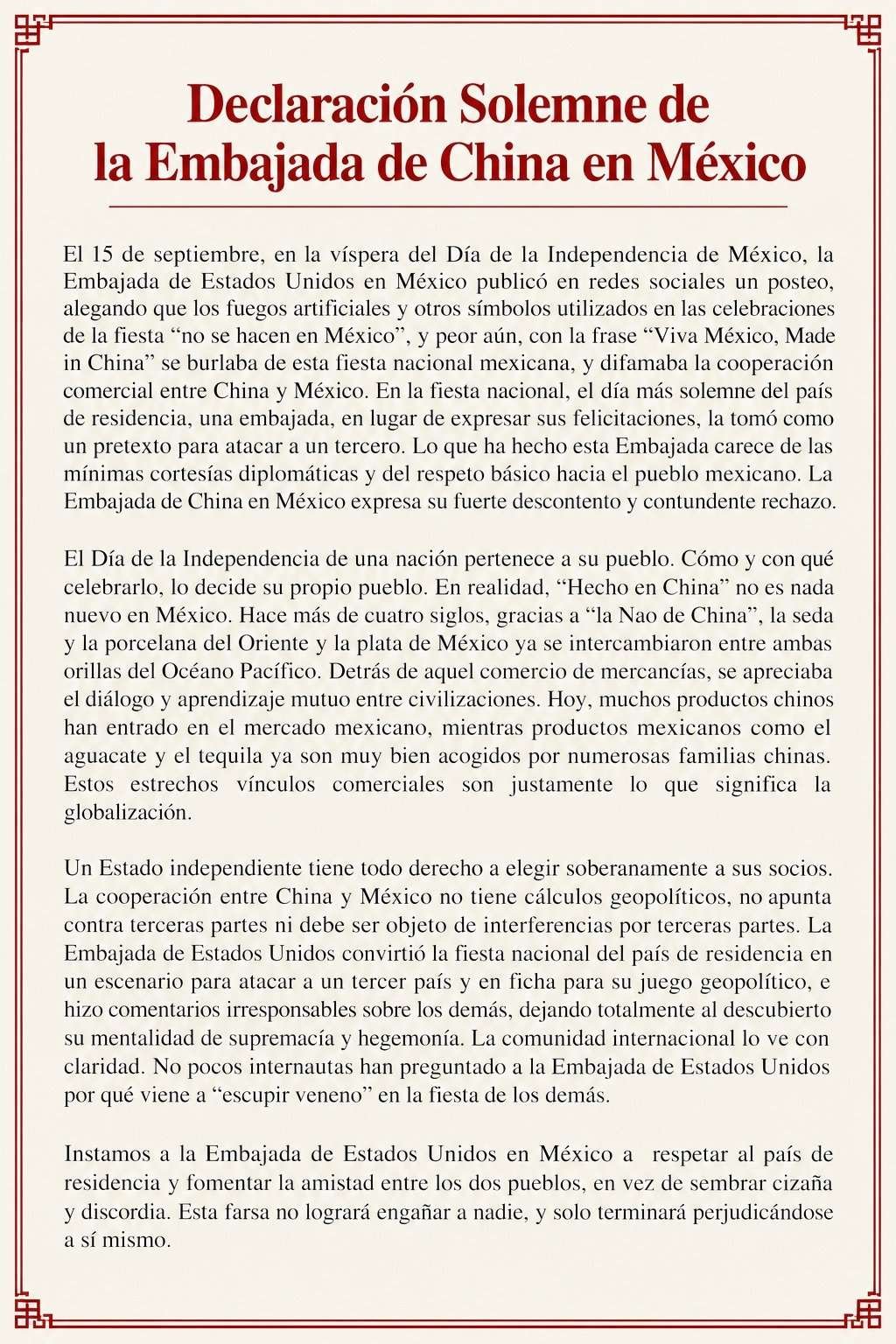
16


Caracas, February 4, 2026 (venezuelanalysis.com) – Chavista supporters filled the streets of Caracas on Tuesday to demand the release of President Nicolás Maduro and First Lady and Deputy Cilia Flores.

The rally marked one month from their kidnapping on January 3 as part of a US military attack against Venezuela.

“We, as an organized people, are making a call to the international community. We work every day to build a country with sovereignty and we will maintain our demand. We will continue protesting,” activist Jonas Reyes told reporters. He also paid tribute to the Venezuelan and Cuban civilians and military personnel killed during the bombing.

Venezuelan government leaders also announced plans to mobilize on February 14, Valentine’s Day, to celebrate what they described as “the profound love of Maduro and Cilia,” as well as on February 27 and 28 to commemorate the 1989 popular uprising known as El Caracazo.

On Tuesday evening, Venezuela’s acting president, Delcy Rodríguez, said that over the past 30 days Venezuela has “transformed and matured” the impact of US aggression into “tranquility,” while promoting national dialogue.

“It is a great victory for the people that there is stability,” Rodríguez told media, adding that “there is a national outcry” for the freedom of Maduro and Flores. She spoke from the Miraflores Palace alongside National Assembly President Jorge Rodríguez and Interior Minister Diosdado Cabello.

The pair’s kidnapping took place amid a US attack involving 150 aircraft, including electronic warfare jets, bombers, assault helicopters, and drones invading Venezuelan airspace.

On January 5, Maduro and Flores were arraigned in New York on charges including drug trafficking conspiracy. Both pleaded not guilty, and Maduro stated before judge Alvin Hellerstein that he is “a prisoner of war.”

The next court hearing, originally scheduled for March 17, was postponed until March 26 following a request from the US Justice Department.

US prosecutors argued that the extension would allow “the ends of justice to outweigh the interests of the public and the defendants in a speedy trial.”

February 3 also saw US-bases solidarity gather outside the Metropolitan Detention Center (MDC) in Brooklyn where Maduro and Flores are being held.

In slogans and posters, activists described the Venezuelan president and first lady as “victims of kidnapping” and demanded that the US government cease its “political persecution.”

“They are innocent of all charges. The guilty parties are the same ones who have been violating the sovereignty of Venezuela and so many countries of Our America,” activist and academic Danny Shaw told reporters. “This has nothing to do with a war on drugs. We have suffered from fentanyl and heroin, and that has nothing to do with Venezuela, much less with its president.”

Shaw vowed that solidarity movements would continue to rally and expressed confidence in the legal efforts of Maduro and Flores’ defense teams.

A separate demonstration in solidarity with the Venezuelan people and denouncing US aggression also took place in New York’s Times Square and some 60 cities around the world.

For her part, Acting President Delcy Rodríguez said she has held direct phone conversations with US President Donald Trump and Secretary of State Marco Rubio, which she said were guided by “interpersonal respect.”

Rodríguez has defended a fast diplomatic rapprochement with the Trump administration, arguing that the two nations can solve “differences” through diplomacy.

Washington’s new chargé d’affaires, Laura Dogu, is already in Venezuela and visited the presidential palace on Monday, February 2.

Edited by Ricardo Vaz in Caracas.

The post Venezuelans Stage Mass Rally, Demand Maduro Liberation and Return appeared first on Venezuelanalysis.


From Venezuelanalysis via This RSS Feed.

17


By Wyatt Reed and Max Blumenthal  –  Feb 1, 2026

Western officials seized on a dubious death toll of 30,000 protesters to escalate against Iran. The number originates with a single, clearly compromised source. But a zealously pro-war Guardian reporter is doing her best to legitimize it.

The claim of “30,000 killed” during two days of protests and rioting across Iran appears to be based largely on a single anonymous source, who admitted extrapolating that figure by assuming without evidence that “officially registered deaths related to the crackdown likely represent less than 10% of the real number of fatalities.”

That quote was attributed by The Guardian to an alleged doctor whose real name the newspaper refused to publish, but whose identity it claimed to have verified.

Originating in TIME Magazine on January 25th, the dubious “30,000” claim was quickly amplified by The Guardian, a key voice of left-liberal London respectability. From there, European officials seized on the death toll to justify designating Iran’s IRGC as a terrorist organization – essentially green-lighting another US-Israeli military assault on Iran.

The author of The Guardian’s article is a former fashion blogger named Deepa Parent, who has become the paper’s go-to source for Iran war propaganda, churning out over a dozen pieces for The Guardian driving the regime change narrative against the Islamic Republic since violent riots engulfed the country on January 8 and 9.

Parent has emerged as the face of The Guardian’s attacks on Iran despite having no apparent ties to the country and not appearing to speak its language. Farsi is not listed among the half-dozen languages in which she claims to be bilingual or speak in some functional professional capacity.

Before adopting the surname Parent around 2019, The Guardian’s go-to Iran reporter wrote under the name Deepa Kalukuri. Her journalistic output was largely limited to fashion reviews in Indian media. A typical piece published in India’s Just For Women magazine in 2016 was headlined: “Samantha Is Setting Some Serious Fashion Goals! Check Them Out!”

“What’s better than a Little Black Dress for a weekend party? Samantha pairs her LBD with these killer stilettos! We are loving it!!! Have a fashionable weekend!!!!”

Elsewhere, in an article informing Indian housewives that “understanding stocks is not [as] difficult as the news shows” suggested, she explained that investing was actually quite simple: “like a playing a video game but only your favorite batman is replaced with that stock broker who gives you the right advice to invest at the end of the bell.”

Published by The Guardian, sponsored by Omidyar
When the “Women, Life, Freedom” protests kicked off in September 2022 following the death of a young woman in Iranian custody, the improbable Parent suddenly materialized as The Guardian’s point woman on civic unrest in a nation with which she had no apparent professional or personal experience.

Much of Parent’s work at The Guardian’s so-called “Rights and Freedom” section has been funded by an NGO called Humanity United, which was founded by tech billionaire Pierre Omidyar and his wife, Pam.

As The Grayzone reported, Omidyar has partnered with US intelligence cutouts like USAID and the National Endowment for Democracy to promote regime change from Ukraine to the Philippines, while advancing various “counter-disinformation” efforts aimed at suppressing anti-establishment viewpoints.

A channel for pro-war regime change activists in TehranAs the violence in Iran continues to dominate the headlines, Parent has all but admitted to functioning as a channel for foreign-backed regime change activists inside Iran. On January 30, she took to Twitter/X to announce that she’d received “permission” to publicize a message from a “student” in Tehran who declared: “We are all getting ready to take to the streets and seize important centers as soon as America attacks.”

Back in 2025, after Iran and Israel reached a ceasefire following a 12 day-long war initiated by Israel, Parent announced that she had received permission from another unnamed source to share “a first message and reaction” from Tehran. The source lamented that Israel’s war on Iran had ended: “This is the worst thing they can do. If they do this, the Islamic Republic will make life hell for the people of Iran.”

“We don’t need to convince anyone” with actual evidenceAs critical observers began to suggest the 30,000 death toll was likely inflated, Parent took to social media to declare that despite being a journalist, she was under no obligation to prove the claims she had printed. The only thing that mattered, she insisted, was that “decision makers” were moved to take action.

“We don’t need to convince anyone about the massacre the IR [Islamic Republic] has carried out on innocent civilians in Iran,” she wrote, since, “decision makers don’t see trolls’ tweets, they see verified accounts and reports.”

The Guardian’s Parent therefore admitted her output was aimed at manipulating Western government officials, not informing the actual people who elect them.

Just a day later, however, Parent apparently had a change of heart, and produced an “anonymous doctor” who she claimed had confirmed the figure after all. This person, who Parent referred to by the pseudonym “Dr Ahmadi,” had somehow “assembled a network of more than 80 medical professionals across 12 of Iran’s 31 provinces to share observations and data,” she insisted. Lo and behold, the number calculated through this murky network coincided perfectly with the guesstimate put forward by an Iranian monarchist operative in Germany who had been the lone source for the figure of 30,000 dead.

Cubans Denounce the Presence of the US Chargé D’Affaires After Interventionist Action

**The ‘big lie’**Since TIME Magazine published its January 25 article asserting without clear evidence that Iran killed 30,000 protesters in two days, the figure has become an article of faith among regime change activists and their journalistic backers. Co-authored by a Persian contributor to the Times of Israel, Kay Armin Serjoie, the TIME article’s dubious data reverberated throughout corporate media. TIME claimed to have received this number from “two senior officials of [Iran’s] Ministry of Health.”

Though the outlet admitted it could not verify the figure, TIME claimed to have confirmed the death toll by insisting it “roughly aligns” with a count prepared by a German eye surgeon named Amir Parasta.

TIME did not inform its readers, however, that Amir Parasta was a hopelessly compromised source. Indeed, Parasta is a close associate of and lobbyist for the self-described “Crown Prince” Reza Pahlavi – the son of Iran’s deposed Shah. Based in Potomac, Maryland, Pahlavi urged Iranians to carry out violence across their country this January. When that campaign failed, he clamored for “anyone” to launch a military assault on the country he left as a young boy with millions of dollars in stolen wealth.

Parasta openly serves as an advisor to NUFDI, the main US-based lobbying group working to realize Pahlavi’s dream of re-establishing himself and his family as Iran’s monarchs.

For its part, the Iranian government has dismissed the 30,000 figure as a “Hitler-style big lie,” framing the narrative of ‘mass murder’ in Iran as part of a US and Israeli-led campaign to manufacture consent for regime change.

In much of the Western world, the ‘big lie’ appears to be working as intended. On January 28th, as the massive new purported death toll was being dutifully disseminated by mainstream media, a European outlet wrote that it had been informed that the revised body count had been enough to convince Italy and Spain to finally agree to sanction Iran’s IRGC.

“The brutality of what we see has made ministers and capitals reconsider their positions,” an anonymous senior European diplomat reportedly told Euro News.

The official described the decision by Italy and Spain – the last two major holdouts on EU sanctions against the IRGC – as “an important signal towards the Iranian government and an expression of support for the Iranian diaspora,” who the diplomat noted “have called for this for a long time.”

As The Grayzone has reported, mainstream outlets have relied virtually exclusively on Iranian diaspora groups closely tied to the US government for the ever-growing death toll they attribute to Tehran.

Parent was no different, frequently citing one of the organizations The Grayzone profiled, which operates under the name “Human Rights Activists in Iran.” The group receives extensive funding from the National Endowment for Democracy, a CIA cutout created under the Reagan Administration to distance Washington’s covert regime change efforts from discredited US intelligence agencies.

**The Guardian’s Parent relies on State Dept-funded “fact checker”**Parent relied on a similar source for her claim that Iran had killed “30,000” citizens during the unrest in January, when she claimed The Guardian had obtained photographs showing “bodies with close-range gunshot wounds to the head that had been transferred from hospital morgues while still attached to catheters, nasogastric tubes or endotracheal tubes.” Though Parent freely acknowledged The Guardian had “not independently verified the photographs,” she nevertheless claimed they had been “verified by [an] Iranian factchecking organisation” known as “Factnameh.”

By its own admission, however, Factnameh is not Iranian. On its website, Factnameh describes itself as a subsidiary of “ASL19, a private company registered in Toronto, Canada.”

More importantly, Factnameh is not actually a neutral factchecking organization, but instead another node in the vast network of US government-sponsored entities seeking to depose the government in Iran. Public records show that between 2022 and 2023 alone, ASL19 received nearly $2.9 million from the US State Department.

While Parent launders her regime change advocacy behind The Guardian’s reputation, she has been more unguarded about her views on social media. Challenged on Twitter/X on whether Iranians who disagree with their government actually want to be bombed by Israel, she fired back: “They prefer freedom from the Islamic Republic & they were being killed by the regime’s forces already.”

(The Grayzone)


From Orinoco Tribune – News and opinion pieces about Venezuela and beyond via This RSS Feed.

18


The acting president of Venezuela, Delcy Rodríguez, announced the appointment of Daniella Cabello as the new Minister of Tourism, replacing Leticia Gómez, who had been serving in the post since August 2024.

On Monday, February 2, Rodríguez announced that Cabello “will now assume responsibility for driving the development and promotion of the National Tourism System,” and thanked the outgoing minister “for her valuable work at the helm of this important ministry.”

Daniella Cabello has served as deputy minister of Foreign Trade and as president of the Export Promotion Agency, the work of which has focused on promoting the diversification of Venezuela’s high-quality products and exploring the country’s potential to place them in international markets.

Daniella Cabello, daughter of Interior Minister Diosdado Cabello, has been president of the Marca País institute since June 2023. Since then, she has been tasked with showcasing Venezuela’s potential in export products, investment opportunities, and tourism.

Venezuela and Dominican Republic Restore Consular Services and Direct Flights

On September 19, 2024, President Nicolás Maduro signed a decree authorizing the creation of the Venezuelan Export Promotion Agency and placed Daniella Cabello at the helm of the agency. That day, he emphasized that the appointment “facilitates the work being carried out with the Marca País Firm at global trade fairs.”

On December 23, 2025, during the Expo Motores Productivos 2025, President Maduro reaffirmed that tourism is “the homeland’s secret weapon.” He reported this sector grew by 44% compared to 2024 and has had a significant impact on the gross domestic product. “Tourism has become an attractive source of foreign exchange for the nation, defeating imperialist aggression,” he said.

(Últimas Noticias) with Orinoco Tribune content

Translation: Orinoco Tribune

OT/SC


From Orinoco Tribune – News and opinion pieces about Venezuela and beyond via This RSS Feed.

19


This Tuesday, January 3, the Venezuelan capital, Caracas, was the scene of a massive demonstration of citizens demanding the return of the Constitutional president of Venezuela, Nicolás Maduro, and the first lady, Cilia Flores, abducted by US imperialism exactly one month ago.

The protest brought together workers, students, and social movements near the La Previsora ​​building in Plaza Venezuela. From there, the march proceeded along Libertador and Urdaneta avenues, ending at the corner of Santa Capilla in the city center, where the demonstrators reaffirmed their commitment to fighting against external pressures.

The vice president of mobilization and events of the United Socialist Party of Venezuela (PSUV), Nahum Fernández, highlighted that the protest was a demonstration of the “unwavering loyalty” of Venezuelans.

Fernández stressed that after 30 days of absence of the head of state and his wife, the popular outcry has not diminished, emphasizing that national unity is the main tool to confront the external siege and defend the sovereignty of the country.

The Venezuelan people, under the premise that there is no power capable of subduing an organized nation, have reiterated that the goal of the street actions is clear: the return of the Bolivarian leaders. In addition, the demonstrations reaffirm the country’s historical commitment to maintaining Venezuela as a free, independent, and sovereign territory.

In the early hours of January 3, US military forces bombed Caracas and several areas of the states of Aragua, Miranda and La Guaira. The illegal incursion left more than 100 people dead, including civilians and military personnel, 32 of them Cuban combatants.

During the attack, the presidential couple was abducted and illegally transported to the United States, where they remain imprisoned in a maximum-security facility. In his first statements before a New York court, Maduro declared: “I am the president of Venezuela and I consider myself a prisoner of war. I was captured in my home in Caracas.”

The president’s courage, as described by Venezuelans, has become a source of strength and resilience in every corner of the country despite the indignation that the US imperialist attack has produced. These are not just political demonstrations: they are acts of love that transform indignation into collective strength, as the protesters emphasized.

Venezuela Exports First Shipment of Liquefied Petroleum Gas

The sense of justice has transcended Venezuelan borders. Since the US military attacks, not only have the Venezuelan people taken to the streets but globally, protesters in multiple countries, including the United States, have demanded the return of President Maduro and Cilia Flores to their nation.

The widespread condemnation of the illegal military attack perpetrated by the US Trump administration has generated an unprecedented wave of international solidarity. Under slogans such as “Hands off Venezuela!” and “No to Colonialism and Fascism,” these campaigns repudiate the flagrant violation of sovereignty and human rights.

These voices not only demand justice but also rise up in defense of the right of peoples to self-determination, refusing to condone the use of force as a mechanism of subjugation.

(Telesur)

Translation: Orinoco Tribune

OT/JRE/SL


From Orinoco Tribune – News and opinion pieces about Venezuela and beyond via This RSS Feed.

20


This article by Georgina Saldierna and Andrea Becerril originally appeared in the February 4, 2026 edition of La Jornada, Mexico’s premier left wing daily newspaper.

Mexico City. The Morena party in the Senate yesterday rejected claims that the reform to reduce the workweek to 40 hours is regressive, as the opposition asserts. “This is a presidential initiative that strengthens labor rights,” commented Enrique Inzunza, president of the Legislative Affairs Committee.

In response to questions from the coordinator of Movimiento Ciudadano, Clemente Castañeda, who insisted that two mandatory days of rest be established, the Morena member recalled that the reform is gradual, as agreed with the labor-business representation.

Inzunza stressed that it is also false that the provisions in the Constitution for the payment of overtime hours will be reduced, which will initially be paid at double, and if they exceed 12, at triple.

At the start of the ordinary session period, the possibility arose that the discussion of the secondary law would analyze the issue of two days of rest, which is not contemplated in the constitutional amendment, where what the Magna Carta establishes, of at least one day of rest per week, is maintained.

The Morena party member made it clear that his parliamentary group will support the Presidency’s initiative as submitted, since it is the product of many months of work and was achieved through responsible dialogue.

Regarding the critical path, he reported that next Tuesday the Committees on Constitutional Matters and Legislative Studies will meet with the Secretary of Labor, Marath Bolaños, and upon their conclusion, they will analyze and vote on the draft opinion. The intention is to pass the reform as soon as possible, he emphasized.

Previously, Castañeda considered the amendment to be regressive regarding labor rights and said that it “sells a pig in a poke,” since the reduction of the work week to 40 hours will not come into effect until 2030. In addition, only one day of rest is maintained, instead of two, as demanded by various social actors.

The Movimiento Ciudadano (MC) candidate held a press conference accompanied by members of the National Front for the 40-Hour Workweek. Érick Huehuetzin, a representative of the group, denounced the initiative, stating that it would pay overtime at double the rate, when it is currently paid at triple, and would legalize a 12-hour workday, when the current one is nine hours.

The senator from Jalisco argued that it would be a historic mistake to approve the proposal in the terms set by the ruling party, and therefore called for reflection.

“We say with all due respect to the majority: if they consider themselves a progressive movement, then what must be put first are the rights of the people and, of course, of those who drive this country, such as the workers of Mexico.”

He reported that he will formally propose to the Constitutional Points Commission the holding of a forum to hear the views of organizations, groups and specialists on the subject.

The post Morena Legislators Defend Gradual 40 Hour Workweek, Lack of Two Days Off appeared first on Mexico Solidarity Media.


From Mexico Solidarity Media via This RSS Feed.
21


Historians and political observers criticize the Trump administration for attempting to justify its own foreign policy toward Latin America.


From Presstv via This RSS Feed.

22


By Faramarz Kouhpayeh  –  Feb 2, 2026

On Sunday, February 1, Iran took the step of publishing the names and national ID numbers of nearly 3,000 individuals killed during the unrest that swept through the country between January 8 and January 14. According to officials, this move was a direct response to weeks of politically motivated reporting and fabrication by Western media outlets.

The disclosure comes after a relentless media campaign where unverifiable death tolls—some climbing as high as 80,000—were circulated by Western-based organizations and news platforms. These claims appeared without any accompanying names, documentation, or forensic proof. Iranian officials argue that the inflated figures aren’t the product of investigative journalism, but rather a calculated effort to manipulate international opinion precisely when US military pressure on Tehran is at its peak.

A senior official from President Masoud Pezeshkian’s office noted that the decision to release the detailed data was made days prior, with the specific goal of “closing the door to fabrication.” Just before the publication, Iran’s foreign minister told CNN Türk that the death toll was consistent with the roughly 3,100 fatalities already announced by the nation’s forensic medicine organization. He challenged critics, stating that Iran is ready to revise that number if any credible party can produce even a single verified identity not currently on the list.

It took Iranian authorities several days to finalize the count once the violence subsided in mid-January. They cited the difficulty of distinguishing between civilians, security personnel, and armed attackers in the aftermath of the clashes. Western media, however, didn’t wait for confirmation. They began publishing sweeping casualty estimates early on, frequently basing their reports on anonymous “activists” or a Washington-based website run by a former detainee previously convicted in Iran for collaborating with foreign intelligence.

The disparity is striking: alleged death tolls ranging anywhere from 6,000 to 80,000, with zero corroborating evidence. Analysts suggest this inflation was deliberate—a tactic to manufacture moral urgency and legitimize foreign military intervention, all while shifting attention away from the far better-documented civilian death toll in Gaza.

A familiar pattern
For observers in Tehran, this entire episode feels like a rerun of a script that is neither new nor unique to Iran.

Go back to 1990: the fabricated story about Kuwaiti babies being thrown from incubators by Iraqi soldiers—a lie traced back to a US-backed PR campaign—helped sell the [Persian] Gulf War to the public. In 2011, claims that Muammar Qaddafi was planning mass rapes and aerial massacres were used to justify NATO’s intervention in Libya, an operation that ultimately collapsed the state. In Syria, allegations of chemical weapons use by Bashar al-Assad’s government—claims later refuted by whistleblowers and independent investigators—became the moral engine for years of sanctions, military strikes, and the funding of terrorist groups.

In every single one of these instances, Western media played a key role in amplifying lies to manufacture consent for intervention. The results were catastrophic. Iraq fell into occupation and sectarian violence; Libya fractured into militia rule and open-air slave markets; Syria suffered over a decade of war and displacement. Now, the same playbook is being used against Iran.

‘Why Don’t You Criticize Iran?’

The West exploited and derailed legitimate protests
The unrest in January started as protests over economic hardship—pain rooted largely in years of US sanctions that have strangled trade, banking, and oil exports. Initially, these demonstrations were largely peaceful and actually led to significant economic reforms by the government.

The situation turned when armed elements were injected into the crowds. Iranian intelligence has since uncovered overwhelming evidence—including weapon seizures and multiple arrests—indicating that the CIA and Israel’s Mossad financed and coordinated these groups.

Just days before the violence erupted, the Mossad’s Persian-language account on X posted that Israeli agents were “on the ground” in Iran. Shortly after that signal, police stations, military sites, banks, and private buildings came under attack. The use of firearms, explosives, and incendiary devices in multiple cities transformed the protests into what was essentially organized urban warfare.

Meanwhile, US President Donald Trump posted messages encouraging rioters to seize government institutions and kill security forces, promising undefined “help” and signaling an incoming US military strike. Those messages served to prolong the violence.

Notably, there have been zero calls from Washington or Europe to ease the sanctions that actually hurt ordinary Iranians. Instead, new punitive measures were announced even as Western leaders claimed to care about the humanitarian plight of the Iranian people.

The victim list released this week covers everyone involved: civilians, police officers, and conscripts, alongside individuals identified as members of terrorist cells. Officials have described this transparency as a “moral duty” to the families of the deceased, but also as a sharp political message to the outside world.

Analysts suggest that the lessons of Iraq, Libya, and Syria are looming large in Tehran right now. In every one of those scenarios, humanitarian arguments were used as a prelude to military action. And in every instance, the collapse of the targeted government resulted in catastrophe rather than relief.

(Tehran Times)


From Orinoco Tribune – News and opinion pieces about Venezuela and beyond via This RSS Feed.

23


By Misión Verdad – Feb 3, 2026

The partial reform of the Organic Hydrocarbons Law (LOH) is at the center of the debate in Venezuela, given that, from various angles of politics, a set of interpretations of the text have been made, in many cases through political biases and deliberate misrepresentations.

The approved text is a reform that builds upon the basic law presented in 2002 by then-President Hugo Chávez through enabling powers to legislate.

In 2006, the LOH was modified to give legal form to the mixed enterprise scheme, within the framework of the re-nationalization process of oil assets, especially in the Orinoco Oil Belt.

The 2026 reform ratifies and, in some aspects, deepens essential elements of the previous legislation.

But, without a doubt, it creates the legal basis for a complete strategic adaptation of the Venezuelan hydrocarbon industry, considering elements of the present context: the persistence of an extended and adverse cycle of illegal sanctions on hydrocarbon activities, and the investment, modernization and growth needs of this activity—the most economically important in Venezuela.

The ‘privatization’ of PDVSA
The new LOH reaffirms that Petróleos de Venezuela SA (PDVSA), or, as it is called, the “company exclusively owned by the Venezuelan State and its subsidiaries,” is of an inalienable and non-transferable nature, preserving the public domain and the ownership of the nation over it, in accordance with what is stated in Article 141 of the National Constitution, cited in the reform in its Article 1.

The new text does not affect this essential principle, as it remains identical to that established in the laws of 2002 and 2006, in accordance with the Bolivarian Constitution.

Primary activities
In the hydrocarbon sector, primary activities—commonly called “upstream”—are the processes that encompass the exploration, extraction, collection, transportation, and initial storage of crude oil and natural gas.

These stages search for deposits, drill wells and manage production from the subsoil to processing centers, which could be refineries or terminals for dispatch and/or marketing, which would already be part of the set of secondary activities.

The new law ratifies the expansion of the scope of participation in primary activities, which was previously exclusively in the hands of state-owned companies, so that national or foreign private companies can also participate.

Is this really new? Definitely not. The reference to “ratify” alludes to reaffirming something that already exists.

The presence in Venezuela of foreign companies such as Chevron, Repsol, and CNPC is possible due to the provisions established by the 2006 reform, which endorsed the joint venture regime under the Hydrocarbons Law. These foreign companies participate directly in primary activities in Venezuelan fields.

Likewise, the Anti-Blockade Law facilitated agreements that allowed private investment in these processes through Productive Participation Contracts (CPP).

Private participation in primary activities was already well-established and was addressed in another complementary law on the matter: the now-repealed Law on the Regulation of Private Participation in Primary Activities (2006). This law would not exist if there were no activities to regulate.

What does this mean in concrete terms? It means that Venezuela could, for example, enter into advanced hydrocarbon exploration contracts with companies that possess technologies PDVSA lacks. Or that a private company could assume operational management of a field, for various financial or technical reasons.

Thus, according to the new Article 23, primary activities will be carried out by three types of companies classified according to their type of ownership: the state-owned (PDVSA), mixed companies, and “private companies domiciled in the Bolivarian Republic of Venezuela, within the framework of contracts signed with companies exclusively owned by the Republic or its subsidiaries.”

Nothing new under the sun.

About joint venturesJoint ventures are ratified in the new Hydrocarbons Law (LOH) as part of PDVSA’s management and partnership model with other companies, both national and foreign. This was already established in the 2006 LOH, and the spirit of that era is reaffirmed now.

These are referred to as “companies in which the Republic or a public entity owns a share greater than fifty percent (50%) of the share capital, which gives it shareholder control,” according to Article 23 of the reformed law.

In light of this, it is not true that PDVSA will now undergo a process of “de facto privatization” of its subsidiaries under the guise of joint ventures, nor that it will grant majority shares in said companies. Doing so is impossible according to the new Hydrocarbons Law.

Therefore, there is no impact on the shareholding situation of mixed companies currently established or that may be formed in the future.

Productive Participation Contracts
The new law recognizes the types of contracts that can be made by PDVSA and its subsidiaries, according to the new Article 40.

As explained, Productive Participation Contracts (CPP) transcend the Anti-Blockade Law and take shape through the figure of “Contracts for the Development of Primary Activities.”

These are broad contracts—covering services, exploration, and product extraction—under a model known as “comprehensive management of primary activities.” The private party in these contracts, whether domestic or foreign, is referred to as the “operator.”

Is this really something new? Absolutely not. PDVSA has been authorized to enter into contracts with private companies, both domestic and foreign, for primary activities. This explains, for example, the presence in Venezuela of multinationals like Halliburton and Baker Hughes, which provide oil services.

However, and this is the important part, this law does provide additional incentives that translate into greater responsibility and operational autonomy for the companies listed in the contracts, depending on the specifics of the projects.

Contracts for the Development of Primary Activities are specially designed for “green fields,” or areas with underground resources that have not yet developed infrastructure or received investment.

The LOH, as is fitting in the spirit of all laws, has been reformed in accordance with the particularities of the times. The 2026 text recognizes several objective conditions.

First, the conditions in the oil business have changed significantly since 2002 and 2006. Investments are now more expensive, the market is more volatile, and there is competition from new technologies in the battle for energy resources (the energy transition). In the long term, this context makes investments more expensive, reduces profits, and increases risks.

Second, the national hydrocarbon industry is burdened by a cumulative 10 years of coercive sanctions, divestment strategies in Venezuela, asset freezing—both liquid and capital goods—and direct impact on the financing mechanisms (petro-bonds) of PDVSA and the nation.

Third, most of Venezuela’s oil reserves are heavy and extra-heavy crude, which requires new technologies and costly investments to be extracted and diluted for commercialization.

These conditions impose a stark reality: neither PDVSA nor the Venezuelan state has the resources to invest heavily in new developments and oil fields. Therefore, further incentives are being offered to attract new investment in these undeveloped oil fields.

This does not imply a loss of sovereignty; it implies creating comparative advantages to attract investment where it is needed.

To determine whether these types of contracts involve a loss of sovereignty or are harmful to the nation, it is necessary to observe what is stated in Article 43:

“Once the term of the contract for the development of primary activities has ended, the operating company must return the leased assets and transfer ownership, free of any encumbrance, to the company wholly owned by the Republic or its subsidiaries (PDVSA), of all assets incorporated, constructed or acquired during the term of the contract, including all data obtained, generated, processed and interpreted, without this generating any obligation of payment or compensation.”

The new Hydrocarbons Law is clear and, in fact, resembles the 1946 law in that it refers to the reversion of assets to the Republic upon termination of contracts, without the need for a nationalization process that would entail high costs for the nation. This is a huge difference compared to the legal framework of the Operating Agreements of the 1990s, which involved high compensation payments and costly legal proceedings when the 2006 nationalization occurred. The cases of Exxon and ConocoPhillips are a prime example.

The marketing of products
This is one of the most prominent—and, in some ways, controversial—elements in the new LOH, especially because it is subject to biased interpretations.

Now, through contracts, private national or foreign companies are authorized to assume, in a shared or total manner, some key processes of the marketing of products outside the country, but “at their exclusive cost, account and risk,” the regulation states verbatim.

Here again, is the application of principles into a law built on the objective realities of the moment, and this refers specifically to the regime of illegal coercive sanctions that exists against Venezuela.

The reality is that no sanctions have been lifted against Venezuela. Nor should we confuse the granting of licenses by the US Treasury Department with the lifting of unilateral sanctions. These hostile measures are a reality, they are long-standing, deeply entrenched, and were not foreseen in either 2002 or 2006.

It is well known that PDVSA’s marketing of products outside the country has resulted in the freezing of assets and even the seizure of vessels and the theft of products.

Now the law protects Venezuela from this risk, creating windows and guidelines for other actors to assume the risk, exposure to hostile financial measures, sanctions and the like.

What does that imply? Some companies that enter into a contract with PDVSA could, in some cases, assume a minority or majority stake in the marketing of hydrocarbons, autonomously carrying out the commercial management process, as indicated in Article 41, as part of the favorable compensation for operators.

If a private company can take over the marketing of certain products in specific sectors, how does the nation benefit? Article 42 states that:

“… as consideration for the use of said assets and areas, the operating company will pay the companies wholly owned by the Republic or its subsidiaries a percentage of the volume of controlled hydrocarbons that will be set in the respective contract.”

In addition, taxes and royalties would be added to this.

Again, with reference to sovereignty and the non-diminution of national heritage, Article 40, in its paragraph 3, states:

“The Republic will retain ownership of the hydrocarbon deposits on which the operating companies will develop their activities… .”

Whereas Article 68 explicitly states:

“The authorized direct marketing will not, under any circumstances, imply the transfer of ownership of the deposits or the authorization for the creation of real guarantees on deposits or on sovereign rights.”

The law is absolutely clear on this point. The Venezuelan State externalizes and transfers to others the risks of commercial activity, while directly benefiting from the activities of the operators, fully preserving public ownership of the deposits and resources.

Taxes and royalties
The 2002 law and its 2006 reform maintained a strict royalty regime, applied to all projects.

The 2026 Hydrocarbons Law, on the other hand, establishes a flexible framework. It sets a maximum royalty rate of 30%, while each project will have its own characterization to determine the royalty margin, according to a discretionary policy of the Ministry of Hydrocarbons, based on technical information.

What does this mean? It means that a green field should not pay the same royalties as a mature field, or that a field in the expansion production phase—which has not yet reached its peak of barrels per day—should not pay the same royalties as a field in depletion or outright decline.

The technical parameters will apply to both nascent developments, where there is no infrastructure, and to established fields. Obviously, fields under development are likely to pay lower royalties.

The reasons governing this criterion are fundamentally technical, as indicated in the new Article 51:

“… taking into account the nature of the project; the capital investment requirements; the cost-effectiveness of the project; and the need to ensure international competitiveness.”

Here, the factors of viability prevail to attract new investments and encourage new developments, based on a criterion of “economic equilibrium,” says the law, which can be applied favorably to the nation once the projects are more profitable, or favorably to an operator if the technical and commercial environment conditions make them less profitable.

This criterion is clearly designed to ensure the operational continuity of projects. Even if environmental conditions change—as has happened in recent years with sanctions and licensing changes—royalties can be adjusted to preserve the “economic equilibrium” in each field, avoid paralysis and disinvestment, and mitigate risks.

Article 51 states:

“The National Executive, through the Ministry with competence in hydrocarbon matters, is empowered to modify the royalty percentage within the limit provided for in this article, when it is demonstrated that it is necessary to guarantee the economic balance of the project, under the terms provided for in this Law.”

What was previously known as the Extraction Tax is now referred to as the Integrated Hydrocarbons Tax, which reaches up to 15%, but is subject to modification depending on the same technical factors that govern the amount of royalties.

Venezuela Exports First Shipment of Liquefied Petroleum Gas

Dispute resolution
The reform of the LOH contemplates the resolution of disputes in three stages or levels: first, by promoting amicable settlement and agreement between the parties; second, through independent international arbitrations; and, third, through courts established in the Republic.

Nowhere does the reform of the Hydrocarbons Law establish the jurisdiction of foreign courts over matters related to hydrocarbons owned by the nation. There is no mention of this, and any assertion to that effect is completely false.

Regarding independent international arbitration, Article 8 refers to it as “alternative dispute resolution mechanisms.” This needs further explanation.

Independent arbitrations are activities carried out by law firms or firms specializing in specific areas, agreed upon by both parties. They are contracted to facilitate negotiations, discuss disputes, reach decisions, and arrange settlements privately and promptly.

This should not be confused with placing Venezuelan issues on the desk of a Democratic or Republican judge in New York, as was customary before the 2002 law.

In the event that PDVSA resorts to independent arbitration, the LOH establishes that the criteria for such a case will be governed in accordance with the provisions of the Organic Law Decree of the Attorney General’s Office and the Commercial Arbitration Law, according to the new Article 8. That is, there is no separation of the State bodies from these matters.

It is worth mentioning that, in practice, many companies would prefer to reach amicable settlements or arbitration in cases of disputes with PDVSA, rather than resorting to Venezuelan courts. The Hydrocarbons Law (LOH) provides incentives to build trust—legal certainty—aimed at companies investing in Venezuela, but emphasizes the need to operate transparently and avoid friction and disputes, since, according to the LOH, the final decision still rests with Venezuelan courts.

(Misión Verdad)

Translation: Orinoco Tribune

OT/JB/DZ


From Orinoco Tribune – News and opinion pieces about Venezuela and beyond via This RSS Feed.

24


By Prince Kapone  –  Jan 30, 2026

The U.S. economy is generating profits without integrating people into stable life. Domestic labor is being recalibrated through precarity, surveillance, and managed migration. Fortress America turns the hemisphere into a disciplined rear-base of corridors, minerals, and compliant labor. The American Pole and technofascism are one system—an empire tightening the enclosure at home and abroad.

When the Empire Starts Rebuilding the Cage
Every system has a moment when it stops pretending. For decades, the U.S. ruling class sold “freedom” as a universal export and “prosperity” as the natural reward for loyalty. But now the mask is slipping, and we can see the gears: a society where wealth accelerates upward like a rocket while life on the ground feels heavier, meaner, more surveilled, and more fenced in. This is not an accident. It is not simply the mood swings of a bad administration. It is the political economy of a declining imperial core reorganizing itself for a harsher era—an era where the empire can no longer buy consent the way it used to, and where it must increasingly manufacture obedience instead.

The core claim of this essay is simple, but it cuts against the liberal fog machine. What we are witnessing is not “authoritarian drift.” It is not an unfortunate detour from an otherwise healthy democracy. It is a structural transition in the relationship between labor, surplus, and social stability inside the imperial core. In plain terms: the empire’s old bargain is breaking down. The system is capturing more wealth at the top while absorbing fewer workers into stable life at the bottom. And when a capitalist order can no longer integrate people through expanding material conditions, it moves toward containment—through policing, border regimes, surveillance, and ideological discipline. That is the logic of technofascism as we use the term: monopoly-finance capital in decay fusing with the security state and the digital apparatus to govern an increasingly surplus, fragmented, and potentially rebellious population.

You can see the outline of this transition in the cold numbers. Labor’s share of national income has been pushed down to levels that would make an old robber baron blush, while corporate profits rise into record territory like a tide that never reaches the shore. Billionaire wealth swells beyond comprehension as the bottom half of households are told to be grateful for crumbs and motivational speeches. This is not merely inequality as a moral problem. It is inequality as a structural feature: the upward transfer of surplus paired with a tightening state apparatus designed to manage the human fallout of that transfer. When capital wins more and labor receives less, the gap must be filled with something. If it cannot be filled with rising wages and stable futures, it is filled with fear, discipline, and force.

This is why the growth of the border regime and the growth of the surveillance regime are not side stories. They are not “culture.” They are not merely “security.” They are governance adapting to material conditions. A society built on imperial plunder once had enough surplus to keep large parts of the settler population pacified—through cheap credit, cheap commodities, and the soft bribes of consumer life. But imperial decline changes the arithmetic. The empire’s global extraction machine faces more resistance abroad and more contradiction at home. Multipolarity is not just a diplomatic slogan; it is a material problem for an empire whose power depended on being the universal gatekeeper of trade, finance, technology, and legitimacy. As that gatekeeping weakens, the ruling class seeks to lock down what it can still control: the domestic population and the hemisphere it has long treated as its backyard.

So we need to name the process with the clarity it deserves: domestic labor recalibration. By this we mean the strategic restructuring of the workforce’s size, composition, and discipline under conditions where the system can no longer absorb labor the way it once did, where automation eats jobs while calling itself innovation, and where global labor arbitrage is increasingly constrained by geopolitical fracture. Recalibration is not a conspiracy theory; it is a ruling-class adjustment. It appears as policy: weakening unions, crushing strategic strikes, expanding precarious work, tightening eligibility for social survival, and weaponizing immigration status as a lever over wages. It appears as technology: algorithmic management, biometric tracking, productivity surveillance, and the conversion of workplaces into monitored zones where the boss has a stopwatch and the state has a database.

And it also appears—crucially—in mass deportations and the militarization of migration. Liberal commentary often treats deportations as pure reactionary theater, and reactionary they are. But reactionary policies can still have rational functions for capital. When millions are expelled or deterred, labor is not simply removed from the U.S. labor market; it is forcibly redistributed into more precarious economies across Central and South America, expanding the reserve army of labor where U.S. corporations and allied comprador elites want to deepen nearshoring and restructured supply chains. Deportation becomes a hemispheric labor policy. It pressures wages downward in the very countries being positioned as low-cost workshops of the American Pole. It undermines popular nationalist development efforts that modestly raise wages and strengthen bargaining power. And it strengthens U.S. leverage over states whose economies become more dependent on compliant labor regimes, remittance flows, and security cooperation.

This is where the internal and external sides of the story fuse into one system. The American Pole is the outward architecture of the same crisis-management project. Fortress America is not a metaphor; it is a strategy of imperial consolidation in the context of western decline. As Washington loses the ability to command the whole planet, it tightens its grip on the hemisphere—over ports, corridors, minerals, energy flows, data networks, and compliant governments. Domestic labor recalibration is the internal discipline required to sustain that outward project; hyper-imperialist recalibration is the external reorganization of the hemisphere into a controlled rear-base for confrontation with rivals, above all China. The empire is shrinking, but it is not becoming gentle. It is becoming more concentrated, more coercive, and more willing to turn every tool—law, money, technology, borders, police—into a weapon.

If this sounds grim, good. Reality is grim. But clarity is not despair. Clarity is the beginning of strategy. The task of Weaponized Information is not to mourn the death of imperial myths but to expose the material anatomy of the new regime being built in their place. When the empire starts rebuilding the cage, we should not ask whether the bars are polite. We should ask who built it, who profits from it, how it functions, and where it can be broken. That is what the rest of this essay will do: trace the economic base driving this transition, map the mechanisms of labor recalibration, and show how technofascism is the political form emerging to govern the crisis—at home, and across the hemisphere the empire is trying to lock into its American Pole.

Growth Without Workers, Profits Without Peace
If you listen to the evening news or read the financial press, you might think the U.S. economy is a stubborn success story. Growth numbers flash green, stock indexes climb like ivy on a crumbling wall, and politicians congratulate themselves for “resilience.” But resilience for whom? Underneath the surface of headline growth lies a different reality: an economy that expands in value but contracts in its ability to absorb human beings into stable, dignified life. This is the economic base of domestic labor recalibration — a system still generating profit, but doing so in ways increasingly detached from broad employment, rising wages, and social reproduction.

Start with where the gains are going. Corporate profits have surged to historic highs, while labor’s share of national income has been pushed down toward record lows. Productivity continues its long march upward, powered by automation, logistics optimization, and digital control systems. But median compensation limps along far behind. Workers are producing more value per hour than ever, yet receiving a shrinking slice of what they create. In earlier phases of U.S. capitalism, rising productivity was partially translated into higher wages, broader homeownership, and expanding social programs — the material basis for social stability in the imperial core. Today, that translation mechanism is breaking down. The surplus flows upward into profits, dividends, and buybacks, not outward into mass prosperity.

Even inflation — which mainstream voices often blame on workers, migrants, or mysterious “supply shocks” — has carried a different signature in recent years. A significant share of price increases has been driven by expanded corporate profit margins rather than runaway wage growth. In plain language: firms used crisis conditions to raise prices beyond cost increases, protecting and expanding profitability while households absorbed the hit. This is not a glitch; it is a class relation. Capital protects its returns first and lets labor adjust through higher rents, higher food bills, and higher debt burdens. The result is an economy that grows on paper while everyday life becomes more precarious for the majority.

Industrial policy, widely celebrated as a renaissance of state-led development, reveals the same contradiction. Massive public subsidies have flowed into semiconductor plants, battery factories, and “strategic” manufacturing under programs like the CHIPS and Science Act. But the jobs picture is more complicated than the ribbon-cutting ceremonies suggest. These new facilities are among the most automated in history. They require highly specialized technical labor in relatively small numbers, not the mass industrial workforce of the twentieth century. Even as billions are invested, analysts warn of labor shortages in narrow skill categories while overall employment gains remain modest. Capital investment surges; broad labor integration does not keep pace. The factory returns, but as a fortress of machines with a skeleton crew.

This is not a failure of policy; it is a reflection of structural limits. U.S. capitalism is trying to rebuild industrial capacity for reasons of geopolitical competition and supply-chain security, not because it has rediscovered love for the working class. The goal is resilient production, not mass employment. From the standpoint of monopoly capital, a highly automated plant is ideal: fewer workers to organize, fewer wages to pay, more predictable output. From the standpoint of society, however, this deepens the core contradiction. Investment rises without a proportional expansion of stable jobs. Growth detaches further from livelihoods.

At the same time, union power remains historically weak relative to the scale of corporate concentration. Union density has fallen to levels not seen since before the New Deal, even as surveys show tens of millions of workers would join a union if they could. This gap between desire and reality is not accidental; it is produced through aggressive anti-union campaigns, legal obstacles, and state interventions that prioritize “supply chain stability” over workers’ bargaining power. When rail workers threatened to strike, federal authority moved swiftly to block them in the name of economic security. The message was clear: when labor action conflicts with the smooth functioning of capital, the state will step in on behalf of the latter.

Mainstream think tanks register these developments, but through a different lens. Where workers see exploitation, policy analysts speak of “skills mismatches” and “labor market frictions.” Where communities experience wage stagnation, reports call for “upskilling” and “workforce development” to meet the needs of strategic industries. Even the more liberal institutions frame the problem primarily as one of competitiveness: how to ensure the U.S. has the right labor inputs to win great-power competition. The distribution of power between capital and labor is treated as background noise. The upward redistribution of surplus is normalized as an economic fact, not a political choice.

This is the heart of the crisis of surplus absorption. Capital continues to generate and capture enormous wealth, but has shrinking outlets for productive, labor-intensive reinvestment that also stabilize society. Instead, surplus is funneled into financial speculation, stock buybacks, luxury real estate, and the defense sector. Wall Street inflates asset values; the Pentagon absorbs trillions in public spending; tech platforms monetize attention and data. These are effective for profits, but weak at integrating people into secure, socially useful roles. The economy becomes top-heavy, like a tree with lush branches and rotting roots.

Under these conditions, domestic labor recalibration becomes a structural necessity from the standpoint of the ruling class. If the system cannot absorb everyone into stable employment with rising living standards, it must manage a growing population that is partially surplus to its needs. Some will be pulled into narrow high-skill sectors; others will circulate through precarious gig work, temp contracts, and informal hustles; many will hover at the edge of unemployment, debt, and state supervision. The old promise — work hard and you will rise — is replaced by a new reality: work constantly just to avoid falling. This is not simply inequality. It is a reorganization of the social role of labor itself in a stagnating imperial core.

And when the economic base takes this form — profits without proportional employment, growth without broad security, productivity without shared gains — the superstructure cannot remain liberal in the old sense. A society that no longer integrates through rising material conditions must increasingly govern through discipline. The numbers are not just statistics; they are signals. They tell us that the system is shifting from expansion to containment, from incorporation to management. The next step in the story, then, is to look directly at the mechanisms of that recalibration — how labor is being reshaped, divided, and controlled to fit the needs of a system that has more capital than it knows what to do with, and more people than it wants to fully include.

Recalibrating the Workforce: Who Is Kept, Who Is Cast Out, Who Is Controlled
If Part II exposed the economic ground shifting beneath our feet, Part III names the process taking shape on that unstable terrain. Domestic labor recalibration is not a slogan; it is a structural response by capital to a world in which it can no longer promise mass prosperity at home while extracting superprofits abroad without resistance. The imperial core is no longer expanding fast enough to absorb everyone into stable employment, yet it still requires labor — just not in the same numbers, forms, or conditions as before. The result is a deliberate reorganization of who gets integrated, who gets marginalized, and how everyone else is disciplined.

First, consider the tightening vise around labor’s share of the social product. Even during periods of growth, real wage gains have trailed behind profit expansion. Corporate margins have proven far more flexible than workers’ paychecks, rising aggressively during crisis periods and remaining elevated afterward. Meanwhile, union density has sunk to levels that would have shocked even the robber barons of the early twentieth century. Tens of millions of workers express a desire to unionize, yet face legal roadblocks, union-busting campaigns, and drawn-out procedures that exhaust momentum. When workers in strategic sectors push too far — threatening to interrupt the smooth circulation of goods — the state reveals its class character. Strikes are blocked, contracts imposed, and “economic stability” invoked as a higher good than democratic control over working conditions. In this way, suppression of labor’s share is not just a market outcome; it is a political project, backed by law, courts, and executive power.

Second comes selective inclusion and exclusion — the careful management of who is allowed into the labor market, under what terms, and with what degree of security. Immigration policy offers a sharp illustration. On one side, millions of migrant workers have entered the labor force in recent years, filling gaps in agriculture, logistics, care work, and tech. On the other side, deportation regimes expand, border zones militarize, and legal statuses become more precarious. The message is contradictory only on the surface. The system wants labor power, but in forms that are flexible, deportable, and politically fragmented. A worker whose right to remain depends on employer sponsorship or constant legal renewal is easier to discipline than one with full political rights and long-term security. At the same time, the growth of gig platforms and temp agencies multiplies forms of contingent labor inside the country, ensuring that even citizens experience employment as a revolving door rather than a stable footing.

This dual movement — import labor, criminalize labor; recruit workers, keep them insecure — is not confusion. It is calibration. Think tanks discuss “labor supply stabilization” and “strategic visas” for critical sectors, while others call for tighter borders and mass removals. These positions appear opposed, but function together in practice. The labor market is not being opened or closed in a simple sense; it is being tuned. Some categories of workers are pulled in to meet industrial or technological needs, others are pushed out or kept in a state of fear, and the overall effect is downward pressure on wages and upward pressure on compliance. Labor becomes a managed flow, not a social right.

Third, technology enters not only as a tool of production, but as an instrument of discipline. The modern workplace increasingly resembles a command center. Warehouses operate under algorithmic management that tracks movement, speed, and even biometric signals. Delivery drivers are scored, nudged, and penalized by software. Office workers face keystroke monitoring and productivity dashboards. Artificial intelligence systems are introduced to automate tasks, but also to measure workers against ever-shifting performance benchmarks. The point is not simply to replace labor with machines, though that happens too. It is to render remaining labor transparent, comparable, and controllable in real time.

Policy discourse softens this reality with the language of innovation and efficiency. Analysts speak of “digital transformation” and “AI-driven productivity,” acknowledging displacement but promising new opportunities somewhere down the line. Yet even the most optimistic assessments concede that entire categories of routine work are being hollowed out. The new jobs that appear often demand higher skills, greater geographic mobility, and constant retraining — conditions that many workers, especially older or poorer ones, cannot easily meet. Thus, automation functions as both a labor-saving technology and a sorting mechanism, separating a smaller core of highly integrated workers from a larger periphery of precarious or displaced people.

All these mechanisms converge on a single outcome: the workforce is being resized, re-tiered, and re-disciplined. A narrow stratum of highly educated technical workers is cultivated and rewarded, especially in sectors tied to national security and high technology. A broader layer cycles through unstable service, logistics, and care jobs with limited bargaining power. Another segment drifts between informal work, unemployment, debt, and state supervision. The old Fordist dream of stable, long-term employment as a social norm fades into a memory. In its place emerges a stratified labor regime designed for a slower-growing, more conflict-ridden imperial core.

From the standpoint of capital, this recalibration is rational. It reduces labor costs, increases flexibility, and aligns the workforce with the needs of automated production and geopolitical competition. From the standpoint of society, however, it generates chronic insecurity, weakened solidarity, and a growing population that is only partially integrated into the formal economy. These people do not disappear; they become subjects of management rather than participants in shared prosperity. And when more and more of the population must be managed rather than integrated, the line between economic policy and social control begins to blur.

Domestic labor recalibration, then, is not a side effect of technological change or globalization. It is a deliberate reorganization of the social role of labor under conditions of imperial strain. It answers a simple question from the ruling class perspective: if we cannot profitably employ everyone on stable terms, how do we restructure work, movement, and discipline so that accumulation continues and unrest remains containable? The answer, increasingly visible, is a labor market engineered for hierarchy, insecurity, and surveillance — a foundation on which a more openly coercive political order can be built.

When Consent Wears Thin: The Turn from Liberal Management to Open Coercion
Every economic order carries a political form that helps stabilize it. For decades, the United States managed its class contradictions through a mix of consumer credit, modest upward mobility, and the promise that tomorrow would be better than today. That promise is now threadbare. When the system can no longer integrate broad layers of the population through rising living standards, it must rely more heavily on containment. What we are witnessing is not simply polarization or “democratic backsliding,” but a structural shift in governance — from managing consent to managing instability.

The warning signs are written across the legal landscape. In the wake of mass protests and social unrest, state legislatures moved swiftly to narrow the channels of political participation. Waves of new voting restrictions reshaped access to the ballot through tighter ID rules, reduced early voting, purges of voter rolls, and increased partisan control over election administration. These measures are often justified in the language of “election integrity,” but their material effect is clear: participation becomes more difficult for the young, the poor, the precariously employed — precisely those most affected by the economic recalibration described earlier. Democracy remains in form, but its social base is quietly thinned.

At the same time, the right to protest has been progressively fenced in. States expanded “anti-riot” statutes, enhanced penalties for blocking roads or critical infrastructure, and broadened the legal definition of disorderly conduct. What was once framed as the democratic right to assemble is increasingly treated as a public order problem. Demonstrations that challenge corporate power, policing, or austerity are met not only with tear gas and batons, but with preemptive legal tools designed to chill participation. In this climate, dissent becomes something to be managed, monitored, and, when necessary, criminalized.

Security frameworks once aimed primarily at foreign threats have been reoriented inward. The language of “domestic extremism” now circulates widely across federal and state agencies. Fusion centers coordinate intelligence between local police, federal authorities, and private actors. Protest movements, labor actions, and community organizations find themselves analyzed through risk matrices more familiar from counterterrorism doctrine than from civic life. The underlying assumption is telling: social unrest is not a signal that material conditions require change, but a security variable to be contained.

This shift is reinforced by bipartisan political behavior. Despite fierce rhetorical battles, there is remarkable continuity when it comes to funding for police, border enforcement, and intelligence agencies. Budgets for surveillance technology, data analytics, and tactical equipment expand even as social programs face austerity pressures. Corporate donors, momentarily startled by open assaults on electoral norms, quickly return to supporting candidates who promise deregulation, tax advantages, and “law and order.” Stability for markets outweighs fidelity to democratic procedure.

Think tank discourse, stripped of its technical polish, reveals the logic at work. Analysts warn that internal disorder could undermine the country’s ability to compete globally. Social cohesion is framed as a strategic asset; unrest as a vulnerability exploitable by rivals. The conclusion drawn is not that inequality should be reduced or labor empowered, but that institutions must be strengthened to ensure continuity and predictability. In practice, “institutional strength” often means expanded policing powers, broader surveillance, and firmer executive authority.

The border becomes a laboratory for this new mode of governance. Vast resources flow into walls, sensors, drones, biometric databases, and rapid-deportation systems. These tools do not remain confined to the geographic edge of the nation. Technologies and practices developed for migration control migrate inward, finding use in urban policing, workplace verification systems, and data-sharing networks between agencies. The distinction between external security and internal order erodes, replaced by a continuous field of monitoring.

Crucially, this evolution does not announce itself as a break with liberalism. It presents itself as a defense of it. Politicians insist that stronger policing protects freedom, that tighter voting rules defend democracy, that expanded surveillance ensures safety. The language of rights is preserved even as the material capacity to exercise those rights narrows for broad sections of the population. Liberal governance, in this phase, becomes a shell within which a more coercive core develops.

Seen from above, the transformation appears rational. If the economy can no longer guarantee stable livelihoods for all, and if social discontent grows as a result, the state must ensure that discontent does not spill over into systemic disruption. From below, however, the experience is one of shrinking space — for organizing, for dissent, for meaningful participation in shaping collective life. Politics becomes less a forum for resolving social conflicts and more a mechanism for administering them.

The transition from liberal management to coercive governance is thus not an accidental slide. It is the political superstructure adapting to an economic base that produces surplus populations, precarious work, and sharper inequality. As the promise of inclusion weakens, the apparatus of control strengthens. This does not yet resemble open dictatorship; elections continue, courts function, media debates rage. But the balance shifts steadily toward surveillance, restriction, and force as normal instruments of rule. In that sense, the path toward a mass surveillance police–military state is paved not by sudden rupture, but by the cumulative normalization of exceptional measures in the name of stability.

Smoke, Mirrors, and Manufactured Enemies: How Ideology Softens the Blow
A system that takes more from working people while giving them less cannot survive on police budgets alone. It also needs stories — loud, emotional, distracting stories that turn anger sideways instead of upward. As domestic labor recalibration deepens and living standards stagnate, ideological management becomes a central task of the state. The goal is simple: prevent class consciousness from forming by saturating public life with cultural battles that feel urgent but leave the economic order untouched.

Across the country, political energy is redirected into carefully staged moral panics. School curricula, gender identity, immigration fears, crime waves, “wokeness,” and patriotic symbolism dominate headlines and legislative sessions. Meanwhile, wages trail productivity, rents swallow paychecks, medical debt grows, and workplace surveillance tightens. The spectacle of cultural conflict functions like a smoke machine on a stage: it fills the air so thoroughly that the machinery moving behind the curtain becomes harder to see.

One of the clearest examples is the wave of restrictions on how race, inequality, and history can be discussed in classrooms. Dozens of states have introduced or passed laws narrowing what teachers can say about systemic racism or historical injustice. These moves are framed as protecting children or preserving national unity, but their deeper function is to block analytical tools that help people understand exploitation and power. A population discouraged from examining the structural roots of inequality is easier to govern when inequality sharpens.

The same pattern appears in the backlash against diversity, equity, and inclusion programs. Corporations and universities that once promoted DEI as a harmless gesture of inclusion now retreat under political pressure. The ruling class is not suddenly allergic to diversity; it is recalibrating ideological strategy. During a phase of contraction, symbolic concessions become expendable. What matters more is consolidating a disciplined social base that can be rallied around nationalism, order, and resentment rather than redistribution or workplace power.

Culture war politics also fragment potential solidarity across lines of race, gender, and immigration status. Instead of seeing common cause against rising rents or precarious employment, workers are encouraged to see one another as threats — competitors for jobs, benefits, or recognition. Migrants are blamed for wage stagnation; urban communities are blamed for crime; youth are blamed for moral decline. Each narrative directs frustration away from the concentration of wealth and power and toward other segments of the working and oppressed classes.

Media ecosystems amplify this fragmentation. Outrage cycles move at high speed, with social platforms and cable news channels monetizing emotional reaction. The attention economy thrives on polarization because polarization keeps people engaged while obscuring shared material interests. A worker who spends hours arguing online about cultural flashpoints has less time and energy to organize at the workplace, attend a union meeting, or analyze why their real wages have barely moved in years.

At the institutional level, this ideological fragmentation is paired with a quiet hardening of political structures. Corporate funding patterns show continuity across partisan lines when it comes to core priorities: defense spending, border enforcement, policing, and corporate tax policy. Candidates who support these pillars remain well financed even if they undermine democratic norms. The message is subtle but clear: stability for capital matters more than procedural democracy when the two come into tension.

Think tanks rarely address this ideological battlefield directly, yet their frameworks implicitly rely on it. Reports speak of “social cohesion,” “national resilience,” and “public trust” as strategic assets. But cohesion is imagined not as shared prosperity or worker empowerment, but as alignment behind national goals defined from above. Division is lamented only insofar as it threatens economic performance or geopolitical standing, not because it reflects deepening class inequality.

In this environment, elections still occur, debates still rage, and freedom of speech is loudly celebrated. But the range of economically transformative options narrows. Policies that would significantly redistribute wealth, strengthen labor power, or demilitarize budgets struggle to gain institutional traction. The political arena becomes a theater where cultural identities clash while the underlying structure of accumulation remains largely undisturbed.

Ideology, in this sense, acts as a pressure valve. It releases social tension in symbolic forms that do not challenge the economic base. Anger finds expression in battles over statues, slogans, and school boards rather than in coordinated demands for shorter workweeks, higher wages, public housing, or workplace democracy. The system permits loud arguments about who belongs, but resists serious challenges to who owns.

For a ruling class navigating decline, this is efficient governance. As long as working people are divided and emotionally invested in symbolic conflicts, the harder realities of labor recalibration — stagnant wages, precarious employment, intensifying surveillance, shrinking public goods — can advance with less unified resistance. The cultural battlefield, then, is not a distraction from political economy; it is one of the key terrains on which the political superstructure is stabilized during a period of tightening material conditions.

When Silicon Wears a Badge: The Political Form of Technofascism
By the time we reach this stage of the transition, the pieces stop looking accidental. Industrial policy wrapped in national security. Immigration managed like a labor input. Automation celebrated while jobs disappear. Surveillance normalized in the name of safety. Corporate power fused with state planning. None of this is a glitch. It is a new political form growing out of a stressed economic base. Not a break from capitalism — capitalism tightening its belt, hardening its face, and wiring itself to machines. This is what we are calling technofascism.

Let’s be clear and throw the academic cushions out the window. We are not talking about goose-stepping uniforms or old European scripts copied and pasted. We are talking about a mass surveillance police-military state built through digital infrastructure, corporate platforms, data extraction, and algorithmic management. The boardroom, the server farm, and the security agency are no longer separate buildings. They are rooms in the same house.

Look at how ruling-class policy thinking lines up. Industrial strategy is no longer about general prosperity; it is about “strategic sectors,” “resilience,” and “competition with adversaries.” That means public money, private profit, and labor discipline all pointed toward defense, chips, AI, energy, logistics. Think tanks across the spectrum — from RAND to CSIS to Brookings — agree on this core: the economy must be reorganized to serve long-term geopolitical rivalry. When the economy becomes a war-prep platform, society follows.

At the same time, immigration policy is treated less as a human question and more as workforce engineering. Some flows are welcomed, others criminalized, depending on sectoral demand and political optics. Migrants become a pressure valve for labor shortages and a scapegoat when wages stagnate. Deportations, visa programs, border militarization, and guest-worker schemes operate together as tools for calibrating labor supply, not expanding rights. Human mobility is managed like inventory.

Automation and artificial intelligence enter the picture not as neutral progress but as instruments of control. In warehouses, trucks, offices, and delivery platforms, algorithms track productivity down to the minute. Facial recognition, keystroke logging, route optimization, and biometric systems turn the workplace into a data mine. The promise sold to the public is efficiency; the reality for workers is tighter supervision, speed-up, and a thinner margin for error or resistance.

Meanwhile, the same technologies flow outward into policing and border enforcement. Predictive policing tools map “risk” onto neighborhoods already marked by poverty and racialized surveillance. Drones, sensors, and databases extend the reach of the state across deserts and city blocks alike. Border regions become testing grounds where tech firms pilot systems that later migrate inward. The line between foreign and domestic security blurs until it almost disappears.

This convergence is not happening in secret. Policy papers openly link internal stability to great-power competition. They argue that a divided, unrest-prone society is a vulnerability. The solution offered is not deep redistribution or worker empowerment; it is resilience through control — stronger security institutions, better data integration, closer partnerships between government and tech companies. Stability is defined as the smooth functioning of markets and supply chains, not the well-being of the people who keep them running.

In this arrangement, democracy does not vanish overnight. It thins. Formal rights remain on paper, but material power concentrates further upward while surveillance capacity expands downward. Elections continue, but the economic options on the table narrow. Media debates rage, but the core alignment of monopoly capital, security agencies, and technology platforms stays remarkably consistent. The system learns to manage dissent, not eliminate it — to monitor, channel, and contain rather than persuade.

Technofascism, then, is not an ideology first. It is a management strategy for a period when the old social contract cannot be maintained. When broad prosperity is off the table, consent must be manufactured through nationalism, fear, and digital mediation, while compliance is ensured through data-driven oversight and an ever-present security apparatus. The velvet glove of consumer choice wraps around the iron hand of algorithmic discipline.

For the working class, this means the terrain of struggle shifts. The boss is no longer just a supervisor; it is a software system. The cop is no longer just on the corner; he is in the database. The border is no longer just a line on a map; it is a network of sensors and contracts stretching deep into everyday life. Resistance has to adapt accordingly — linking workplace organizing to fights over data rights, surveillance, automation, and public control over technology.

Strip away the branding, and the pattern is blunt. Monopoly capital needs new tools to manage a tighter labor market, thinner margins of legitimacy, and a more volatile world. The state needs new tools to maintain order without the cushion of rising living standards. Digital technology provides those tools. Technofascism is what happens when they are fused into a governing model.

This is not the end of struggle. It is the sharpening of its edges. Because the same networks that track and discipline can also connect and inform. The same workers squeezed by algorithms can organize across warehouses, platforms, and borders. The same communities targeted by predictive policing can build alliances that expose and resist it. The political form of technofascism is rising — but so too is the possibility of a new, more technologically literate, more strategically coordinated resistance rooted in the lived reality of this new system.

Yet this domestic fusion of capital, state, and tech is inseparable from—and sustained by—the external reorganization underway in the hemisphere.

The Pole and the Cage: How Hemispheric Fortress Fuels Domestic Technofascism
Technofascism, then, is not just a domestic mutation of liberal democracy under stress. It is the internal political form of a system that is also reorganizing itself externally. The same ruling class that wires the workplace, fuses tech with policing, and normalizes algorithmic oversight at home is simultaneously redesigning the geopolitical environment in which that system must survive. Industrial policy, border militarization, and AI-driven labor control are not self-contained responses to domestic crisis; they are the inner gears of a larger imperial recalibration. To understand why the surveillance state is expanding, why labor is being tiered and disciplined, and why insecurity is becoming a permanent condition, we have to look outward—toward the hemispheric fortress being built to stabilize these changes.

Because the United States is not simply hardening internally; it is contracting strategically. As global dominance becomes harder to sustain in a multipolar world, the empire shifts from universal manager to regional enforcer. That shift reshapes everything. The Western Hemisphere is recast as a controlled rear-base, a secured zone of labor, resources, logistics corridors, and compliant governments meant to underwrite long-term rivalry with other great powers. And once that external consolidation begins, it feeds directly back into domestic governance: labor must be disciplined to match fortress supply chains, migration must be managed as workforce engineering, and surveillance must scale to contain the social fallout. What looks like a national turn toward technofascism is inseparable from this hemispheric turn toward Fortress America.

To understand what is happening inside the United States, we have to stop treating “the homeland” and “foreign policy” like two separate rooms in the same house. They are the same room—just viewed from different doors. Domestic labor recalibration is the inner architecture of a system that is tightening. The American Pole is the outer scaffolding holding that tightening structure in place. And Fortress America is the shared method: when an empire in decline can’t govern by abundance, it governs by constraint—locking down movement, locking down resources, locking down dissent, and locking down the terms on which working people can survive.

This is the feedback loop liberal analysis keeps missing. The United States does not securitize migration because it suddenly developed a passion for border paperwork. It securitizes human movement because labor is one of the last great levers the ruling class can still pull in a period of imperial contraction. And it doesn’t pull that lever only inside the U.S. labor market. It pulls it across the hemisphere. The deportation flight, the detention contract, the visa bottleneck, the militarized checkpoint—these aren’t disconnected scenes. They are components of a regional labor regime, built to keep wages low, keep bargaining power fragmented, and keep the reserve army of labor circulating in the direction most profitable to capital.

When masses of workers are expelled or deterred, labor power is not simply “removed” from the U.S. economy. It is pushed into more precarious economies across Central and South America—exactly where the empire is trying to deepen nearshoring, restructure supply chains, and build a disciplined rear-base for confrontation with rivals. That is why mass deportation is never just reactionary theater. It is workforce engineering with a badge on it. It exports surplus labor southward, cheapens nearshore production for U.S.-aligned monopolies, and reinforces dependency in states pressured to absorb the fallout. Then, in the other direction, the system selectively imports labor back in—often under statuses that are conditional, revocable, employer-tethered, and therefore perfectly designed for compliance in agriculture, logistics, care work, and the lowest-rung sectors that keep the imperial core functioning.

This is what “Fortress America” really means. It isn’t only walls and speeches. It is the conversion of an entire hemisphere into managed space: ports, corridors, minerals, energy routes, data pathways, and compliant governments arranged like pieces on a board. “Homeland security” becomes hemispheric war-planning, and the rhetoric of “invasion,” “narco-terror,” and “border emergency” becomes the moral alibi that launders old imperial doctrine into new administrative language. Yesterday it was “communism.” Today it is “narco-terrorism.” Same function: turn political disobedience into criminality, and criminality into permission for siege.

The doctrine itself signals this shift. The 2026 National Defense Strategy frames border security as national security, calls for coordinated deportation and border sealing, and elevates control of “key terrain”—including the Panama Canal, the Gulf of America, and Greenland—as core strategic priorities. It criticizes the post–Cold War era for outsourcing industry and opening borders, explicitly linking those choices to internal vulnerability and external rivalry. This is not the language of a confident global manager. It is the language of consolidation—of an empire redefining its minimum viable zone of control.

Now watch how this external consolidation boomerangs inward. The technologies used to police the hemisphere do not stay at the border. They migrate into workplaces, cities, and everyday life. Drones, biometrics, predictive analytics, data integration, fusion-center logic—first normalized in border zones and counterinsurgency theaters, then redeployed domestically under the banners of “efficiency” and “public safety.” What begins as counterinsurgency logistics at the edge becomes algorithmic management in warehouses and predictive policing in neighborhoods, turning hemispheric war-prep tools into domestic labor-discipline infrastructure.

This is also why labor discipline and geopolitical strategy increasingly speak the same language. “Resilience,” “supply chain security,” “strategic sectors,” “critical infrastructure”—these terms are not neutral. They are the vocabulary of a war-prep economy. When production is reorganized for long confrontation, workers are treated less like citizens and more like inputs. The state and capital want high-output logistics with low-disruption labor. They want automated plants with skeleton crews. They want gig workers that can be tracked, scored, and replaced. They want unions weak enough that “economic stability” can be invoked to crush strikes the moment circulation is threatened. In short: they want a workforce calibrated for a fortress economy—disciplined, tiered, surveilled, and permanently unsure of its footing.

So the American Pole is not “foreign policy” running beside domestic technofascism like a parallel track. It is the track. Hemispheric consolidation creates the external conditions for domestic labor recalibration: cheaper labor reservoirs abroad, friend-shored corridors controlled by compliant regimes, resource flows protected by coercion, and rivals denied durable footholds. And domestic technofascism creates the internal conditions for hemispheric consolidation: a population managed for instability, dissent pre-empted by surveillance, and work reorganized for strategic rivalry rather than human need.

This is why the fortress metaphor matters. The structure is being rebuilt from both ends. The bars are economic—profit without broad employment, productivity without shared gains, debt as a leash. The bars are political—restricted protest, criminalized disruption, tightened voting access where it threatens power. The bars are technological—algorithmic management at work, predictive policing in neighborhoods, biometric identity regimes at the border. And the bars are hemispheric—sanctions, corridor control, chokepoint strategy, “security cooperation” that functions as counterinsurgency logistics. Different materials. One enclosure.

And yet every enclosure built in a hurry shows its seams. A fortress that must police movement across a hemisphere is confessing weakness, not strength. A labor regime that relies on insecurity and surveillance is admitting it can no longer integrate people through rising life. A doctrine that collapses “homeland” into “hemisphere” is saying the global grip is slipping—and the base is being hardened. That is the contradiction. The empire digs in, but digging in creates pressure. Pressure creates learning. Learning creates organization. The same networks used to monitor can be used to connect. The same corridors built for capital can become choke points for labor. The same attempt to discipline the hemisphere can generate new solidarities across it.

This is what clarity is for. Not despair. Strategy. Once the Pole and the enclosure are seen as one system, the fights stop looking isolated. The strike and the deportation raid become connected. The warehouse algorithm and the border biometric become connected. The sanctions regime and the rent hike become connected. The American Pole is not simply a map of empire abroad. It is the exterior wall of a domestic order that is hardening. Fortress America is not a slogan. It is a construction site. And technofascism is the political form rising to run it.

Surplus People in a Surplus System: Why Recalibration Becomes Survival Strategy
By now the pattern should be visible without a magnifying glass. The system is not simply being governed differently; it is being stabilized differently. What we have been calling domestic labor recalibration is not a side effect of bad leadership or partisan dysfunction. It is a survival strategy for an imperial economy that can no longer grow its way out of contradiction. When surplus can’t be expanded smoothly, populations themselves begin to be treated as surplus.

In earlier phases of U.S. capitalism, expansion provided breathing room. New industries, new suburbs, new markets abroad, and new credit

25


Canada must make “any sacrifice necessary” to protect its independence as US expansionist pressure intensifies, former Prime Minister Harper says.


From Presstv via This RSS Feed.

view more: next ›