Green & indigenous News
A community for Green & indigenous news!

Forest fires in southern Argentina have scorched more than 15,000 hectares (37,000 acres) this week, authorities said, though rain began falling in parts of Patagonia on Sunday to the relief of residents.
From Earth News - Earth Science News, Earth Science, Climate Change via This RSS Feed.

Amelia Schafer
ICT
Jose Roberto “Beto” Ramirez found himself sitting in the back of a blacked out Ford SUV, his hands cuffed behind his back as immigration agents mocked and teased him Thursday morning.
The 20-year-old was forcibly detained by ICE agents despite being a United States citizen and a Red Lake Nation descendant.
It had been less than 24 hours after immigration agents shot and killed a 37-year-old mother on the southside of Minneapolis, near a historically significant neighborhood for Indigenous peoples to be in community, sparking protests across the nation.
Ramirez was on his way to his aunt Shawntia Sosa-Clara’s house in Crystal, Minnesota, from McDonald’s when he noticed he was being tailed by a blacked out SUV.
With Renee Good’s death in the back of his mind, he began to panic.
Filled with anxiety, he called his aunt for advice. She told him to pull over at a nearby grocery store and wait for her.
In the HyVee grocery store parking lot, a video from Sosa-Clara’s Facebook shows agents striking Ramirez multiple times on his head and face and dragging him out of his aunt’s vehicle.
Ramirez said his phone was slapped out of his hand by an agent before the agent began to repeatedly strike him on his face and neck.
“I was complying with them and they just started acting crazy,” he told ICT. “They were trying to make it seem like I’m some kind of murder, like I did something wrong.”
Ramirez said multiple times he tried informing the agents he was a US citizen and a descendant of a federally recognized tribe, but his words fell on deaf ears, he said.
“I felt like I was kidnapped,” he said.
It’s been more than 24 hours since his detainment, Ramirez still had bruises on his wrists and the back of his neck. His handcuffs were too tight, he said, and every time the agent’s vehicle breaked he’d be sent flying forward, further tugging on the handcuffs.
Once he arrived at the B.H. Whipple Federal Building in Minneapolis, Ramirez said he had to wait more than three hours outside in the cold. The only available bathroom, a porta potty, was locked. He had no access to food or water and his sweatshirt had been ripped when he was dragged out of his aunt’s car.
Once he was inside, agents questioned him, he said. They told him he had allegedly assaulted an officer who had since been sent to the hospital and that charges against him were pending. He was told he’d be sent to federal prison for this and that he’d ruined his life, he said.
At no point was he informed of why he was trailed by officers or apprehended.
As of Friday, no assault charges have been filed against Ramirez. ICE has not responded to ICT’s requests for comment regarding why Ramirez was detained.
Other community members have reported agents stopping them without reason and requesting identification.
Friday morning, on the southside of Minneapolis, Rachel Dionne-Thunder, who is Plains Cree and the co-founder of Indigenous Protectors Movement, said ICE agents stopped her and questioned her near the Powwow Grounds coffee shop.
Dionne-Thunder said she locked her vehicle doors when agents approached her and knew from prior Know Your Rights training that she did not need to comply with agents’ orders to show her ID or exit the vehicle.
“They don’t give you a reason [why they’re stopping you],” she said. “They just do it… They arrest and then they ask questions later.”
Several Native community members exited the coffee shop and came towards Dionne-Thunder’s car, after which the agents got back in their vehicles and left.
In a Friday press conference with Dionne-Thunder, community leaders, and The Metropolitan Urban Indian Directors, which is a coalition of urban Native organizations, they urged ICE to leave the city and stop harassing the Indigenous community. The group said that a task force of on-the-ground organizers will be patrolling the community to ensure safety.
Nearly a day after he was freed and bruises remaining from detainment, Ramirez says he’s still shocked by Thursday’s events.
“I’m nervous to go out now,” he said. “My auntie [Sosa-Clara] especially, she’s really traumatized. I feel bad that I involved her but calling her, I felt safe. She’s my go-to person. She doesn’t even want to go outside. She doesn’t want to send her kids to school.”
Ramirez said while he was waiting in the Whipple building, he met with a public defender and was released not long after.
Eventually Ramirez was released around 5:33 p.m. Central Time, a little over six and a half hours after he was initially detained.
“I thought I was going to be locked up for weeks,” he said. “They told me they were sending me two hours away to Sherbourne County.”
At home, he was greeted by his little cousins, aunts and uncles.
“There’s a lot of things going through my mind,” he said. “It was a crazy experience.”
Editor’s note: ICT identifies Ramirez as a descendant of the Red Lake Nation because his maternal great-grandparents were both enrolled members of the Red Lake Nation.
The post ‘I felt like I was kidnapped’: Ojibwe man recounts ICE detainment appeared first on ICT.
From ICT via This RSS Feed.
On Friday morning, the U.S. House of Representatives approved a bill that would get the Department of Energy out of the business of energy standards for mobile homes — also known as manufactured homes — and could set the efficiency requirements back decades.
Advocates say the changes will streamline the regulatory process and keep the upfront costs of manufactured homes down. Critics argue that less efficient homes will cost people more money overall, and mostly benefit builders.
“This is not about poor people. This is not about working people,” said Melanie Stansbury (D-NM), who grew up in a manufactured home, on the House floor before the vote. “This is about doing the bidding of corporations.”
The average income of a manufactured home resident is around $40,000 and they “already face disproportionately high energy costs and energy use,” said Johanna Neumann, senior director of the Campaign for 100% Renewable Energy at Environment America. That, she said, is why more stringent energy codes are so important. But the Energy Department, which oversees national energy policy and production, didn’t always have a say over these standards.
Starting in 1974, the Department of Housing and Urban Development, or HUD, became tasked with setting building codes for manufactured homes. But HUD last updated the relevant energy efficiency standards in 1994, and they have long lagged behind modern insulation and weatherization practices. So, in 2007, Congress assigned that task to the Department of Energy. It still took 15 years and a lawsuit before President Joe Biden’s administration finalized new rules in 2022 that were projected to reduce utility bills in double-wide manufactured homes by an average of $475 a year. Even with higher upfront costs taken into account, the government predicted around $5 billion in avoided energy bills over 30-years.
At the time, the manufactured housing industry argued that DoE’s calculations were wrong and that, regardless, the upfront cost of the home should be the primary metric of affordability. Both the Biden and now Trump administrations have delayed implementation of the rule and compliance deadlines, which still aren’t in effect.
Read Next
Why forcing people to go green can backfire
This house legislation would eliminate the DoE rule and return sole regulatory authority to HUD. Lesli Gooch, CEO of the Manufactured Housing Institute, a trade organization, describes it as essentially a process bill aimed at removing bureaucracy that has stood in the way of action.The paralysis is because you have two different agencies that have been tasked with creating energy standards,” Gooch said. “You can’t build a house to two different sets of blueprints.”
Jake Auchincloss, a democrat from Massachusetts, agreed and called the move “common-sense regulatory reform” in a letter urging his colleagues to support the bill. Ultimately 57 democrats joined 206 republicans in voting for the bill — and it now moves to the Senate, where its prospects are uncertain.
If the bill becomes law, however, the only operative benchmark would be HUD’s 1994 code and it could take years to make a new one. While more than half of the roughly 100,000 homes sold in the U.S. each year already meet or exceed the DoE’s 2022 efficiency rules, ACEEE estimates that tens of thousands are still built to just the outdated standard.
“Families are struggling,” said Mark Kresowik, senior policy director at the nonprofit American Council for an Energy-Efficient Economy, and he does not expect HUD, under Trump, to move particularly quickly on a fix. “I have not seen this administration lowering energy bills.”
For now, though, it’s the Senate’s turn to weigh in.
This story was originally published by Grist with the headline Mobile homes already have huge utility bills. Congress may make it worse. on Jan 9, 2026.
From Grist via This RSS Feed.
On Thursday, Republicans in the House failed to override President Donald Trump’s first two vetoes in office: a pipeline project that would bring safe drinking water to rural Colorado, and another that would return land to the Miccosukee Tribe of Indians in Florida. Their inability to block the president’s move signals their commitment to the White House over their prior support for the measures.
The Miccosukee have always considered the Florida Everglades as their home. So when Republicans in Congress voted to expand the tribe’s land base under the Miccosukee Reserved Area Act – legislation that would transfer 30 acres of land in the Everglades to tribal control – the Miccosukee were thrilled. After years of work, the move would have allowed the tribe to begin environmental restoration activities in the area, and better protect it from climate change impacts as extreme flooding and tropical storms threaten the land.

A portion of the Miccosukee Indian Reservation in Florida’s Everglades known as a tree island, Thursday, July, 11, 2024. Rebecca Blackwell / AP Photo
“The measure reflected years of bipartisan work and was intended to clarify land status and support basic protections for tribal members who have lived in this area for generations,” wrote Chairman Cypress in a statement last week. “Before the roads and canals were built, and before Everglades National Park was created.”
The act was passed on December 11th, but on December 30th, President Donald Trump vetoed it; one of only two vetoes made by the administration since he took office. In a statement, Trump explained that the tribe “actively sought to obstruct reasonable immigration policies that the American people decisively voted for when I was elected,” after the tribe’s July lawsuit challenging the construction of “Alligator Alcatraz”, an immigration detention center in the Everglades.
“It is rare for an administration to veto a bill for reasons wholly unrelated to the merits of the bill,” said Kevin Washburn, a law professor at University of California Berkeley Law and former assistant Secretary of Indian Affairs for the Department of the Interior. Washburn added that while denying land return to a tribe is a political act, Trump’s move is “highly unusual.”
When a tribe regains land, the process can be long and costly. The process, known as “land into trust” transfers land title from a tribe to the United States, where the land is then held for the benefit of the tribe and establishes tribal jurisdiction over the land in question. When tribal nations signed treaties in the 19th century ceding land, any lands reserved for tribes, generally, reservations, were held by the federal government “in trust” for the benefit of tribes—meaning tribal nations don’t own these lands despite their sovereign status.
Almost all land into trust requests are facilitated at an administrative level by the Department of Interior. The Miccosukee, however, generally must follow a different process. Recognized as a tribal nation by the federal government in 1962, the Miccosukee navigate a unique structure for acquiring tribal land where these requests are made through Congress via legislation instead of by Interior.
“It’s ironic, right?” said Matthew Fletcher, a law professor at the University of Michigan. “You’re acquiring land that your colonizer probably took from you a long time ago and then gave it away to or sold it to someone else, and then years later, you’re buying that land back that was taken from you illegally, at a great expense.”
While land into trust applications related to tribal gaming operations often meet opposition, Fletcher says applications, like the Miccosukee’s, are usually frictionless. And in cases like the Miccosukee Reserved Area Act which received bipartisan support at the state and federal levels, in trust applications are all but guaranteed.
On the House floor on Thursday before the vote, Florida’s Democratic Representative Debbie Wasserman Schultz said “this bill is so narrowly focused that [the veto] makes absolutely no sense other than the interest in vengeance that seems to have emanated in this result.” The bill’s sponsor, Republican Representative Carlos Gimenez of Florida, did not respond to requests for comment. In July last year, Gimenez referred to the Miccosukee Tribe as stewards of the Everglades, sponsoring the bill as a way to manage water flow and advance an elevation project, under protection from the Department of Interior, for the village to avert “catastrophic flooding.”
“What you’re asking is for people in the same political party of the guy who just vetoed this thing to affirmatively reject the political decision of the President,” Fletcher said.
The tribe is unlikely to see its village project materialize under Trump’s second term unless the outcome of this year’s midterms invites a Democratic-controlled House and Senate. Studies show that the return of land to tribes provides the best outcomes for the climate.
This story was originally published by Grist with the headline The Miccosukee Tribe blocked Alligator Alcatraz. Then Trump blocked a bill to return their land. on Jan 9, 2026.
From Grist via This RSS Feed.
In Indigenous Asháninka belief, bees were once spirits in human form. Stories tell of a woman who enjoyed making masato, a traditional Amazonian fermented beverage. Every day, she would boil and mash the yuca, patiently fermenting it and offering the drink to whoever stopped by. Whole families would go and sit to drink it. The woman made more and the masato never ran out. Word spread throughout the forest until it reached Avireri, the god of creation, who went to the community to see the woman with his own eyes. He tried the masato and waited for it to run out, but it never did. Intrigued, the god looked at her and asked, “Why does your masato never run out? I’d better turn you into a bee.” Thus, the legend goes, stingless bees were born, destined from that moment on to make the sweetest honey in the Peruvian Amazon. Richar Antonio Demetrio had to leave his community in search of better formal educational opportunities, but he returned to study their knowledge using scientific methods. Image courtesy of Richar Antonio Demetrio. This story, which has been passed down from generation to generation among the more than 50,000 Asháninka who currently live in Peru, is now enshrined in a scientific paper. Published in the journal Ethnobiology and Conservation in March 2025, the study documents, for the first time, traditional ecological knowledge (TEK) about stingless bees in two communities of the central Peruvian rainforest, Marontoari and Pichiquia. The study reveals that Asháninka communities…This article was originally published on Mongabay
From Conservation news via This RSS Feed.

The Humboldt County Sheriff’s Office announced a $20,000 reward for information leading to the location of Andrea “Chick” White, who has been missing for more than three decades.
From Currents - Native News Online via This RSS Feed.
In the shallow waters of the Florida Keys, juvenile Caribbean spiny lobsters are unwittingly meeting their doom by stumbling into naturally occurring ecological traps, according to a new study published in the Proceedings of the National Academy of Sciences.
From Biology News - Evolution, Cell theory, Gene theory, Microbiology, Biotechnology via This RSS Feed.
You have probably seen the images of the surface of Mars, beamed back by NASA's rovers. What if there were a time machine capable of roaming Earth during its remote geological past, perhaps even going right back to its beginnings, beaming back pictures of similar quality?
From Earth News - Earth Science News, Earth Science, Climate Change via This RSS Feed.
Camera traps installed in the world’s largest tiger reserve, in China, have captured footage of an Amur tigress and her five cubs for the first time. Recorded in November 2025, the footage from Northeast China Tiger and Leopard National Park shows an adult tigress ambling along a dirt road, and four young cubs tootling behind her. After a few seconds, as two of the cubs pause to sniff what looks like a stone, a fifth tries to catch up with the rest of the family. Scientists say they believe the tigress is about 9 years old (tigers typically live for about 10-15 years in the wild), and the cubs are about 6-8 months old. The 14,100-square-kilometer (5,400-square-mile) national park has China’s largest populations of Amur, or Siberian, tigers (Panthera tigris altaica) and leopards (Panthera pardus orientalis). It’s seen an increase in tiger numbers in recent years: in 2024, 35 cubs were born there. Amur tigers, which roam the dense forests and snowy mountains of northeast China, Russia’s far east and parts of the Korean peninsula, are endangered due to poaching, forest logging, habitat fragmentation and prey scarcity. By the 1930s, scientists estimated there were fewer than 30 Amur tigers left in the wild. Latest estimates from the IUCN, the global wildlife conservation authority, suggest there might be 265-486 tigers in Russia and roughly 70 in China, mostly in Northeast China Tiger and Leopard National Park. “Amur tigers were all but written off in China only twenty-five years ago when,…This article was originally published on Mongabay
From Conservation news via This RSS Feed.
The ecology of the North Atlantic is constantly changing. Sometimes it changes abruptly. Extreme events are one driver of such sudden changes. A team of researchers has discovered that a single, large-scale heat wave has affected ecosystems and trophic interactions in the subpolar North Atlantic, and the effects are still felt today. The study has now been published in Science Advances.
From Biology News - Evolution, Cell theory, Gene theory, Microbiology, Biotechnology via This RSS Feed.
A new study presents a zero-shot learning (ZSL) framework for maize cob phenotyping, enabling the extraction of geometric traits and estimation of yields in both laboratory and field settings without the need for model retraining.
From Biology News - Evolution, Cell theory, Gene theory, Microbiology, Biotechnology via This RSS Feed.
Where do the well-known cannabis compounds THC, CBD and CBC come from? Researchers at Wageningen University & Research have experimentally demonstrated for the first time how cannabis acquired the ability to produce these cannabinoids. In the process, they also developed enzymes that show promise for the biotechnological production of cannabinoids for medicinal applications.
From Biology News - Evolution, Cell theory, Gene theory, Microbiology, Biotechnology via This RSS Feed.

Nika Bartoo-Smith
Underscore Native News + ICT
Caskey Russell, an enrolled member of the Tlingit Nation (Eagle / Kooyu Kwáan) of Alaska, is a father, a professor and a musician.
Russell currently teaches Indigenous studies and literature at Fairhaven College at Western Washington University, where he also attended for his undergraduate and masters degrees.
This September, Russell published his debut novel, “The Door on The Sea.” The epic fantasy is a sort of coming of age story about Elān, a young book-lover. He must embark on a journey to save his people, the Aaní, from the shape-shifting Kóoshdakáa, who are enslaving Indigenous tribes across the region. The novel is the first in a trilogy, with book two set to publish in September 2026, and book three in September 2027.

Photo courtesy of Caskey Russel
The book began as a bedtime story for his young boys, who were both homesick while Russel was on sabbatical with his family in New Zealand in 2013.
“Tired of Tolkien worship and European mythmaking, tired of nightly tears, I found an hour almost every day to write a half page or so about a young warrior from the Flicker House off to battle the infamous Kóoshdakáa of Tlingit myth, the very same shapeshifters my grandmother scared me with as a child,” Russell writes on his website, describing the novel.
Russell’s grandmother, Teew, was born and raised in Heenya Kwáan (Klawock, Alaska). Her family comes from the Kóon Hít (Flicker House) of the Naasteidi Kooyu Kwáan on the eagle/wolf side of the Tlingit Nation. This is the basis for the village where the main character, Elān, comes from.
Russell joined Underscore Native News + ICT via Zoom from his classroom at Fairhaven College, in Bellingham, Washington. This interview has been edited for length and clarity.
Underscore Native News + ICT: You mention on your website how the initial ideas for this novel were born in Aeotearoa, and began as a bedtime story that your sons helped add to. Tell me more about that time and your inspiration.
Caskey Russell: In 2013 I [took] a sabbatical at the University of Wyoming. I was really excited. And I was going to take my whole family. My boys were in first and fifth grade, and they were not so excited. We left in January, right after New Year’s 2013 and we flew into Auckland. After a day or two the novelty wore off and they were ready to come home.
There were quite a few nights of scenes of crying. I remember sitting around the dinner table and they’re inconsolable, just crying, and they said something like, “We don’t like this house.” And my youngest one said, “And they don’t drive on the right side of the road here.”
The Hobbit movie had just come out, and I would take them to the Hobbit movie at night, and that’s the only thing that seemed to kind of pacify them. We watched the film for about the fifth time. We rented the Lord of the Rings series, and watched that.
So I was sitting in my office at the university, and thought, “I am going to write a book. I’m just going to start writing something Hobbit-like, based on some of the Tlingit tradition I heard growing up and from my grandmother, and then I’m going to read it to them, and I’m just going to create this to try to entertain them, and then also get their feedback.”
I wrote a few pages, read it to them, and immediately they were like, “Oh, we want to be part of this. We want to be characters.” And so I said, “What kind of character do you want to be?”
They told me the characters they wanted. One wanted to be a middle aged warrior. And then Chet wanted to be this armored wolf because he brought a stuffed animal that’s kind of like it was a dog, but it has the Tlingit name Wolf. So I wrote them in there, I combined their first name as middle names.

Photo courtesy of Caskey Russel
Every day I’d write a page or two at the university, and at night, I’d read it to them. So it became a ritual. For like two months, they wanted to hear these stories, and I took all their notes. And then after about two months, they found some good friends and got acclimated, and so we missed a couple nightly readings, and then just kind of fell off.
Then in the pandemic, I found the novel [on my computer]. I opened it up and it was like 80 pages. I thought,“I got plenty of time during the pandemic, let me try to finish this thing.” So I finished it over the pandemic.
UNN + ICT: Tell me more about your grandmother and how she influenced this story?
CR: Growing up, I heard a lot of stories from her, especially around the campfire on the beach, stories about Raven. Those were always memorable, and they’re often very humorous. He was a complete contrarian. The stories I remembered were often involving him lying and having gluttony.
And then I remember the Kóoshdakáa stories she would tell, which are shape shifters in Tlingit. Even when I was living with her after college in my mid 20s, I remember she would hear like a dog howling outside or something at night, and she’d say, “Don’t go out. The Kóoshdakáa is out there.” The dogs can sense the Kóoshdakáa, which in the novel, the wolf can [also sense].
Living with my grandparents, being very close to them, hearing about growing up in the village, all influenced the story. My grandmother was born in 1916 in Heenya Kwáan (Klawock, Alaska). [She stayed there until [her] 30s [when] she came down to Bellingham to go to school. The Bureau of Indian Affairs sent her and a few other Alaskan Natives to go to school, in fact, here at Western Washington University, to become a teacher.
I never really learned Tlingit when I was a kid, but I know some phrases. So the stories, the language, hearing her stories growing up and just who she was, all kind of inspired me.
UNN + ICT: What research went into the book for you?
**CR:**My dissertation was on the Tlingit tribe. Having grown up in the city and having not grown up in Klawock, Alaska, I had the feeling that I was missing out because I’d hear my grandmother and my great uncles talk about Klawock in a very special way. So I decided to have my dissertation focus on stuff I wanted to learn about the Tlingit Tribe. I focused on civil rights, education, language, carving, storytelling, and a poet named Nora Marks Dauenhauer. I would say I have been researching the novel since my 20s, since writing the dissertation.
UNN + ICT: Tell me about your foul-mouthed, somewhat frustrating, yet ultimately very wise, raven character.
CR: I loved writing him because in the beginning I talked about Raven the same way my grandmother did, to get us to laugh and think at the same time and be the contrarian that he was in a lot of the stories I heard growing up. So writing him was fun.
The key to him, his character, is in that very first paragraph or two: salmon. So if you’re wondering about Raven’s motivation, it’s the salmon. That’ll become explicit in book two and then in Book Three. But he doesn’t care much for humans at all. His main motivation is the health of salmon. He’s obsessed with eating salmon, and so to protect the salmon, you have to protect the land. You have to protect the rivers. You have to protect everything, right? Whatever he can do to get humans to protect their rivers, his rivers, as he sees it, and thereby protect the salmon runs he will do.

Photo courtesy of Caskey Russel
UNN + ICT: For most of this story, the characters are on an epic journey in a canoe. Did you grow up canoeing?
CR: I grew up boating and fishing, I was obsessed. I can even remember the first salmon I caught and how that was a big deal coming back, and my grandmother making me cut it up. And my grandmother made the best, what we called growing up Indian barbecue salmon, kind of slow smoked salmon over coals. And kind of like Raven my favorite food ever is salmon.
The canoe I kind of dreamed up. I was over in Maori country in New Zealand and canoeing, like with the Pacific Northwest, is big out there. So I kind of dreamt up a canoe with my boys: two big outriggers where you could store stuff and keep water in it, and attached to it, a big canoe with netting on the side. And my sons drew it, and that was kind of fun, and we imagined what it would be like. And the Maori word for canoe is waka, so I just named it after the Maori word, waka.
UNN + ICT: Are there particular messages or lessons that you hope people will learn from this book?
CR: One of the things I was worried about, I think this is on my website too, is how should I try to make it authentic to Tlingit culture? What do I do when you have two young boys demanding that their stuffed animals [be] in it, that there be pubs like we went to in Hobbiton when we visited the film set? And they wanted metal weapons and they wanted armor. I kind of jettisoned early on this notion that I should try to be authentic to Tlingit culture circa 1700s.
So I jettisoned the notion of trying to be authentic and I put it in a completely speculative world and universe, and then I could have metal armor and swords, and then all these fantasy elements and alien tech, like the dzanti.
So I think the message would be one, there’s a place to try to be as authentic as possible and understand what that means. But there’s also a place for opening up a whole new world and new storytelling and new inventions and new speculative fiction based on the spirit of Tlingit culture.
And then, of course, the Koosh are an allegory for Europeans coming. They come in through the door with this tech. We find out who had a hand in helping the Koosh come into the world in books two and three. But they come in, they take over, they enslave some Indigenous tribes and force them to make their boats so they can go out and travel around. So that’s kind of the allegory for colonization there.
UNN + ICT: So this book began as a bed time story for your, at the time, young boys. Now that it is fully written and published, what feedback have you received from them about the book?
CR: When they were kids, they gave me a whole host of things they wanted to see in the novel: pubs, metal weapons, swords. And they’re the ones that talked about having bear humans who watch out for the bears. Because one of the boys asked me, “Who is protecting bears when they hibernate? Aren’t they vulnerable?” That kind of led to these bear cousins that protect them in the forest. I thought that was a brilliant idea, an island of bears, dangerous bears that don’t like humans.

Photo courtesy of Caskey Russel
The one thing I didn’t put in there that they wanted was laser firing shrimp. I said no. My youngest son has said he refuses to read the novel until I put laser shrimp in there. Of course, he’s kind of joking, but I’m not sure what he thinks of it. I don’t think the oldest one has read anything beyond what I read to him in New Zealand, so I’m not sure what their take on it is, although, when they do read it, they’re going to see there’s a lot of easter eggs for them. It’ll be interesting to see what the boys think. I hope they enjoy it.
UNN + ICT: What else do you want people to know about you and this book?
CR: My website had that line where I’m worried that people don’t like me using Tlingit culture in non traditional ways or non authentic ways. Hopefully people kind of leap into the salmon stream of the fantastic with me. I meant it to not misappropriate or denigrate tradition or authenticity or anything like that, but just to open up a new avenue of storytelling, storytelling in the spirit of Tlingit culture, but also in the spirit of speculative and fantasy fiction.
This story is co-published by Underscore Native News and ICT, a news partnership that covers Indigenous communities in the Pacific Northwest.
The post Opening the door to speculative fiction, in the Spirit of Tlingit culture appeared first on ICT.
From ICT via This RSS Feed.

Letter from Publisher. Happy New Year to our readers and supporters,
From Currents - Native News Online via This RSS Feed.
Every year, researchers and people out in nature capture some aspect of animal behavior that’s unusual or unexpected in some way, changing how we understand the natural world. Here are five such examples that Mongabay reported on in 2025: Massive fish aggregation seen climbing waterfalls in Brazil For the first time, scientists observed a “massive aggregation” of small bumblebee catfish (Rhyacoglanis paranensis) climbing up waterfalls in Brazil in November 2024. Rhyacoglanis species are considered rare and scientists don’t know much about their biology and behavior, making these observation especially valuable. Researchers say the fish were likely heading upstream to spawn. Wolf hauls up crab trap to eat bait In Canada, Indigenous Haíɫzaqv guardians and collaborating scientists set up a camera trap to see who was damaging traps they’d submerged to capture invasive European green crabs. The video showed a female wolf (Canis lupus) swimming with a trap’s rope in her mouth, pulling it to ground once ashore, then opening the trap and eating the herring bait inside. These actions suggest the wolf understood there was food inside a hidden, submerged container, researchers say. This offers a new understanding of wolf cognition, they add. Parasitic ants grab power by turning workers against their queen For the first time, researchers observed queens of two ant species — L. orientalis and L. umbratus — take over other ant colonies by tricking the worker ants into killing their own queen, then accepting the intruding queen as their new leader. The parasitic queen takes advantage…This article was originally published on Mongabay
From Conservation news via This RSS Feed.
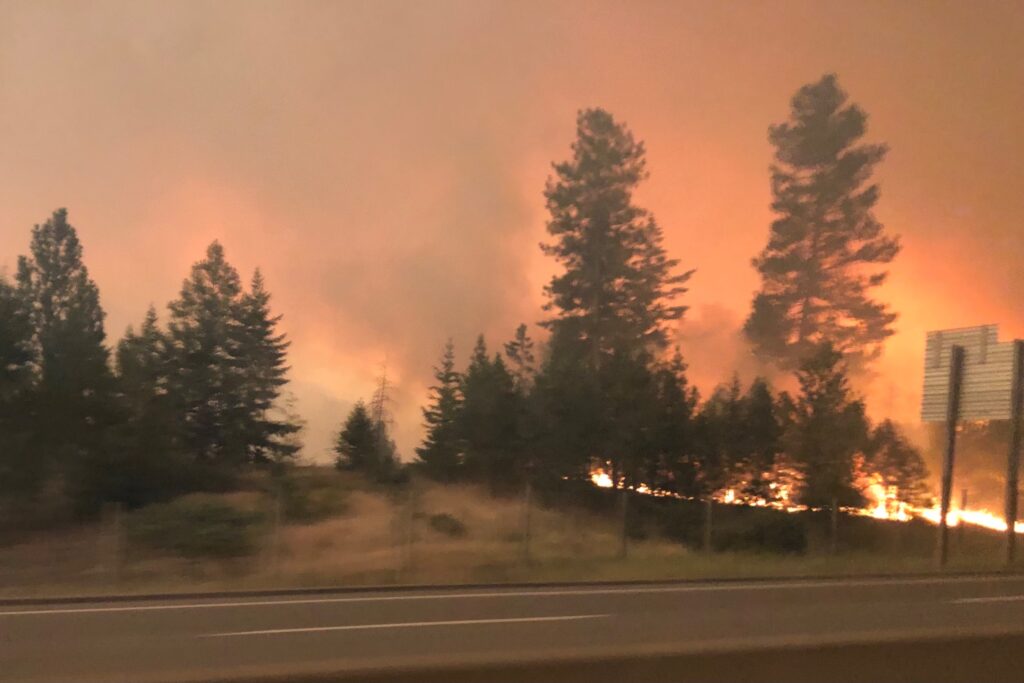
Wildfire smoke is an emerging nationwide crisis for the United States. Supercharged by climate change, blazes are swelling into monsters that consume vast landscapes and entire towns. A growing body of evidence reveals that these conflagrations are killing far more people than previously known, as smoke travels hundreds or even thousands of miles, aggravating conditions like asthma and heart disease. One study, for instance, estimated that last January’s infernos in Los Angeles didn’t kill 30 people, as the official tally reckons, but 440 or more once you factor in the smoke. Another recent study estimated that wildfire haze already kills 40,000 Americans a year, which could increase to 71,000 by 2050.
Two additional studies published last month paint an even grimmer picture of the crisis in the U.S. and elsewhere. The first finds that emissions of greenhouse gases and airborne particles from wildfires globally may be 70 percent higher than once believed. The second finds that Canada’s wildfires in 2023 significantly worsened childhood asthma across the border in Vermont. Taken together, they illustrate the desperate need to protect public health from the growing threat of wildfire smoke, like better monitoring of air quality with networks of sensors.
The emissions study isn’t an indictment of previous estimates, but a revision of them based on new data. Satellites have spied on wildfires for decades, though in a somewhat limited way — they break up the landscape into squares measuring 500 meters by 500 meters, or about 1,600 feet by 1,600 feet. If a wildfire doesn’t fully fill that space, it’s not counted. This new study increases that resolution to 20 meters by 20 meters (roughly 66 feet by 66 feet) in several key fire regions, meaning it can capture multitudes of smaller fires.
Individually, tinier blazes are not producing as much smoke as the massive conflagrations that are leveling cities in the American West. But “they add up, and add up big time,” said Guido van der Werf, a wildfire researcher at Wageningen University & Research in the Netherlands and lead author of the paper. “They basically double the amount of burned area we have globally.”
With the 500-meter satellite data, the previous estimate was around 400 million hectares charred each year. Adding the small fires bumps that up to 800 million hectares, roughly the size of Australia. In some parts of the world, such as Europe and Southeast Asia, burned area triples or even quadruples with this improved resolution. While scientists used to think annual wildfire emissions were around 2 gigatons of carbon, or about a fifth of what humanity produces from burning fossil fuels, that’s now more like 3.4 gigatons with this new estimate.
The type of fire makes a huge difference in the emissions, too. A forest fire has a large amount of biomass to burn — brushes, grasses, trees, sometimes even part of the soil — and turn into carbon dioxide and methane and particulate matter, but a grass fire on a prairie has much less. Blazes also burn at dramatically different rates: Flames can race quickly through woodland, but carbon-rich ground known as peat can smolder for days or weeks. Peat fires are so persistent, in fact, that when they ignite in the Arctic, they can remain hidden as snow falls, then pop up again as temperatures rise and everything melts. Scientists call them zombie fires. “It really matters where you’re burning and also how intense the fire can become,” van der Werf said.
But why would a fire stay small, when we’ve seen in recent years just how massive and destructive these blazes can get? It’s partly due to fragmentation of the landscape: Roads can prevent them from spreading, and firefighters stop them from reaching cities. And in general, a long history of fire suppression means they’re often quickly extinguished. (Ironically, this has also helped create some monsters, because vegetation builds up across the landscape, ready to burn. This shakes up the natural order of things, in which low-intensity fires from lightning strikes have cleared dead brush, resetting an ecosystem for new growth — which is why Indigenous tribes have long done prescribed burns.) Farmers, too, burn their waste biomass and obviously prevent the flames from getting out of hand.
Whereas in remote areas, like boreal forests in the far north, lightning strikes typically ignite fires, the study found that populated regions produce a lot of smaller fires. In general, the more people dotting the landscape, the more sources of ignition: cigarette butts, electrical equipment producing sparks, even chains dragging from trucks.
Yes, these smaller fires are less destructive than the behemoths, but they can still be catastrophic in a more indirect way, by pouring smoke into populated areas. “Those small fires are not the ones that cause the most problems,” van der Werf said. “But of course they’re more frequent, close to places where people live, and that also has a health impact.”
Read Next
Wildfire smoke could soon kill 71,000 Americans every year
That is why the second study on asthma is so alarming. Researchers compared the extremely smoky year of 2023 in Vermont to 2022 and 2024, when skies were clearer. They were interested in PM 2.5, or particulate matter smaller than 2.5 millionths of a meter, from wildfire smoke pouring in from Quebec, Canada. “That can be especially challenging to dispel from lungs, and especially irritating to those airways,” said Anna Maassel, a doctoral student at the University of Vermont and lead author of the study. “There is research that shows that exposure to wildfire smoke can have much longer-term impacts, including development of asthma, especially for early exposure as a child.”
This study, though, looked at the exacerbation of asthma symptoms in children already living with the condition. While pediatric asthma patients typically have fewer attacks in the summer because they’re not in school and constantly exposed to respiratory viruses and other indoor triggers, the data showed that their conditions were much less controlled during the summer of 2023 as huge wildfires burned. (Clinically, “asthma control” refers to milder symptoms like coughing and shortness of breath as well as severe problems like attacks. So during that summer, pediatric patients were reporting more symptoms.) At the same time, climate change is extending growing seasons, meaning plants produce more pollen, which also exacerbates that chronic disease. “All of those factors compound to really complicate what health care providers have previously understood to be a safe time of year for children with asthma,” Maassel said.
Researchers are also finding that as smoke travels through the atmosphere, it transforms. It tends to produce ozone, for instance, that irritates the lungs and triggers asthma. “There’s also the potential for increased formation of things like formaldehyde, which is also harmful to human health. It’s a hazardous air pollutant,” said Rebecca Hornbrook, who studies wildfire smoke at the National Center for Atmospheric Research, or NCAR, but wasn’t involved in either study, though a colleague was involved in the emissions one. (Last month, the Trump administration announced plans to dismantle NCAR, which experts say could have catastrophic effects.)
As wildfires worsen, so too does the public health crisis of smoke, even in places that never had to deal with the haze before. Governments now have to work diligently to protect their people, like improving access to air purifiers, especially in schools. “This is no longer an isolated or geographically confined issue,” Maassel said. “It’s really spreading globally and to places that have never experienced it before.”
This story was originally published by Grist with the headline Wildfire smoke is a national crisis, and it’s worse than you think on Jan 2, 2026.
From Grist via This RSS Feed.
In his 15 years of farming full time, Quentin Connealy has weathered his share of storms — literally.
The first major flood hit in 2011. Three more came in 2019. The waters rose again in 2024 and ruined about 20 percent of his crops. This past summer, he dealt with at least three hail and wind events that damaged his corn and soybeans.
To Connealy, whose family has been farming in Nebraska for 131 years, the weather has grown more extreme, posing a greater threat to his family’s farmland, which extends across thousands of acres in Burt County about an hour north of Omaha. He tries to plan as much as possible and relies on multiple sources of scientific information to do so.
“The weather’s so unpredictable, we need as many resources around as possible,” Connealy said.
But one of those resources that he — and others — rely on is going away.

Quentin Connealy looks back at his crops from the seat of his tractor. Connealy, who has been farming full time for the past 15 years, said he has had to deal with increasingly extreme weather. Courtesy of Quentin Connealy via Flatwater Free Press
Last month, the University of Nebraska Board of Regents voted to eliminate the Department of Earth and Atmospheric Sciences and three other programs at the University of Nebraska-Lincoln, or UNL.
The move means the university system’s flagship campus will no longer be able to produce homegrown meteorologists and geologists — professions that monitor for severe weather and study groundwater, both of which are critical in a state where agriculture remains the economic backbone. The cuts have raised alarm both in and out of the soon-to-be shuttered department.
“The [department] … is a nationally recognized program,” wrote nine professors from the University of Wisconsin-Madison in a letter of support. “Particularly for a state in the center of ‘Tornado Alley,’ there is a need for trained meteorologists and climatologists, which contribute to Nebraska residents’ safety. More nationally, the need for geologists to secure domestic sources of critical minerals is a stated national security concern. Closing this program disrupts a crucial pipeline of qualified professionals for all of these fields.”
While acknowledging the pain inflicted by the cuts, regents and university leadership said action was needed. UNL, the largest of the University of Nebraska System’s four campuses and the largest college in the state, faces a $21 million structural budget deficit. Eliminating the Earth and Atmospheric Sciences Department, estimated to save $1.85 million, was part of a larger effort to erase the deficit.
“My family, we’ve got 26 degrees from this institution, so to say that this decision comes lightly is as far from the truth as it can be,” Regent Tim Clare said at a December 5 meeting where the board voted to eliminate the department. “We’re confronting a serious budget challenge that threatens the long-term stability of our university system.”
But proponents of the Earth and Atmospheric Sciences Department say its elimination will do long-term harm to Nebraska.
“Outside of cutting agronomy, animal science or plant pathology, I don’t think you could have another department at the university that was more important to agriculture, because that’s your groundwater, that’s your weather,” said Eric Hunt, assistant extension educator of agricultural meteorology at the University of Nebraska Extension. “We just cut something that is vital to the long-term viability of agriculture in the state.”
Losing local knowledge and expertise
Adam Houston is blunt about the importance of his students’ work when they leave UNL, particularly those who become forecasters at the National Weather Service, the federal agency responsible for issuing extreme weather warnings.
“The work that we’re doing is training these students to go out and save lives,” said Houston, a professor of atmospheric sciences in the soon-to-be eliminated department.
Other Nebraska universities offer courses similar to those in the department, but the Earth and atmospheric sciences degree program is the only one of its kind in the state, according to regents’ meeting documents.
While weather forecasts are easily accessible these days, there is a human element to that data and forecast, said Martha Durr, a faculty member at the Nebraska Indian Community College and a former state climatologist.
“There is still a human at the forecast desk, and they are using their local knowledge and expertise to nudge that forecast model output in a certain way, or to issue a watch and a warning,” Durr said.
Nebraska is no stranger to extreme weather. The past few years alone have brought flash flooding, drought, outbreaks of tornadoes, and strong thunderstorms. These types of weather events are expected to become more frequent due to climate change — making homegrown local expertise all the more valuable. Already, Nebraska is 2.3 degrees Fahrenheit warmer today than in 1970, and rain events now drop 24 percent more water. The state has also experienced 36 billion-dollar disasters since 2005 — up from four in the previous 20-year period.

Quentin Connealy’s farmland in Burt County, Nebraska, flooded three times in 2019. When forecasts allow enough notice, Connealy tries to take steps to protect his farming equipment.
Courtesy of Quentin Connealy via Flatwater Free Press
“What further sets our [Earth and atmospheric sciences] alumni apart is their deep familiarity with Nebraska’s regional climate and weather patterns,” wrote KLKN-TV chief meteorologist Rusty Dawkins in a letter of support for the department. “Their localized knowledge enables them to offer context-sensitive forecasts and risk assessments that out-of-state professionals may miss.”
This need for local expertise also translates to other subjects taught by the department, including geology, Hunt said.
Geologists from the department have worked with local natural resources districts monitoring groundwater — the primary source of drinking water in Nebraska and an essential resource for the state’s ag economy.
At a press conference earlier this year, Governor Jim Pillen referred to water as the state’s lifeblood and called the Ogallala Aquifer, the largest aquifer in North America, “our pot of gold,” the Nebraska Examiner reported.
Read Next
Groundwater is drying out, heating up, and causing sea level rise
Asked specifically about the cuts to the Earth and Atmospheric Sciences Department, spokesperson Laura Strimple said the governor applauded “university leadership for having the courage to make tough decisions in eliminating bloated and duplicative programs to achieve cost savings. More is still needed.”
The department does work on similar topics as other UNL programs, specifically the Institute of Agriculture and Natural Resources. But state climatologist Deborah Bathke, who has worked in both departments, said the focus in each program varies greatly. “I can say without any doubt that they are not the same thing.”
The department’s alumni have gone on to serve critical roles within the state — the current heads of the Nebraska State Climate Office, the National Drought Mitigation Center, the Conservation and Survey Division, and the Nebraska Water Center all graduated from the department, according to department documents.
Others have gone on to work for local natural resource districts, the Air Force, the Army Corps of Engineers, the National Weather Service, and TV stations across the state.
“We are losing the ability to train the next generation of scientists that want to serve Nebraska … and serve the country the way that we all do with our scientific expertise,” said Bathke, an Earth and Atmospheric Sciences Department alum.
Far-reaching research
There are about 17 faculty in the Earth and Atmospheric Sciences Department, Houston said. Their research carries benefits locally, nationally, and internationally.
Department chair Clinton Rowe highlighted faculty’s research in carbon-sequestration opportunities underneath the state. This subject is of national interest.
“Those kinds of things are important for the economic future of Nebraska,” Rowe said.
And the department has received national renown. Sherilyn Fritz, a professor in the department, was elected this past April to the National Academy of Sciences for her research reconstructing “the history of the environment.”
Fritz is also a lead investigator for the Trans-Amazon Drilling Project, an international research project looking at the evolution of the Amazon rainforest over geologic time.
David Harwood studies past climates and environments as part of the department. He is a leader for the Antarctic Drilling Program, or ANDRILL, an international research effort to understand how ice sheets behaved in the past so that we know what to expect from current global warming.
And then there’s the climate and weather research. Houston led the TORUS project, where his team chased storms to understand their internal structures through drones, mobile mesonets, and radars. Houston’s and the department’s work in meteorology is nationally and internationally recognized, Fritz said. Houston even consulted on the 2024 movie Twisters.

A farmer inspects rotten soybeans on a field destroyed and flooded by the Missouri River near Omaha in 2019.
Johannes Eisele / AFP via Getty Images
Research from the department also informs work coming out of other parts of UNL, including the Institute of Agriculture and Natural Resources. Associate professor Andrea Basche is among the institute’s researchers who have used Earth and Atmospheric Sciences Department research in the past.
“Getting rid of this department degrades the state’s capacity to predict and adapt to weather and weather extremes that dictate our agricultural success,” Basche said.
Some faculty say they have been offered alternate positions at the university. It is unclear how many will take them or stay in Nebraska.
In her role as state climatologist, Bathke was the lead author on the 2024 Climate Change Impact Assessment Report, detailing how a warming planet is impacting Nebraska. Earth and Atmospheric Sciences Department members served as advisers on the report, and one faculty member was also a lead author.
There were plans for follow-ups, such as using regional climate modeling with crop modeling to determine specific impacts to agriculture and natural resources in Nebraska. Now, Bathke is unsure if those follow-up studies will happen.
“We would have to contract that out to someone who does not have the local expertise of Nebraska,” Bathke said. “Anytime you contract something out, it’s more expensive than if you do it in house.”
This story was originally published by Grist with the headline University of Nebraska is eliminating a key climate research department on Jan 2, 2026.
From Grist via This RSS Feed.
Founder’s Briefs: An occasional series where Mongabay founder Rhett Ayers Butler shares analysis, perspectives and story summaries. When Truphena Muthoni stepped up to a royal palm in Nyeri and wrapped her arms around its trunk, few expected her to stay there for three days. Even fewer thought the gesture would spark a national conversation. Muthoni is 22, softly spoken, and no stranger to environmental advocacy. Her 72-hour embrace, now awaiting verification by Guinness World Records, said something that cut through official statements and tired public debates: Kenya’s forests are in trouble, and people know it. Her vigil began as a “silent protest.” Muthoni wanted authorities to face the consequences of unplanned development, shrinking tree cover, and neglected water catchment areas. She also linked her action to mental health. “The reason for hugging trees is that it is therapeutic,” she said before starting. The claim sounded odd to some. By the end, the crowd around her included police officers, county officials, and residents who stood in the rain cheering her on. Tree hugging, usually dismissed as a caricature of environmentalism, has a long history of serious resistance. The Bishnoi of Rajasthan paid with their lives in 1730 when more than 300 villagers died protecting khejri trees at Khejarli, at the ahnds of soldiers sent by the maharaja of Marwar. Their stand helped inspire the Chipko women of Uttarakhand, who in the 1970s placed their bodies between loggers and oaks, insisting on their right to intact forests. Later came the Appiko Movement…This article was originally published on Mongabay
From Conservation news via This RSS Feed.
Environmental and territorial defenders in Guatemala face a critical moment as violence targeting them increases across the country. In 2024, at least 20 such defenders were killed for their work, up from four in 2023, according to a report by advocacy NGO Global Witness. The country was second only to Colombia in the number of defenders killed or disappeared, accounting for 13% of the total cases identified worldwide by Global Witness. As a proportion of the country’s population, the number also leaves Guatemala with the highest rate of killings of environmental defenders in the world. The report says that at least 10 of those killed were Indigenous or campesino individuals. Since 2012, Global Witness has documented 106 killings and disappearances of environmental defenders in Guatemala, half of them Indigenous people and a fifth campesinos, who were engaged in defending their rights to land or opposing the extraction of natural resources. Mongabay Latam interviewed the report authors, along with activists and defenders, who agreed that the main factors behind the increase in violence are a land distribution system that has historically benefited the elite, the continued violation of Indigenous peoples’ rights, and the spread of organized crime. The Campesino Committee of the Highlands (CCDA) has reported killings and criminalization of its members. Image courtesy of CCDA. The new political landscape When Bernardo Arévalo took office as president in January 2024, he and his party, Movimiento Semilla, had the broad backing of Guatemala’s Indigenous peoples. But this hasn’t translated into a reduction…This article was originally published on Mongabay
From Conservation news via This RSS Feed.
In 2019, Bangladesh set a target to end the use of traditional bricks and switch to concrete blocks in all government construction works by June 2025. Aimed at preventing the loss of farmland and the high greenhouse gas emissions associated with brickmaking, the result has largely been “a failure,” according to a top official. “Initially, our target was to use concrete blocks and hollow bricks in all kinds of government works including building public infrastructures, roads, etc.,” Syeda Rizwana Hasan, an adviser to the Ministry of Environment, Forest and Climate Change (MoEFCC), told Mongabay. “Unfortunately, most of the government works have continued to be carried out with the traditional bricks, which mostly made the target a failure.” Various government departments run a wide range of construction projects, including the Ministry of Housing and Public Works, the Education Engineering Department and the Roads and Highways Department. “Of them, only the public works ministry reached its use of 100% clean materials while the others are far behind the target,” Hasan said. Md. Ziuaul Haque, additional director-general of the Department of Environment, said a new deadline for the transition is being planned. “As per our estimation, around 30-40% of the total government works have come under the use of alternative building materials so far,” he said. “We are planning to set a new timeline and impose strict directions to the related government agencies to meet the goal of 100% use of clean bricks.” Damaging to land and climate A boom in infrastructure and…This article was originally published on Mongabay
From Conservation news via This RSS Feed.