cross-posted from: https://lemmy.world/post/33049926
The Buddha addresses a brahmin in verses who believes in purification through bathing in river.
At that time, the brahmin Sundarika Bhāradvāja was seated not far from the Blessed One. Then, the brahmin Sundarika Bhāradvāja said to the Blessed One: “But, does venerable Gotama go to the Bāhukā river to bathe?”
“Why brahmin, go to the Bāhukā river? What can the Bāhukā river do?”
“Venerable Gotama, the Bāhukā river is regarded as meritorious by many people. Venerable Gotama, many people go to the Bāhukā river to wash away the injurious actions [1] they have done.”
Then the Blessed One addressed the brahmin Sundarika Bhāradvāja in verse:
“Bāhukā and Adhikakka, Gayā and Sundarikā; Sarassatī and Payāga [2], and the Bāhumati river— Even if an immature [3] person were to plunge into them repeatedly, his dark deeds would not be purified.
What can the Sundarikā river do? What the Payāga or the Bāhukā do? For a person who is violent and has committed injurious actions, these rivers will not purify the evil-doer.
For the pure one, every day is a sacred festival [4], For the pure one, every day is an observance day [5]; For the pure one, whose actions are clean, His practice [6] always succeeds; Bathe here itself brahmin, establishing a refuge (safety, security [khematā]) for all beings.
If you speak no falsehood, if you do not harm living beings; If you do not take what is not given, having faith and are free from stinginess; What will going to Gayā do for you? for any well is your Gayā.”
When this was said, the brahmin Sundarika Bhāradvāja said to the Blessed One: “Excellent, venerable Gotama! Excellent, venerable Gotama! Just as if one might set upright what had been overturned, reveal (uncover [vivarati]) what had been concealed, point out the way to one who was lost, or hold up a lamp in the dark so that those with eyes could see forms, in the same way, venerable Gotama, the Dhamma [7] has been explained (illustrated [pakāsita]) by you in many ways. I go for refuge to the Blessed One Gotama, to the Dhamma, and to the Saṅgha [8] of bhikkhus. May I receive the going forth in the presence of the Blessed One Gotama, may I receive the full ordination.”
Then the brahmin Sundarika Bhāradvāja received the going forth in the presence of the Blessed One, he received the full ordination. Having recently received full ordination, the venerable Bhāradvāja, dwelling alone, secluded, diligent, with continuous effort, and resolutely, soon realized with direct knowledge, in this very life, the unsurpassed culmination of the spiritual life, for the purpose of which sons of good families rightly go forth from the household life to the homeless life, and having personally attained it, he dwelled in it.
He understood: “Birth is ended, the spiritual life has been lived, what had to be done has been done, there is no more coming to any state of existence.” And the venerable Bhāradvāja became one among the arahants [9].
[1] injurious actions [pāpakamma] ≈ harmful, bad, potentially evil intention or action
[2] Payāga [payāga] ≈ name of a holy bathing place, modern day Allahabad
[3] immature [bāla] ≈ lacking in discernment or good sense, child-like in understanding
[4] sacred festival [phaggu] ≈ This refers to the Phagguna month in the traditional lunar calendar, which corresponds roughly to February-March in the modern calendar. This is a significant time for spiritual observances and other purification practices.
[5] observance day [uposatha] ≈ Occurring on specific lunar days such as the full moon, new moon, and quarter moons, this is a time for renewing virtue, deepening practice, and purifying the mind.
[6] practice [vata] ≈ spiritual practice, duty, vow
[7] Dhamma [dhamma] ≈ teachings of the Buddha that point to the nature of reality, the ultimate truth
[8] Saṅgha [saṅgha] ≈ The community of monks and nuns practicing in line with the Buddha’s teachings. In the broader sense, this is the community of disciples who have realized the noble path and fruition through the Buddha’s teachings
[9] arahants [arahant] ≈ fully awakened ones, free from all mental defilements; worthy of offerings and veneration; also an epithet of the Buddha
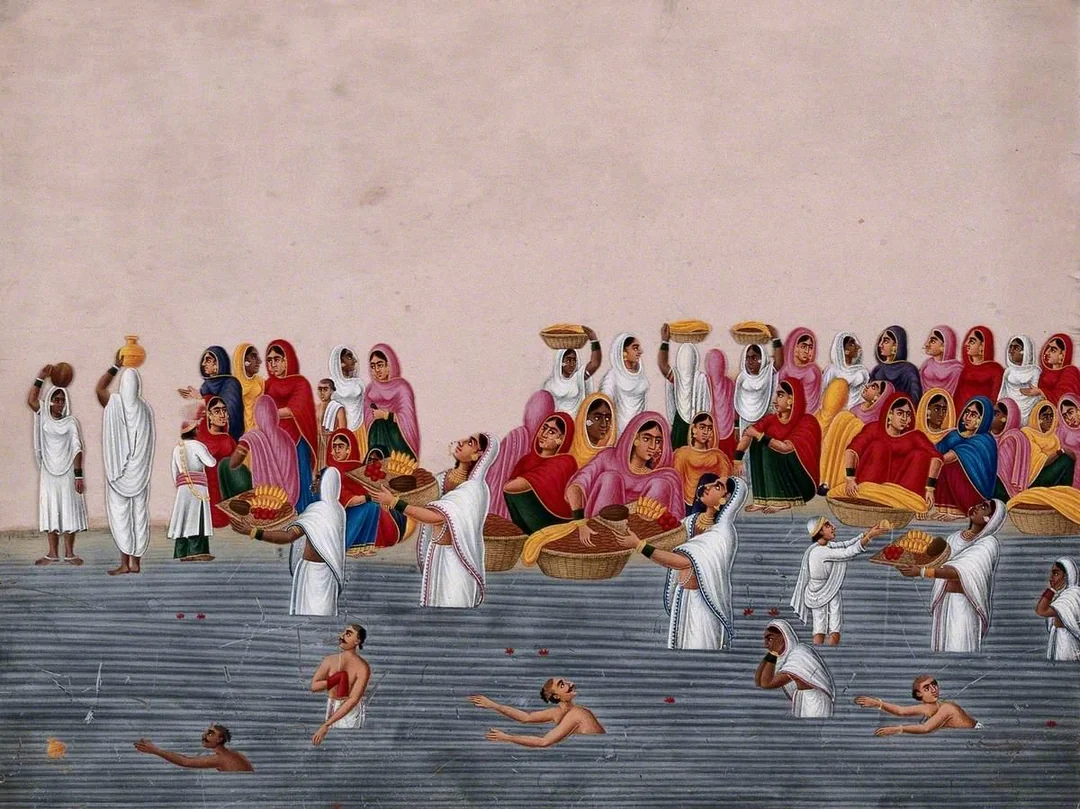
Picture: People Bathing and Praying in the Holy River Ganga, 19th century