Africans will learn whichever languages gives them the best economic opportunities. That is still going to be English and will likely be so for a long time. The only realistic challenger will be Mandarin, but not for a long time.
4
Scientists use sunlight to turn problematic plastic waste into clean hydrogen fuel
(interestingengineering.com)
1
Egypt plans $10B green ammonia project in Ras Banas targets 2031 launch
(www.businesstodayegypt.com)
2
New system enables simultaneous production of hydrogen using waste glycerol
(interestingengineering.com)
1
Low-pressure hydrogen bridges seasonal gaps in solar-powered Japanese building
(www.pv-magazine.com)
I’m interested in when we arrive at a situation where its the best solution among all technology offerings. It will take some technological leap before I think that will happen though.
At some point, hydrogen energy storage systems will have a similar efficiency to a conventional battery. It is sorta possible now, if you utilize CHP (combined heat and power).
Just so we're clear, we may eventually see something similar to your cheap all-in-one solution. We simply aren't there yet technology-wise.
The main point is that hydrogen is totally feasible as a home energy storage system. It will make sense for some people or some situations, but not everyone or every situation.
Well then I retract my previous statement. However, your product is likely not something you would use in a home solar setup. This is more of a camper/RV power system. A real system would be significantly larger and more robust. Adjust costs accordingly.
Your assertion was that the hydrogen solution would be cheaper. I don’t really care about the size right now. I’ve looked in the past and haven’t seen anything close for the performance or low cost. Please list a product(s) for sale showing this competitive price for equal performance.
Looking around, it doesn't seem like there is an equivalent product using hydrogen at the same price. The closest would be a self-contained hydrogen stove system, for around $1,100: https://interestingengineering.com/energy/plug-and-play-hydrogen-stove
I suppose that's "close for the performance," depending on your perspective.
Regardless, hydrogen systems are rapidly coming down in price. For instance, PEM electrolyzers are available for a few tens of dollars these days:
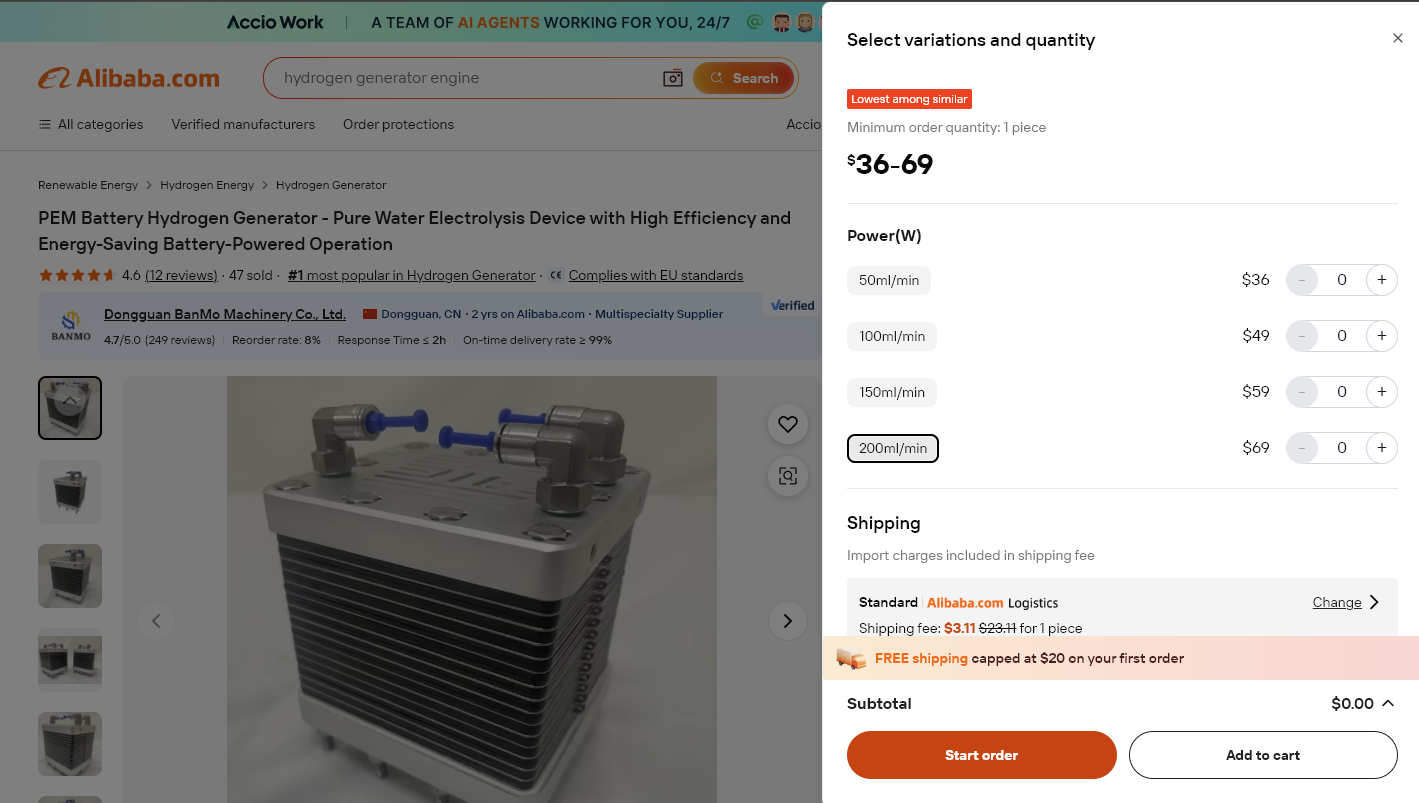
So I suspect we will see a hydrogen system for a similar price to what you are showing.
You're ignoring the need for an invertor and other electronics.
A super scaled down version of a hydrogen electrolyzer plus storage system is not nearly as big as you think. Not impossible that it would fit in a backpack, and cost similar to what you're proposing.
It is possible that it will be the cheaper of the two options. A household-sized system is not an industrial system, and will be using much smaller and fewer components. You may even forgo the hydrogen tanks and compressor altogether, and use something like a metal hydride storage system instead.
I didn’t even bring up the fact that those electrolyzer catalysts are likely a consumable part that need to be replaced at regular intervals.
PEM electrolyzers are not consumable parts and can last for decades.
Why not simply use the “abandoned solar panels” to generate electricity for immediate use or storage in a battery?
The point is that you avoid having to buy the electronic equipment for that. It says in the article:
Unlike conventional systems, which rely on power electronics such as inverters or maximum power point trackers, the approach uses internal reconfiguration of the PV module to match its current-voltage curve to the electrolyzer’s requirements. This removes the need for additional components and reduces system complexity, the scientists explained.
That's liters of hydrogen, not liters of water. Water consumption is very small. The system generates more than enough hydrogen for daily use, so it is an effective use of abandoned solar panels.
Then you are falling for battery propaganda. There have been many deaths related to battery fires. This has been well documented. Meanwhile, hydrogen deaths are nearly zero. The fuel does not concentrate enough to be all that dangerous. There have been zero "movies style car crashes".
Your study is basically the fossil fuel propaganda I'm talking about. It openly admits that hydrogen is not a direct GHG. So it conjures up a hypothetical situation where it extends the life of methane in the atmosphere. Even if it is real, it goes away once methane emissions stop. It can only be a problem if we fail to stop fossil fuel use.
Not really. Only PEM require precious metals, and even then just a few grams of it per car. This will trend downwards over time. Not to mention it is also easily recycled. Fuel cells are much lighter and require much less raw materials to make compared to batteries. In the long run, they will cost much less than batteries to produce.
Hydrogen is much safer than batteries in an accident. Li-ion are known to be extremely flammable and have killed hundreds of people in various fires. Hydrogen is lighter than air and does not linger in a leak. Hydrogen is not toxic and not a GHG (be wary of fossil fuel propaganda against green technology. Even wind turbines "caused global warming" according to the fossil fuel companies).
Fuel cells are much simpler than ICEs and much lighter than batteries. A fuel cell car could be cheaper than both. Hydrogen-ICE cars are also possible.
Gasoline and natural gas are fossil fuels. Green hydrogen is not. Of course, you can make green gasoline or natural gas (basically what e-fuels are) but both require hydrogen as an input.
view more: next ›
It needs to run on non-AMD hardware too.