this post was submitted on 03 Aug 2026
21 points (100.0% liked)

No Stupid Questions

49237 readers
859 users here now

No such thing. Ask away!

!nostupidquestions is a community dedicated to being helpful and answering each others' questions on various topics.

The rules for posting and commenting, besides the rules defined here for lemmy.world, are as follows:

Rules (interactive)


Rule 1- All posts must be legitimate questions. All post titles must include a question.

All posts must be legitimate questions, and all post titles must include a question. Questions that are joke or trolling questions, memes, song lyrics as title, etc. are not allowed here. See Rule 6 for all exceptions.


Rule 2- Your question subject cannot be illegal or NSFW material.

Your question subject cannot be illegal or NSFW material. You will be warned first, banned second.


Rule 3- Do not seek mental, medical and professional help here.

Do not seek mental, medical and professional help here. Breaking this rule will not get you or your post removed, but it will put you at risk, and possibly in danger.


Rule 4- No self promotion or upvote-farming of any kind.

That's it.


Rule 5- No baiting or sealioning or promoting an agenda.

Questions which, instead of being of an innocuous nature, are specifically intended (based on reports and in the opinion of our crack moderation team) to bait users into ideological wars on charged political topics will be removed and the authors warned - or banned - depending on severity.


Rule 6- Regarding META posts and joke questions.

Provided it is about the community itself, you may post non-question posts using the [META] tag on your post title.

On fridays, you are allowed to post meme and troll questions, on the condition that it's in text format only, and conforms with our other rules. These posts MUST include the [NSQ Friday] tag in their title.

If you post a serious question on friday and are looking only for legitimate answers, then please include the [Serious] tag on your post. Irrelevant replies will then be removed by moderators.


Rule 7- You can't intentionally annoy, mock, or harass other members.

If you intentionally annoy, mock, harass, or discriminate against any individual member, you will be removed.

Likewise, if you are a member, sympathiser or a resemblant of a movement that is known to largely hate, mock, discriminate against, and/or want to take lives of a group of people, and you were provably vocal about your hate, then you will be banned on sight.


Rule 8- All comments should try to stay relevant to their parent content.


Rule 9- Reposts from other platforms are not allowed.

Let everyone have their own content.


Rule 10- Majority of bots aren't allowed to participate here. This includes using AI responses and summaries.


Credits

Our breathtaking icon was bestowed upon us by @Cevilia!

The greatest banner of all time: by @TheOneWithTheHair!

founded 3 years ago
MODERATORS
 

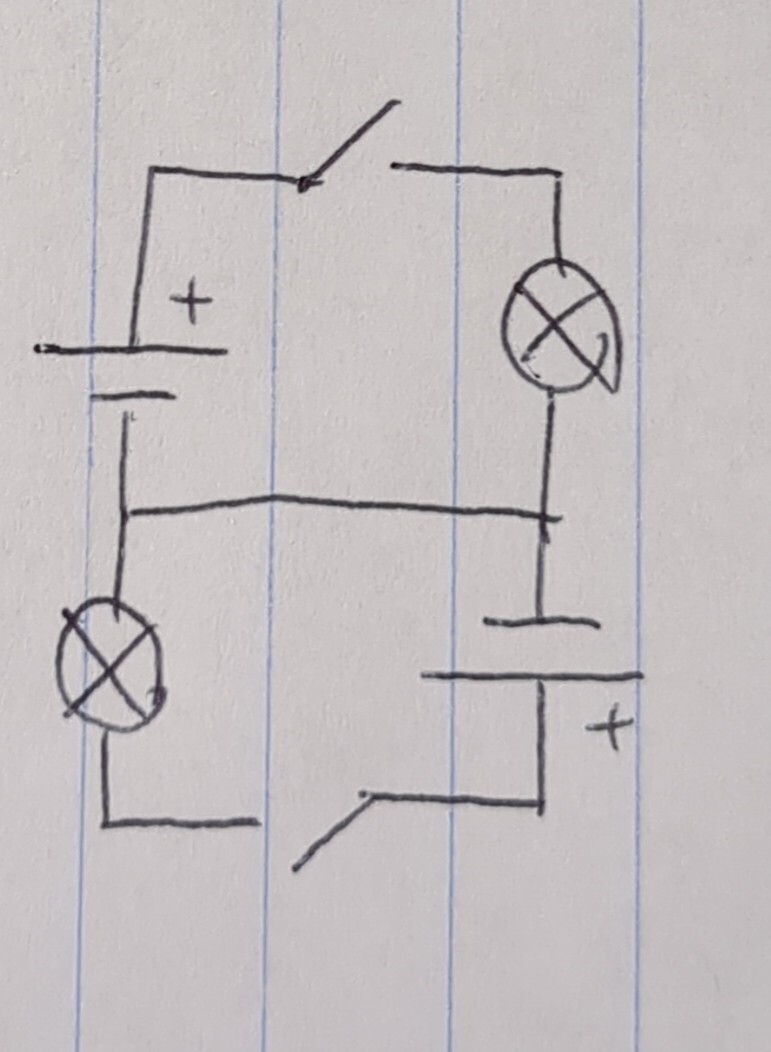
From one of my favorite books, Code: The Hidden Language of Computer Hardware and Software by Charles Petzold:

7dDVB9Hvgu9qKxP.png

Here, he explains how to setup switches and lightbulbs in two locations with the purpose of communicating by turning the lights on and off according to some previously established protocol/code.

My question: is he oversimplifying - because that isn't the point of this chapter - which route/path the current would take when both switches are closed? As in:

poKdbhPdpYAALnJ.png

Would the wire, which I awkwardly marked blue, also become charged and/or carry current? Or would there be no current because the cathodes of the two adjacent batteries cancel out any difference/voltage in the "blue wire" that would otherwise cause a current?

top 11 comments
sorted by: hot top controversial new old
[–] Natanael@infosec.pub 2 points 1 day ago (1 children)

If you want to be very very hyperpedantic, when the circuit gets closed there is initially a current everywhere reachable and an electric field absolutely everywhere. It then settles down in passive DC circuits when equilibrium has been reached, and with an equal but opposing voltage ("electric field pressure") on both sides of this wire the current is zero

It's like a water pipe with stale water between two water pumps

[–] akunohana@piefed.blahaj.zone 1 points 1 day ago* (last edited 1 day ago)

Thanks! I was just waiting for somebody to point that out! Namely, that there should be a momentary... "Effect"? Of an electric field in all parts of the circuit before it equalizes. Thanks! 😊

One of these days, I'll pull myself together and read up on AC too. πŸ˜…

[–] fullsquare@awful.systems 14 points 1 day ago (2 children)

It's easier to see that this circuit is rather symmetric when you redraw it

Then with both switches closed blue wire (the one in the middle) should only carry small current. If both halves are exactly the same it should be zero

In general when circuit doesn't include nonlinear components (semiconductors most commonly) you can sum two valid solutions and you'll get another valid solution. Note that when one switch is closed, current in blue wire goes one way and when the other is closed, in opposite way

[–] neidu3@sh.itjust.works 6 points 1 day ago

Thanks for drawing it so I didn't have to; I got nerd sniped from seeing what seemed like two identical circuits with shared ground

[–] akunohana@piefed.blahaj.zone 5 points 1 day ago (1 children)

This was an amazing explanation. I'm saving it. Thank you so much! I wanna learn writing schematics or whatever they're called so badly but...

[–] SuiXi3D@fedia.io 3 points 1 day ago

Check out the game Spintronics. It’s kind of expensive for the whole set, but absolutely worth it if you want to play around with circuits without shocking yourself.

[–] marcos@lemmy.world 9 points 1 day ago (2 children)

On a real circuit where every component is different from each other, yes there will be current there.

On that ideal circuit, try specifying the characteristics of those components and writing down how much current goes through each segment. That will let you understand what is happening.

Thanks! In this book, for better and for worse, we are only trying to understand binary logic and how to express parts of that (AND and OR) with serial and parallel switches, so we're not really touching on the electrical characteristics of the individual components. But I'll keep your reply in mind going forward! 😊

[–] Successful_Try543@feddit.org 2 points 1 day ago (1 children)

Try visualizing the current by using arrows of a proportional length directing from+ to - (or in opposite direction).

[–] marcos@lemmy.world 1 points 1 day ago (1 children)

If the book is trying to explain an Wien bridge, the OP will need to actually put numbers there. Just looking at the sizes won't be enough.

It doesn't matter if you use numbers or scaled! vectors.