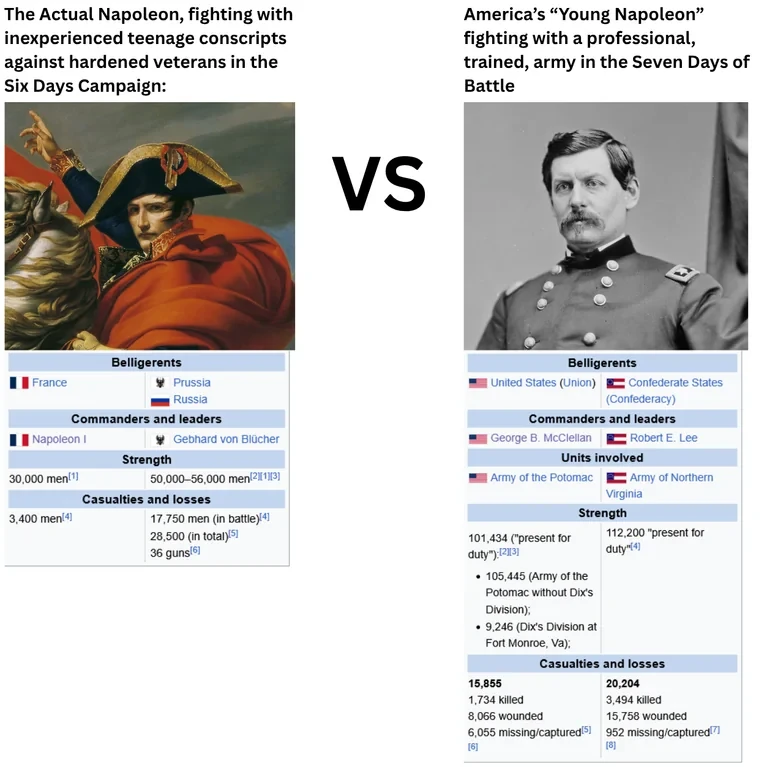
Explanation: Napoleon Bonaparte was a French commander of Corsican origins who is (rightly) considered legendary for his military exploits in the 1800s and 1810s, wherein he often pulled off daring and ambitious battle plans, and regularly overcame larger or better-supplied foes.
Even as early as the 1860s, Napoleon's reputation was well-established. For this reason, a young and academically talented American officer, George McClellan, earned the nickname "The Young Napoleon" for his sharp military mind. Going into the US Civil War. Assured of victory with another such great genius on the side of LIBERTY, the Union's newspapers praised General McClellan's intellect and eagerly awaited news of the victories he would surely deliver to the Union's cause against the pro-slavery secessionist Southern Confederacy!
... those victories never materialized. McClellan was an intelligent and academically gifted man, but he was no Napoleon - and his military expertise was overwhelmingly on paper. He was a good organizer who understood conventional strategy of the time, but who was overly-cautious and prone to overestimate his enemy, both in quality and quantity, sometimes suggesting that the ragged and poorly-supplied Confederate armies he faced had twice(!!!) the number of troops in-theatre as they actually had.
After letting numerous opportunities to seize the initiative slip through his fingers, and no stunning victories to make up for that either, McClellan was replaced. After trying out several similarly ill-suited generals (Hooker, an aggressive idiot; Burnsides, an engineer by trade who admitted he was not much good at commanding), the Union landed on General Meade, who delivered the great, if hard-fought, victory at Gettysburg to the Union. The up-and-coming star of the war, General Ulysses S. Grant, would replace Meade (amicably) shortly after finishing up affairs in the Western Theatre, and finally bring the Union to victory over the slavers, ending the US Civil War!