Space
A community to discuss space & astronomy through a STEM lens
Rules
- Be respectful and inclusive. This means no harassment, hate speech, or trolling.
- Engage in constructive discussions by discussing in good faith.
- Foster a continuous learning environment.
Also keep in mind, mander.xyz's rules on politics
Please keep politics to a minimum. When science is the focus, intersection with politics may be tolerated as long as the discussion is constructive and science remains the focus. As a general rule, political content posted directly to the instance’s local communities is discouraged and may be removed. You can of course engage in political discussions in non-local communities.
Related Communities
🔭 Science
- !curiosityrover@lemmy.world
- !earthscience@mander.xyz
- !esa@feddit.nl
- !nasa@lemmy.world
- !perseverancerover@lemmy.world
- !physics@mander.xyz
- !space@beehaw.org
🚀 Engineering
🌌 Art and Photography
Other Cool Links
I fucking knew it. Everyone knows that the Earth is round, but I just knew that Jupiter was flat!
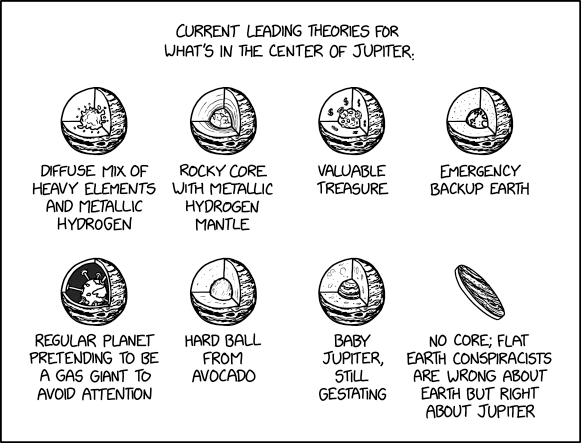 [^1]
[^1]That’s really interesting, I wonder how many other planets might be bigger or smaller than scientists originally thought. It would cool to know if any are in the future, with all the advances in science and technology I’m sure we could know very soon into the near future, maybe a few years from now.
Wouldn't something of that size necessarily turn spherical due to its mass?
Or is there enough inertia from the planet spinning that it bulges at the equator?
Is that equatorial inertia or are you happy to see me?