
615
Using AI for just 10 minutes erodes your ability to persist at hard things - Berkeley News
(news.berkeley.edu)
This is a most excellent place for technology news and articles.
Forgive me, but i’m not understanding why you find the headline to sensationalize or over state the actual findings of the study. The abstract of the paper directly says:
I’m struggling to discern a meaningful difference between “erodes your ability to persist at hard things” and “reduced persistence of unassisted performance”. Forgive me for not understanding but I would appreciate your explanation. The paper's very own conclusion actually uses the term erosion:
I found a definition of erosion: "the gradual loss of something as a result of an ongoing process". Trust can erode and be rebuilt; soil can erode and be restored.
I agree that 10 mins of foundation model assistance likely doesn’t “permanently damage your brain or destroy your ability to think for yourself”. However, in my reading of the Berkeley news piece, I find no claim of this specific kind. Does the text of the press release explicitly claim the duration of effect is long-term or lasting? Does it explicitly claim the the erosion is permanent? Again, I find myself confused what you are arguing against.
Of course I'll be happy to explain, the title of the article states:
The findings of the study do not indicate that using an LLM (AI) for ten minutes removes your ability to do hard things. The study showed that it was harder to perform tasks without AI assistance after having access to it. In fact, people who used AI for ten minutes before performing difficult tasks actually performed better than those who did not.
The ten minutes was simply used as a control so that everyone had the same amount of time with AI. It had nothing to do with the erosion of their ability to perform difficult tasks. The conclusion the researchers drew, which is up for interpretation, was that prolonged AI usage may potentially impair people's ability to perform harder tasks without assistance.
The title heavily implies that just ten minutes of AI usage makes difficult tasks harder to perform, which is not what the study showed or concluded. Therefore, the title has been intentionally sensationalized as clickbait. It objectively misrepresents the findings by encouraging a different interpretation and conclusion than what the study actually demonstrated.
The study itself is interesting, but apparently, the researchers' findings weren't sensational enough on their own. The people posting these articles still felt the need to mislead their audiences into drawing a different conclusion from the one the research actually supports.
"The study doesn't show it removes the ability to do hard things" Again, who exactly are you arguing against? Nobody said this... Neither the press release nor I
"People who used AI for ten minutes before performing difficult tasks actually performed better than those who did not." I'd gently encourage a quick re-read of the paper, as the statistic results directly contradict your claim. Here's experiment 1 (fraction math problems):
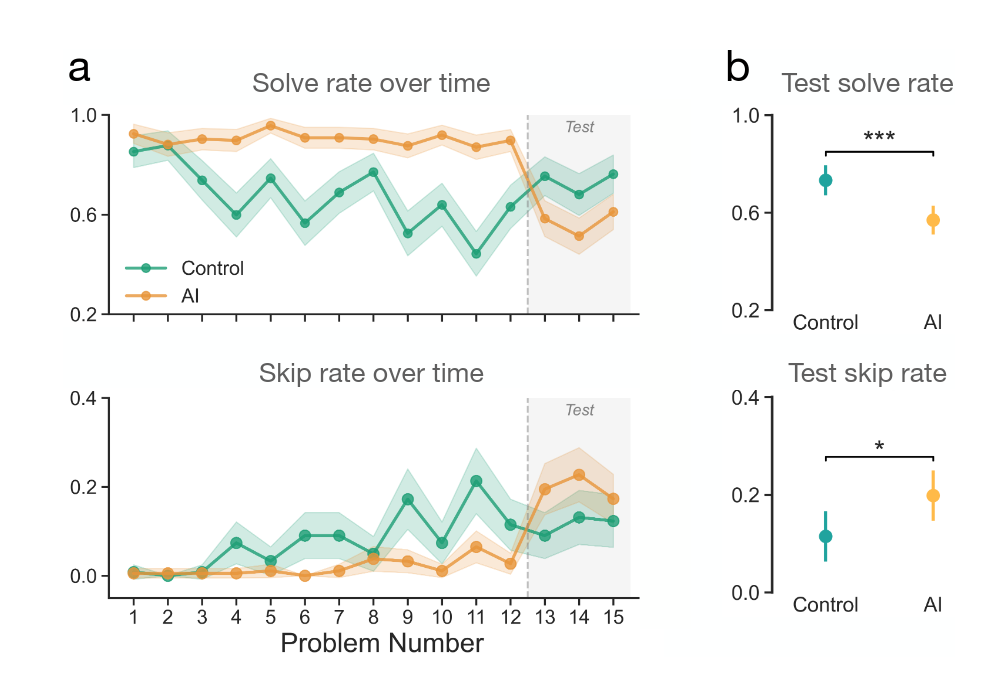
"The title heavily implies that just ten minutes of AI usage makes difficult tasks harder to perform, which is not what the study showed or concluded" and Again, just to make sure we aren't proceeding on a misunderstanding here, the headline says "persist", which means to refusing to give up. The definition of persist is not that of perform. Further, I suggest you re-read the research paper. The abstract directly states, "impairment of unassisted performance"
"The conclusion the researchers drew, which is up for interpretation, was that prolonged AI usage may potentially impair people’s ability to perform harder tasks without assistance." I think you may be confused about how experimental studies work in research. In the experiment, when they controlled the variable of AI assistance, the experimental results showed statistically significant results proving the hypothesis that test solve rate of the control group was greater than the test solve rate of the AI group.