this post was submitted on 15 Sep 2026
351 points (99.7% liked)
Memes of Production
1705 readers
367 users here now
Seize the Memes of Production
An international (English speaking) socialist Lemmy community free of the “ML” influence of instances like lemmy.ml and lemmygrad. This is a place for undogmatic shitposting and memes from a progressive, anti-capitalist and truly anti-imperialist perspective, regardless of specific ideology.
Rules:
Be a decent person.
No racism, sexism, ableism, homophobia, transphobia, zionism/nazism, and so on.
Other Great Communities:
founded 8 months ago
MODERATORS
you are viewing a single comment's thread
view the rest of the comments
view the rest of the comments
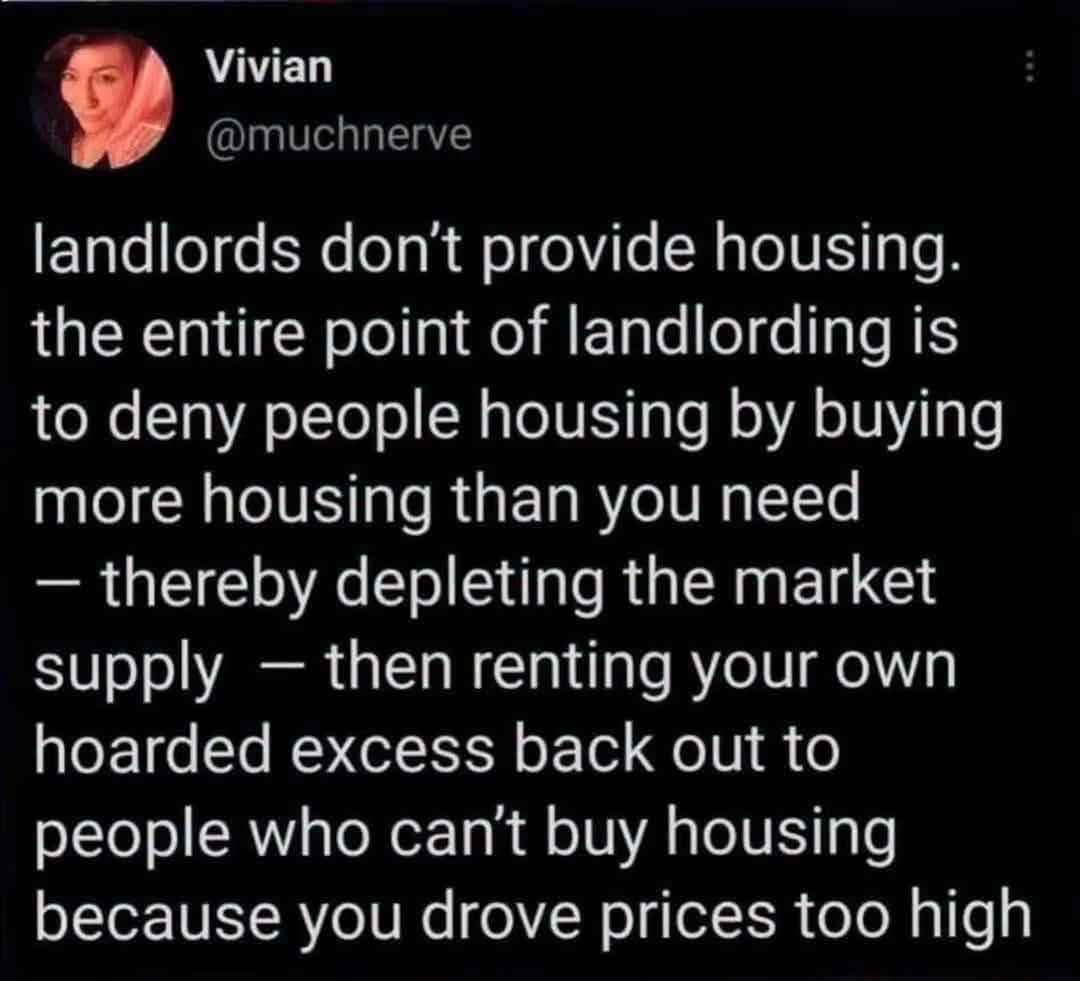
Yup. Rent needs to go up so as the monthly rent needs to be 1/100 of the purchase price. (A general rough guide on rent prices.)
Not going to escape this until we have free places to live and store some stuff.
Whose guide? I've never seen more than 1/150 on any listing, 1/200 is more realistic. Renting itself isn't even profitable in most places once you factor in people who just stop paying rent and people who outright destroy the place, requiring remodeling. There's only so much that a deposit worth 1-2 months rent covers. The appreciation of property values is where the big money lies. E.g if you'd bought a place in 2009 here, your investment would've more than tripled by now (most of that growth being post-COVID, COVID increased purchase prices like 70% in about 2 years, rents luckily didn't go up as much). Luckily, minimum wage has even increased a bit more than property prices. Of course, S&P 500 went up nearly 10x in the same timeframe.
It is often repeated on various "build up your wealth" guides as the "1% rule". here is a random link I found by searching, but there are many others, that directly states "The 1% rule says: monthly rent should be at least 1% of purchase price. On a $200,000 property, you'd want monthly rent of $2,000+."
We clearly head different things about "landlording". My knowledge of landlording is mostly from online references suggesting how to do it well, and the remaining if horror stories from associates who didn't do any research.
Well your knowledge might be from online references, mine is from having been a renter and knowing some landlords operating in the real world.
If you buy a €200,000 apartment in my country, the absolute most you'll get in rent is about 1k. And if that €200k apartment was brand new as they usually are in that price range, you'd still need to furnish it. You just don't get a lot of apartment for 200k anymore and nobody's gonna pay you that much in rent if there are cheaper apartments available to rent. In a surprising turn of events, capitalism and the free market have largely worked in favor of renters here, mostly because mixed usage is allowed almost everywhere so they build grocery stores and mid-rise apartment buildings in areas that used to be dominated by single family homes from the 2008 construction craze to the point that they used to look like American suburbia. The other thing that helps is that we're still constantly building more, while our population is down from its peak in 1990. Of course it does also mean us millennials will have to give up the idea of retiring in our 60s, there's just not enough young people here to support us.
And there's no real way to avoid being burnt occasionally. Like 90% of renters are bound to be young people who don't have a ton of history to check up on. You don't really get people in their 40s or 50s renting much unless they're down on their luck or move around a lot. This sort of incentivizes keeping rents flat rather than raising every year and otherwise being good to your tenants if they reliably pay rent and don't smear literal feces on the walls and whatnot. When COVID hit, my landlady, unprompted, told me that if anything happens to my job, she's OK with me withholding rent payments till I get back on my feet. This was a person I'd known for like half a year. Luckily didn't need to do that, but being understanding of your tenants is moderately common here because other than in august and september (start of university), it's good tenants that are in short supply, not apartments.
It would seem the amount of rent one can charge relative to purchase price is country related (likely also region dependent). Everything you have described is a strange version of the opposite here.