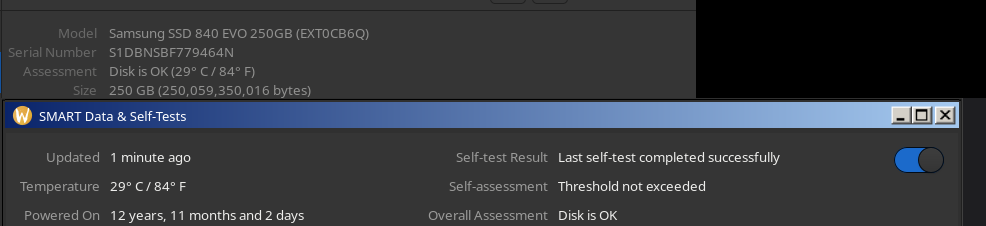
12 years and 11 months of powered-on time for this SSD... I should definitely turn it on for another month lol
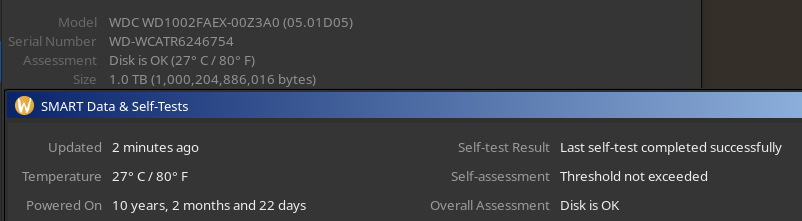
10 years powered-on time for this HDD. Who says HDDs aren't reliable? 😂
Anyone got better numbers than these?
A place to share alternatives to popular online services that can be self-hosted without giving up privacy or locking you into a service you don't control.
Rules:
Be civil.
No spam.
Posts are to be related to self-hosting.
Don't duplicate the full text of your blog or readme if you're providing a link.
Submission headline should match the article title.
No trolling.
Promotion posts require active participation, with an account that is at least 30 days old. F/LOSS without a paywall has exceptions, with requirements. See the rules link for details. Tags [CBH] or [AIP] are required, see the links in Rule 8 for details.
AI-related discussions and AI-involved promotional posts have additional requirements for tagging, as noted in Rule 7 and the AI & Promotional Post Expanded Rules post, and find example disclosures here.
Resources:
Any issues on the community? Report it using the report flag.
Questions? DM the mods!
12 years and 11 months of powered-on time for this SSD... I should definitely turn it on for another month lol
10 years powered-on time for this HDD. Who says HDDs aren't reliable? 😂
Anyone got better numbers than these?
No screenshots, but I had an old server with a pair of mirrored 8GB Seagates hosting a particularly specialized service on a very beefy and regularly maintained UPS and it had a server uptime of 21 years (had not been rebooted since somewhere around 1999) when I finally decommissioned it about 5 years ago, both disks would've been the same. It was on the public internet the whole time too, running Debian Slink with kernel 2.0.36, which had been awkwardly patched and rebuilt somehow to make the service (itself already obsolete at that time) actually work. I don't know why I remember all this, but I do.
I do remember monitoring the SMART status at various points and the drive bearings must've been pretty cooked because those two drives were always running at 50-60C and I had a big old box fan pointed at the thing with the side panel off.
This example is also why I don't always buy into the cult of "you must always regularly update all software immediately all the time". Old software is not always bad software, same with old hardware. Sometimes it's genuinely possible to have a bulletproof system. The problem is you never really know you do, until it either enters survivorship bias or becomes catastrophically proven otherwise. But you can make educated guesses, and if you're going to naively assume that your old software must have exploitable security holes it seems equally naive to me to assume that updates must never have exploitable security holes. I think the risk calculus has to be done on a case-by-case basis.
Are you me?
This is the exact argument I make about updating.
Without knowing, you're just trading known risks for unknown risks.
Known risks can be managed.
My opinion of the constant update cycle today: it rationalizes management's liability offloading while also justifying staffing requirements and therefore budget.
Liability and risk are related, but very different things.