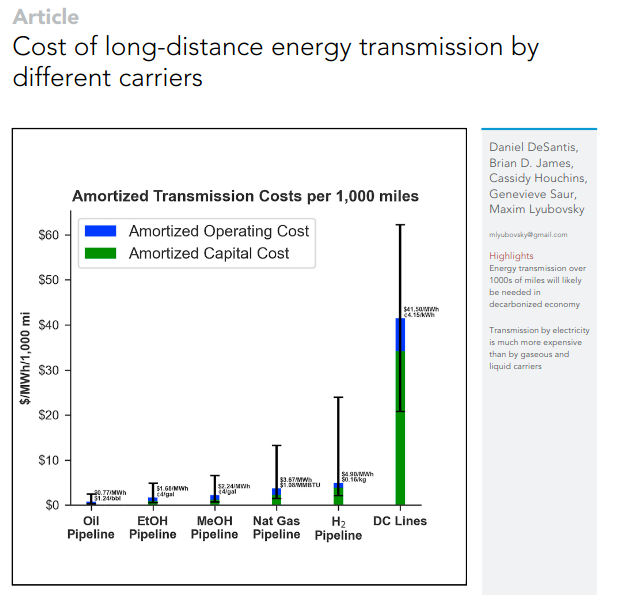
so the goal is to transport renewable energy from the point of production (e.g. coastline for offshore wind) to the point of consumption (e.g. big factory 300 miles from the coast).
what is the cost of doing this? when comparing different technologies. i.e. you can just build a cable and transport the electricity through that, or you convert the energy into hydrogen at the point of production, then pipe that hydrogen gas through a pipeline to the point of consumption. many big consumers can naturally consume hydrogen instead of electric power anyways, for example large steel mills. they require power for heating and reduction, but in both cases, both power sources can be used (for reduction, electrolysis vs. chemical reduction).
it's well-known that the LCOE (levelized cost of electricity) for solar and wind is around 6 ct/kWh (citation needed, i'm citing from memory). so what is the cost of transporting that electric power over 300 miles? according to the diagram, it's 4 ct/kWh over 1000 miles, so probably 1.33 ct/kWh over 300 miles using wires. so it makes a small part of the cost.
meanwhile if you use hydrogen, you have around a 70% conversion+storage efficiency (electric power -> hydrogen, plus storing it in an underground cavern) (source: this paper and german wikipedia about hydrogen storage). so to produce 1 kWh hydrogen, you need 1.4 kWh electricity at the cost of 1.4 * 6 ct/kWh = 8.4 ct/kWh. transmitting it over the pipeline, meanwhile, costs almost nothing, as seen in the diagram.
so in summary, producing+storing+transmitting hydrogen is slightly more expensive than just producing+transmitting electric power, but that already includes the storage cost. for electric power, you need additional batteries which i'm too lazy to write about now. just to give you an idea.
interesting piece of trivia: In 2003ish, there was a major power outage across the northwestern US and much of eastern Canada. One major issue was that the grid became desynchronized so resynchronizing was a major problem they had to solve to bring the grid back up. The province of Quebec uses high voltage DC lines (and also massive amounts of hydroelectric power, but that's a conversation for another day) so they didn't have that same problem and had returned their power to normal long before the rest of the region.