this post was submitted on 09 May 2026
670 points (99.0% liked)
People Twitter
10008 readers
650 users here now
People tweeting stuff. We allow tweets from anyone.
RULES:
- Mark NSFW content.
- No doxxing people.
- Must be a pic of the tweet or similar. No direct links to the tweet.
- No bullying or international politcs
- Be excellent to each other.
- Provide an archived link to the tweet (or similar) being shown if it's a major figure or a politician. Archive.is the best way.
founded 2 years ago
MODERATORS
you are viewing a single comment's thread
view the rest of the comments
view the rest of the comments
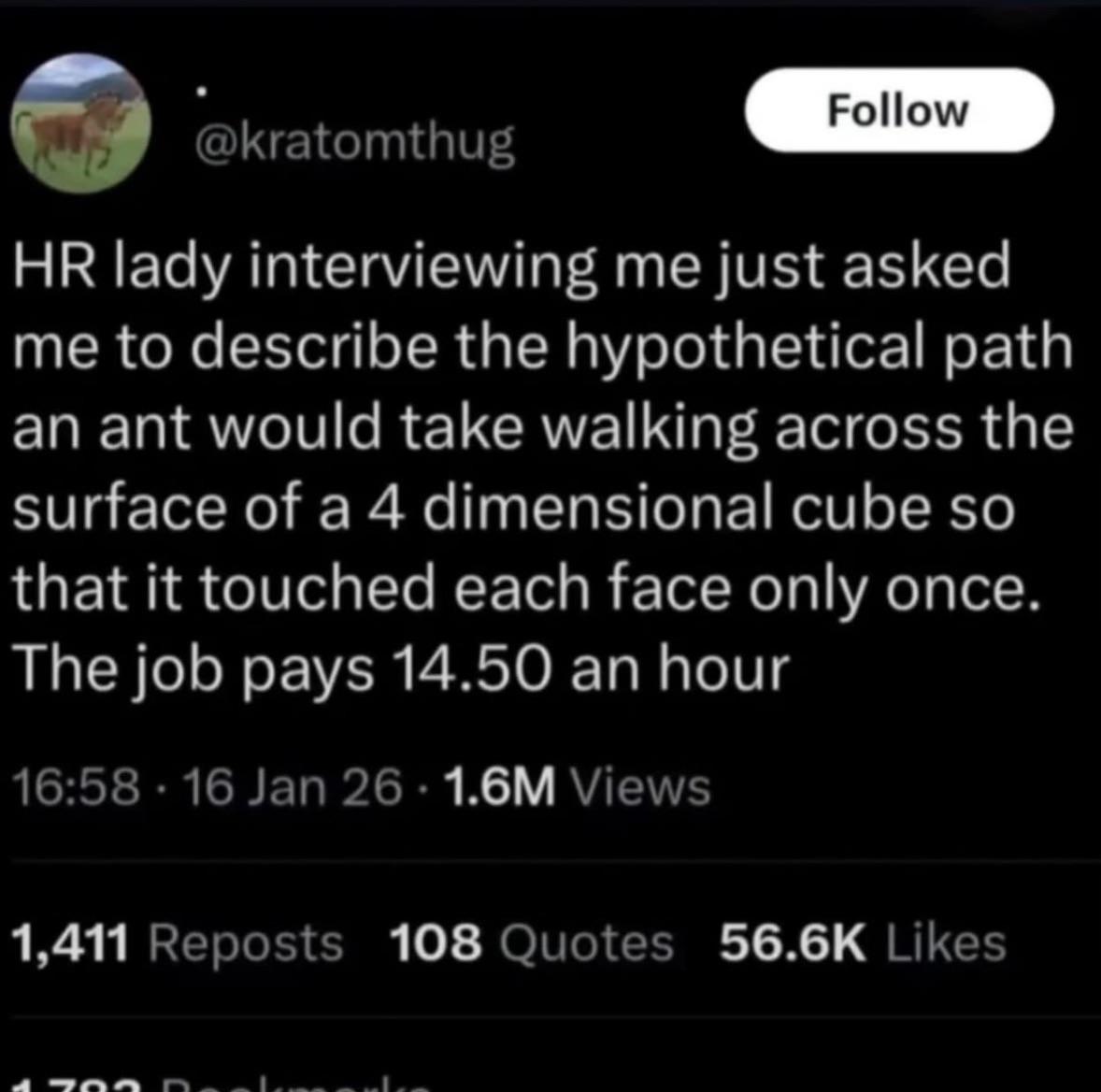
Well technically as the ant is traveling across the fourth dimension, time in most cases, in the example meaning it instantaneously travels the entire surface and touches the faces an infinite number of times in an infinite path unless only one edge touches a surface without any 3 dimensional velocity. If the latter, then let us define the faces along said edge as 1 and 4, the faces between but parallel in edges as 2 and 3, and the faces on the perpendicular axis as 5 and 6. Then, its path is 1, 5, 2, 6, 3, 4, and dismount. To ensure the ant never again approaches the cube in infinite time, have it travel in a perfect circle around the cube infinitely.
In mathematics, the 4th dimension isn't in any way privileged, so the ant isn't "traveling across the fourth dimension" as such, it's tracing a path through all four dimensions, just like you'd trace a path through three dimensions.
You're needlessly abstracting it. The ant has a constant 4th dimensional vector and a variable 1st, 2nd, and 3rd dimensional vector as a function of it.
I have traced the path, the addition of the 4th dimension doesn't change it.
If the interviewer didn't intend for this answer then they should have specified a different 4th dimension which is non-constant nor linear.
There's no "constant 4th dimensional vector" here.
You’re overcomplicating it by treating the 4th dimension as time. In a tesseract puzzle, the 4th dimension is just another spatial direction. The ant simply walks across adjacent cubic cells on the hypersurface, much like walking across faces of an ordinary cube. The problem reduces to finding a path through the adjacency graph of the 8 cells.
Your lack of understanding of movement as a combination of vectors makes me think you're talking out your ass.
This is linear algebra. The solution can be written as a matrix of 4th dimensional space. Its all vectors.
And despite your confidence, your answer is wrong. You're talking about a 3-cube embedded in 4-space instead of a 4-cube, which is why you only see 6 faces, whereas a 4-cube (a tesseract) has 24 faces.
Real life cubes are 4 dimensional.
The 4th dimension is time.
How you define the 4th dimension changes the question and I leveraged that to get an easy solution.