this post was submitted on 09 Feb 2026
213 points (100.0% liked)
NPCs (NonPolitical Comics)
1181 readers
298 users here now
A community for comic lovers who just want to get away from politics and gloom and doom.
- Rule 1 - Be civil.
- Rule 2 - Don't be uncivil.
Posting guidelines:
- No political comics. This generally includes anything referencing whatever bullshit Trump is up to, but also includes the megacorps. Essentially if the comic is about how the world today sucks, it doesn't belong here.
- Where possible, tag the title with [comic name]. This refers to the name of the artist or overall comic, not the title of the specific strip.
- Tag NSFW / NSFL / AI content accordingly.
founded 1 month ago
MODERATORS
you are viewing a single comment's thread
view the rest of the comments
view the rest of the comments
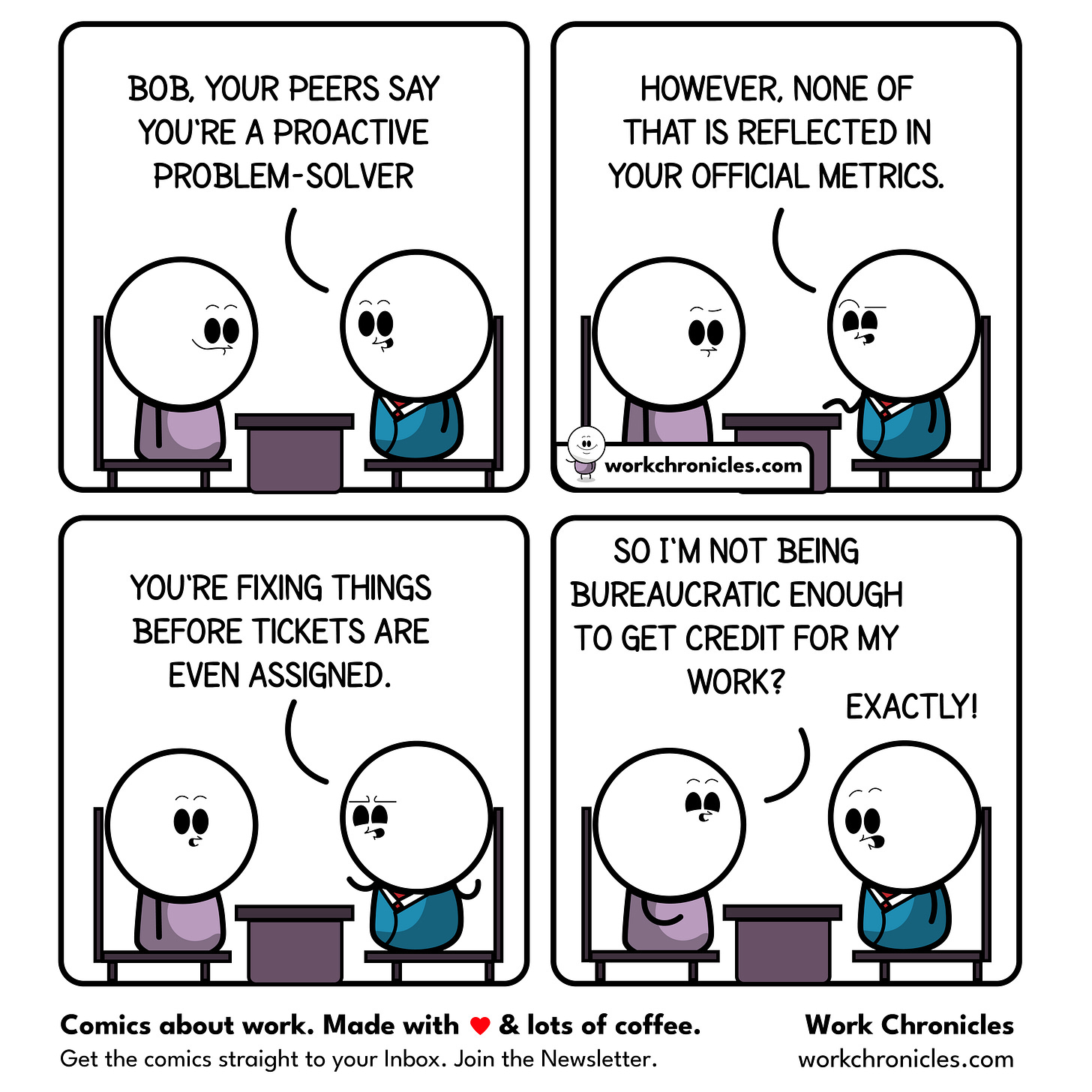
I’ve never received a satisfactory explanation what the difference between pro-active and active is. Like, every single example usage in the dictionary you could swap in “active” without changing the meaning.
The emphasis is distinction from reactive. Proactive means you act before something has occurred (for example to prevent it or to prepare for its occurrence), as opposed to reactive, which is acting after the fact. If you're fixing issues proactively, that means you anticipate that something is going to become a problem and change it, rather than waiting for it to become a problem and (reactively) fixing it.
Of course, the difficulty with appreciating the impact of proactivity is that it changes what happens and thus makes it harder to see what might have happened otherwise. If I (proactively) replace some machine part that was close to breaking, the result (business as usual) is less visible than if I had let it break (interrupting business) and (reactively) fixed it.
The "pro-" is derived from Ancient Greek and means "earlier" or "prior". So, "proactive" means to become active before something (typically bad) happens. It's the opposite of "reactive", which means to become active after something (bad) happens, i.e. in response to it.
An example: To help with fighting fires, you can proactively remove flammable materials or buy fire extinguishers. But if a fire breaks out anyways, then you have to deal with it reactively, a.k.a. react to it, by then making use of the fire extinguishers.
In both cases, you become active, but one time you become active before something happens (proactive), the other time you become active after something happens (reactive).
Well, and the things you do in those situations are generally also different. Proactively, you try to prevent a catastrophe from happening and prepare remedies in case it still happens anyways. Whereas reactively, you use those remedies to condemn the damage and try to get things back into working order as quickly as possible.
And of course if you fix things proactively (before they happen) then that's likely to be expenditure which will be seen as unnecessary if/when it doesn't happen. So:
a) the best way to do it
AND
b) management will hate you for it.
So it’s exactly the same as if you’re actively working on fire prevention, as I suggested.
Yeah, it is literally just saying "active before something happens", so you can also omit the information that it's "before something happens", and therefore you do just express that you're being "active".