this post was submitted on 17 Jan 2026
43 points (97.8% liked)
YUROP
793 readers
1 users here now
Welcome to YUROP
The Ultimate Eurozone of Culture, Chaos, and Continental Excellence
A glorious gathering place to celebrate (and lovingly roast) the lands, peoples, quirks, and contradictions of Her Most Magnificent Europa. From the fjords to the Med, the steppes to the Atlantic spray, this is a shrine to everything that makes Europe gloriously weird, wonderfully diverse, and occasionally passive-aggressive in 24 languages.
Here we toast:
🇪🇺 The progressive Union of Peace (and paperwork)
🧀 The freest of health care
🍷 The finest of foods
🏳️🌈 The liberalest of liberties
🌍 The proud non-members and honorary cousins
💶 And the eternal dance of unity, confusion, and cultural banter.
Post memes, news, satire, linguistic wars, train maps, cursed food photos, Eurovision fever, propaganda and whatever makes you scream “only in YUROP.”
Leave your stereotypes at the border control and enjoy the ride.
founded 11 months ago
MODERATORS
you are viewing a single comment's thread
view the rest of the comments
view the rest of the comments
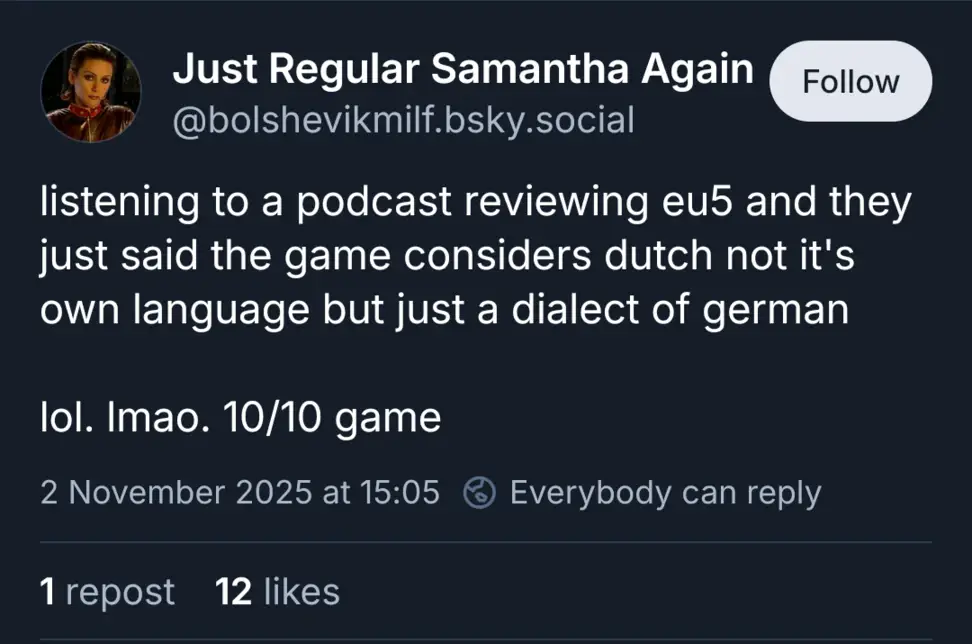
Early Dutch was actually a Middle German dialect that had some elements of Low German, there was basically no difference between the dialect that was/is spoken in the German town of Kleve and the Dutch across the border, and the Kleve dialect was/is just another in a gradient of similar dialects in the area. And yes, High German is distinct from Low German, but Low German is not less German than High German; if anything, today's Standard German is mostly based on Middle German dialects such as Obersächsisch (Upper Saxon, unrelated to the Low German-speaking Saxons), with some pronounciation elements from both Low German and High German.
Calling Standard German "Hochdeutsch", though common in colloquial German, is a misnomer and doesn't really correspond to the linguistic categories of Low, Middle and High German.
I'm not suggesting that Low German is any less German than High German. I just don't think grouping them together makes sense linguistically.