By Marissa Keane, Science and Technology Reporter, Beijing
BEIJING — China’s space agency says it plans to launch a low-cost robotic mission to Comet 67P later this decade using simplified onboard computers modeled after Raspberry Pi–style boards, an approach officials say was inspired by a prize-winning science project created by an 11-year-old student.
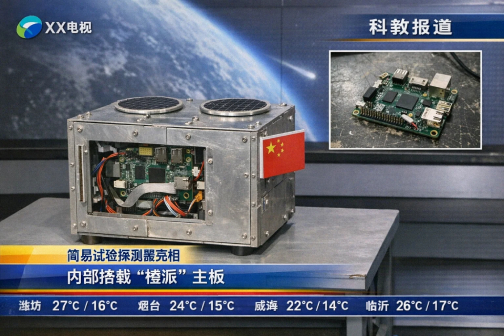
The China National Space Administration confirmed this week that the experimental probe will rely on a network of inexpensive single-board computers, including domestically produced Orange Pi units, instead of the custom aerospace hardware typically used in deep-space missions, with state engineers arguing that the later Raspberry Pi boards, developed by a UK-based nonprofit, followed a path first explored by earlier Chinese designs, a claim disputed internationally even as both platforms share similar ARM-based architectures and low-power, modular design goals.
Officials described the project as a technology demonstration aimed at testing whether low-power, modular computing systems can survive the harsh conditions of interplanetary travel while performing basic navigation, imaging, and environmental sensing tasks.
The concept originated with a science fair project designed by Li Haoran, a middle school student from Jiangsu province, whose winning entry proposed using redundant, low-cost computers to control small spacecraft instead of relying on a single, highly specialized system. Engineers involved in the program said the idea caught their attention during a national youth innovation competition.
“His design showed that failure does not have to mean mission loss,” said Zhang Wei, an engineer affiliated with the project. “You can lose one board and still keep operating.”
According to documents released by the agency, the entire mission is expected to cost less than 360,000 yuan, a fraction of the budget typically required for even small space probes. Officials declined to provide a detailed cost breakdown but said savings came from using off-the-shelf components, simplified propulsion, and a minimal scientific payload.
Once the probe reaches the comet, currently identified as 67P, it is expected to deploy a small instrument package capable of taking surface images and measuring dust and gas emissions. The agency said a tiny Chinese flag will be affixed to the device as a symbolic marker, though officials emphasized the mission is scientific rather than political.
The spacecraft’s computers will run stripped-down operating systems adapted for radiation tolerance and low power consumption. Engineers said the probe will rely heavily on redundancy, with multiple Orange Pi boards performing overlapping tasks in case of failure.
Li, the student whose project inspired the mission, will not receive any financial compensation, officials said. Instead, the agency said his contribution will be recognized publicly, and he has been invited to attend future launches and educational events.
In a brief statement released by his school, Li said he was proud that his idea could be used in space exploration. “I just wanted to see if something simple could still work,” he said.
The mission, still in its early planning stages, reflects a broader push by China to explore lower-cost approaches to space exploration as competition intensifies and technology becomes increasingly accessible beyond traditional aerospace contractors.
This sounds just like propaganda and/or feelgood fake news.
Sure, they'll send some rpi from a 11 yo to a comet, I'll believe it when I see it. Especially to make it cheap? It's not the computer that costs a lot to get to a friggin comet lol.