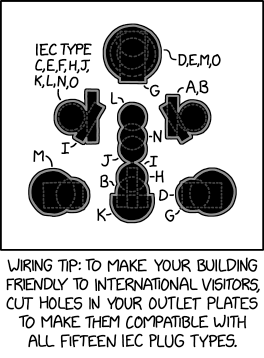
xkcd #3186: Truly Universal Outlet
Title text:
Building Inspectors HATE This One Weird Trick
Transcript:
Transcript will show once it’s been added to explainxkcd.com
Source: https://xkcd.com/3186/
A community for a webcomic of romance, sarcasm, math, and language.
xkcd #3186: Truly Universal Outlet
Title text:
Building Inspectors HATE This One Weird Trick
Transcript:
Transcript will show once it’s been added to explainxkcd.com
Source: https://xkcd.com/3186/
The problem with USB-A is that well, it has to have no problems.
Ramblings
What I mean by that is, for USB to be a 'universal' serial bus it has to keep legacy support while still allowing the standard as a whole to keep up with new tech, and there's just no sane way to do that on one plug type.As for why type C is the way it is:
The USB Implementers Forum decided that adding more pins to the original format (type A) was a dead end (no way to keep backwards compatibility after a point), and the only way foward was to make type A a 'legacy' port while a new connector would take over as the main/modern one.
The forum decided that to make that happen type C has to be more decoupled from type A then previous connectors.
Since the most profitable market for electronics is the mobile one, that's what they aim for with type C. (And because all the previous mobile USB types sucked, especially the micro).
Also probably atleast some if not most of the forum members wanted planned obsolescence, it's goverened by tech companies after all.
Still, type C and the 4.0 standard in general is pretty good at doing what it was meant to do.