Maple Syrup

123 readers
13 users here now

A community for maple syrup makers and maple syrup lovers. Makers from the one bucket on a spile crowd to serious hobbyists to commercial producers are welcome. Post pictures, ask questions, tell us how your season is going.

You may also be interested in:

Maple_Engineering

RULES:

  1. All Lemmy.ca rules apply here.

  2. Everyone (see rule 98) is welcome.

  3. If you’ve seen a question 100 times answer it the 101st time or ignore it. Even better, write a complete, detailed answer and suggest that the mod(s) pin it to the community.

[Did you actually think there were 98 rules?]

  1. If you present something as fact and are asked to provide proof or a source provide proof or a source. Proof must be from a reliable source. If you fail to provide proof or a source your post or comment may be removed.

  2. Don’t be a dick. Yes, this is a catch-all rule.

  3. The mod(s) have the final say.

founded 2 years ago
MODERATORS
1


I have a pair of 9" tablets above my desk in my office so that I can monitor and control the machine room while I'm doing my day job. This is a pair of screenshots from the two tablets as they are right now. The system is not running and the measurements are all wrong. I was sending measurements manually to test my MQTT broker. I'm running Mosquitto Broker on my shed notebook. The tablets are running MQTT Dash.

I've been considering publishing this information to a public MQTT server so that other people can run this MQTT dashboard and watch my system in real time.

If anyone wants an explanation of any of these widgets are information about how these data points are collected please feel free to ask.

2


This controller is based on a pair of custom boards that I designed, had manufactured, and assembled. The main board uses an Arduino MEGA2560 Pro and an ESP32. The MEGA2560 runs the machine and the ESP32 acts as a WiFi modem that the controller uses to send MQTT messages.

The top section of this controller is the mains entry, a 12VDC power supply and a 5VDC power supply. The next section down is the PLC that does all the work and a 24VDC power supply that I added later but didn't have room for in the power section above.

On the bottom the left section is analog inputs, the middle section is digital inputs, and the right hand section is digital outputs, mostly using solid state relays.

The box at the bottom of the right section is a driver for a motorized ball valve that I'm planning to use to replace the air solenoid on the vacuum releaser I will eventually replace the vacuum solenoid as well.

The code on the MEGA2560 is written in Bascom AVR, a compiled AVR BASIC. I'm moving away from BASCOM to Great Cow BASIC because the guy who wrote Bascom AVR had a hissy fit when I found a problem in one of the libraries and asked too many question. He cancelled my license and banned me from the forums. Don't use BASCOM AVR, the guy is a dick.

Great Cow BASIC is cross platform and supports AVRs, PICs, and LGTs (Chinese knockoffs of the AVR chips.)

The code for the PLC is around 8,000 lines.

The code for the ESP32 is written in C++.

3


This is my vacuum releaser. I built it from 12" PVC watermain that I pulled out of the garbage pile at a local construction company, aluminum that I bought at my local metal supply company, lexan that I bought and had machined at a local plastic supply company, and blumbing that I bought on Ebay, Amazon, AliExpress, and at local hardware stores. The large white pipe and the clear check valves are from CDL.

I spent the day today cleaning everything, replacing a couple of o-rings, and putting the machine back together. I had a big vacuum leak that it took me a while to find but I eventually managed to get the main releaser chamber down to 26.5 inhg.

4


I made a video tour of the maple syrup system a few years ago.

5


I ordered a bunch of 316 stainless steel plumbing parts from McMaster-Carr and picked up a few from Wolseley. These are the parts I need to connect up the new 4040 RO membrane.

The black piece at the bottom is the end of the 4040 RO housing. In the back is a 1/2" x 2" nipple to a 1/2" 90. This is the permeate outlet. Permeate is the clean water which I give back to the trees by sending it out onto the ground outside of my sugar shack. In the front is a 1/2" x 4" nipple to a 1/2"-1/4"-1/2" reducing T. This one is for a pressure gauge. Next is a 1/2" x 2" nipple to another reducing T. This one is for a pressure transducer. Then another 1/2" x 2" nipple to the Hikelok pressure relief valve. The drain on the valve is where the concentrate comes out. In a normal, domesic household RO system the permeate is what you drink and the concentrate is what you throw away. In a maple syrup system you throw away the permeate and save the concentrate.

With my old system I could take the sugar content from around 3% to around 10%. That makes a big different to your yield over the course of a day.

All the joints were taped with the correct teflon tape.

6


One of the things I have to do in the late winter is look for animal damage to my lines. I suspect that this was done by a while tailed deer.

I had o cut out a section of the pipe and replace it. The roll of tube I'm working with this year is blue. I used a pair of flat hooks to make the splice.

7


These are my 5/16" tubing insertion plyers. They have a pair of vice grips with a split, threaded rod adapter to grip the tubing and a pair of fingers to hold the fitting. I've modified them to make them line up a bit better for the way I use them. I'm thinking about taking off the plate with the fingers and making the slot smaller to better fit the fittings I use. This tool is an absolute must have if you're going to build a vacuum tube system.

I bought these at CDL (catalog)but it doesn't look like they sell this model any more. The closest one I see in the catalog is pn 6623157 which has an added knife for some reason.

8


I have begun the process of getting my system ready for the sugaring season.

First, a bit of explanation. I've been away from the hobby for three years. Two years ago the winter and spring weather were not good in our area. The season lasted for about a week. It takes me a solid two weeks to get setup and two weeks to tear down. A one week season doesn't make it at all worthwhile.

Last year I was just finishing six months of chemo for Hodgkins Lymphoma and was too weak to tromp through the woods on snowshoes.

This year we've had a great winter (from a maple syrup perspective.) We've had LOTS of snow and lots of very cold temperatures.

So, I've been spending time in the woods freeing up my lines (many were down because of fallen trees and branches) and doing repairs. All but six of my lines are now up and ready to vacuum test. Two of the remaining six are up but in need of major repairs. Two are short and look ready to go. They will only need inspections. The other two are longer and have lines down. I will be working on getting those six up and ready to go this afternoon.

I quit yesterday late afternoon because I didn't have any taps (spouts) in my tubing bucket. I have struggled to find my tools and fittings after three years. I had decided that I needed to make a trip up to CDL in Perth to buy taps and flat hooks. (I use the flat hooks to anchor the lateral lines to the wire supporting the main line to remove the stress on the saddle and to give me a loop that makes it really obvious if there is a leak on the lateral line.) This morning I decided to take another look and found a milk crate with a bag each of health Ts, end of line hooks, flat hooks, and taps.

Thank you past me for buying lots of supplies!

In this photo are a 5/16" MAXFlow end of line adapter (pn 66265099), a 5/16" MAXFlow Health T (pn 660300099), a 5/16" MAXFlow flat hook (pn 66303099), and a 5/16" MAXFlow spout (pn 66090516).

All parts are from CDL (catalog).

9


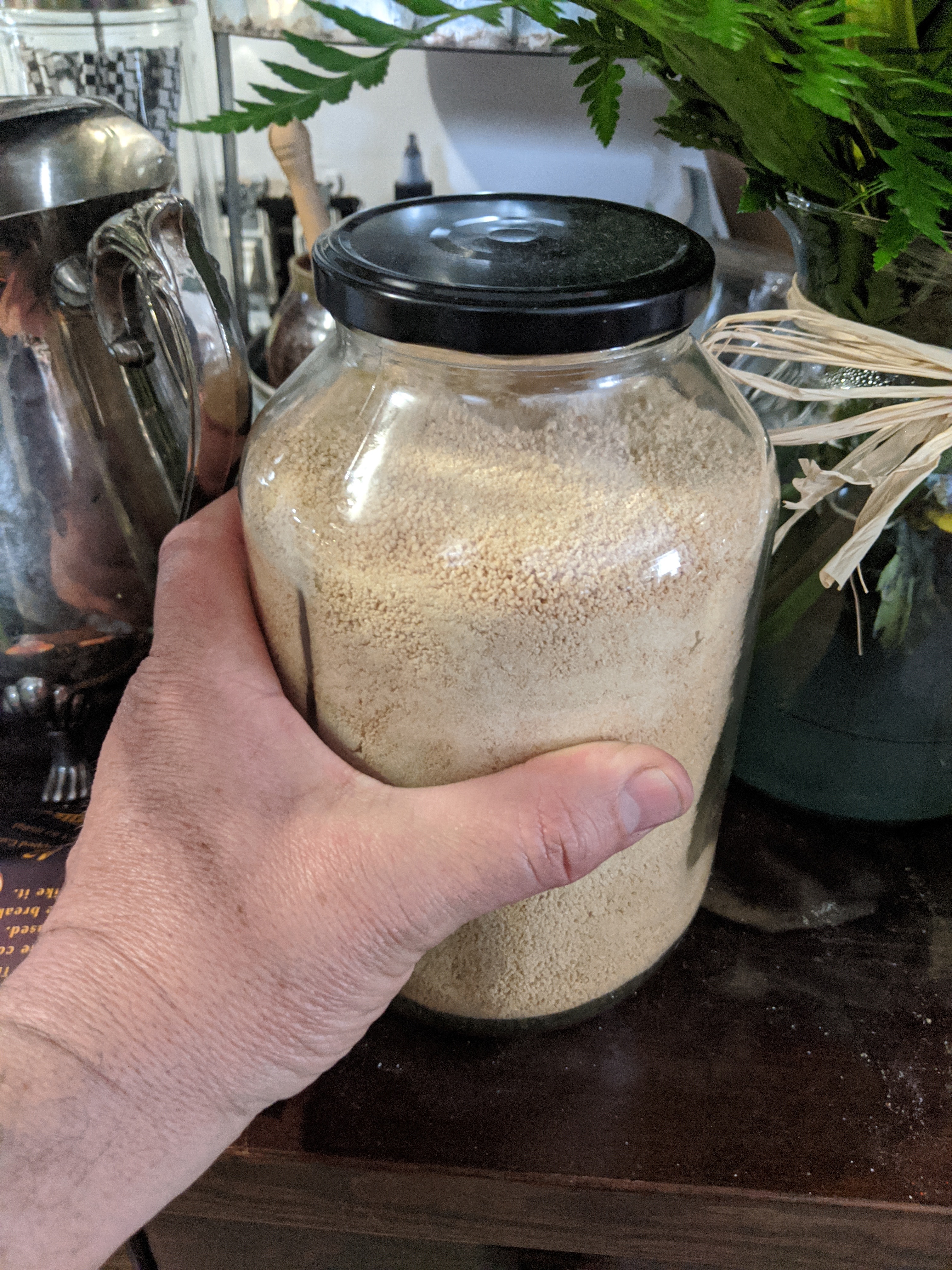
When you're a maple syrup producer you sometimes get to the next maple syrup season with maple syrup still on hand. When that happens at our house my wife boils it down carefully to make maple sugar.

She has this jar sitting on her coffee table so that she can use it in her coffee in the morning. We use it for baking, candy and ice cream making, and to add some extra depth of flavor to savory dishes.

10


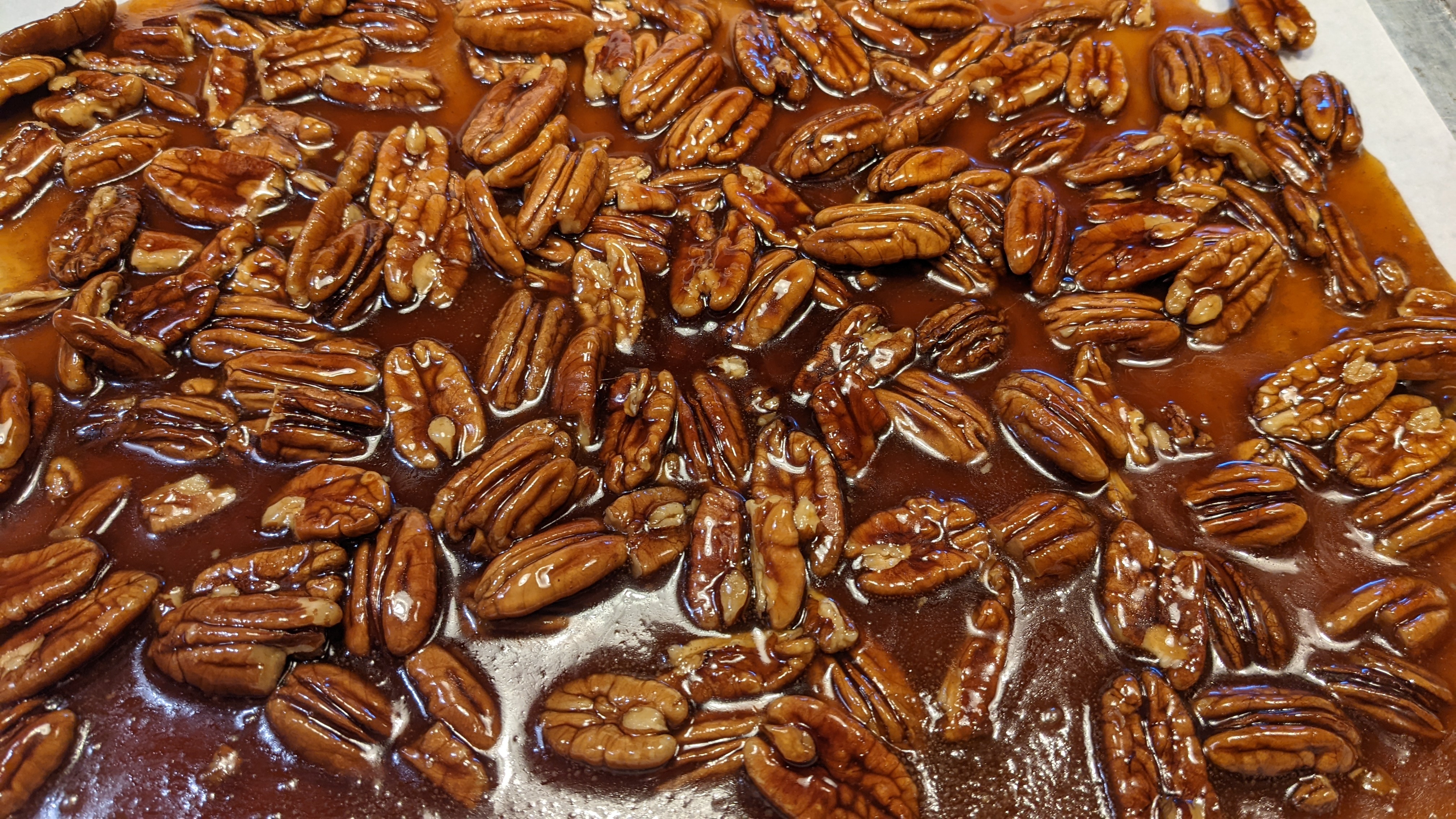
Sometimes when I'm sitting on the couch and start to feel a bit snackish for something sweet and salty I make this stuff.

I throw a bunch of pecan halves into a frying pan, add a bunch of maple syrup (not quite to cover the nuts, a splash of vanilla (preferably Madagascar Bourbon Vanilla in bourbon, I love the flavor), and a healthy pinch of salt.

Then...I turn on the first and give it a mix until everything is dissolved. I carefully boil off the water until it starts to dry and and get really sticky then I turn it out onto a piece of baking paper and let it cool down.

This is the end result. The matrix of this confection is solid maple sugar.

You can add butter, too, but that tends to make it more chewy. You can add a bunch of butter and some heavy (whipping) cream and you end up with @$% delicious ice cream sauce.