Hackaday

76 readers
0 users here now

Fresh hacks every day

founded 5 months ago
MODERATORS
1


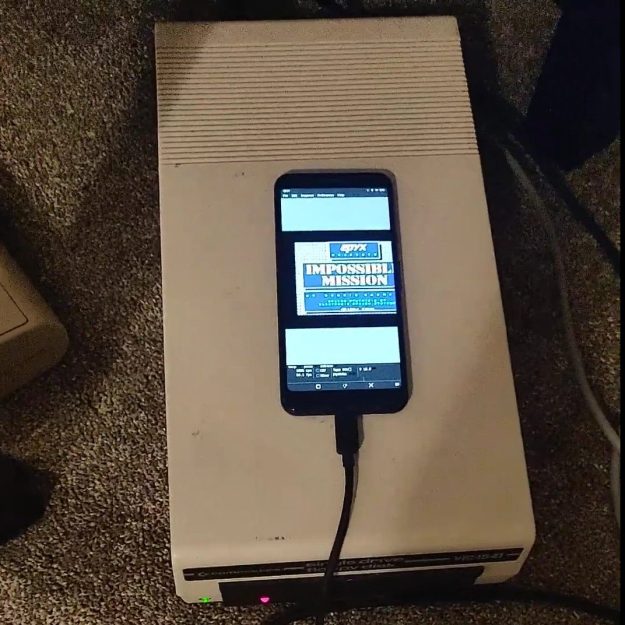
It all started with a sarcastic comment right here on Hackaday.com: ” How many phones do you know that sport a 5 and 1/4 inch diskette drive?” — and [Paul Sanjay] took that personally, or at least thought “Challenge accepted” because he immediately hooked an old Commodore floppy drive to his somewhat-less-old smartphone.

The argument started over UNIX file directories, in a post about Redox OS on smartphones— which was a [Paul Sanja] hack as well. [Paul] had everything he needed to pick up the gauntlet, and evidently did so promptly. The drive is a classic Commodore 1541, which means you’ll want to watch the demo video at 2x speed or better. (If you thought loading times felt slow in the old days, they’re positively glacial by modern standards.) The old floppy drive is plugged into a Google Pixel 3 running Postmarket OS. Sure, you could do this on Android, but a fully open Linux system is obviously the hacker’s choice. As a bonus, it makes the whole endeavor almost trivial.

Between the seven-year-old phone and the forty-year-old disk drive is an Arduino Pro Micro, configured with the XUM1541 firmware by [OpenBCM] to act as a translator. On the phone, the VICE emulator pretends to be a C64, and successfully loads Impossible Mission from an original disk. Arguably, the phone doesn’t “sport” the disk drive–if anything, it’s the other way around, given the size difference–but we think [Paul Sanja] has proven the point regardless. Bravo, [Paul].

Thanks to [Joseph Eoff], who accidentally issued the challenge and submitted the tip. If you’ve vexed someone into hacking (or been so vexed yourself), don’t hesitate to drop us a line!

We wish more people would try hacking their way through disagreements. It really, really beats a flame war.


From Blog – Hackaday via this RSS feed
2


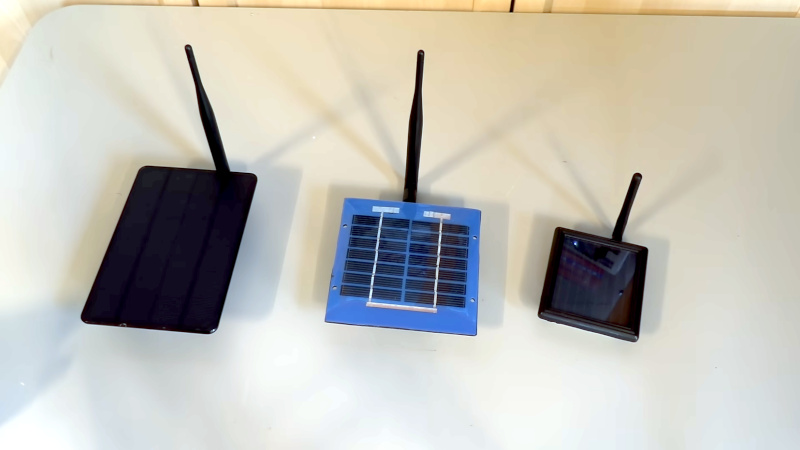
A Meshtastic node has been one of the toys of the moment over the last year, and since they are popular with radio amateurs there’s a chance you’ll already live within range of at least one. They can typically run from a lithium-ion or li-po battery, so it’s probable that like us you’ve toyed with the idea of running one from a solar panel. It’s something we have in common with [saveitforparts], whose experiments with a range of different solar panels form the subject of a recent video.

He has three different models: one based around a commercial solar charger, another using an off-the-shelf panel, and a final one using the panel from a solar garden light. As expected the garden light panel can’t keep an ESP32 with a radio going all day, but the other two manage even in the relatively northern climes of Alaska.

As a final stunt he puts one of the nodes out on a rocky piece of the southern Alaskan coastline, for any passing hacker to find. It’s fairly obviously in a remote place, but it seems passing cruise ships will be within its range. We just know someone will take up his challenge and find it.


From Blog – Hackaday via this RSS feed

3


Some readers may recall the Lynx-R1 headset — it was conceived as an Android virtual reality (VR) and mixed reality (MR) headset with built-in hand tracking, designed to be open where others were closed, allowing developers and users access to inner workings in defiance of walled gardens. It looked very promising, with features rivaling (or surpassing) those of its contemporaries.

Founder [Stan Larroque] recently announced that Lynx’s 6DoF SLAM (simultaneous location and mapping) solution has been released as open source. ORB-SLAM3 (GitHub repository) takes in camera images and outputs a 6DoF pose, and does so effectively in real-time. The repository contains some added details as well as a demo application that can run on the Lynx-R1 headset.

The unusual optics are memorable. (Hands-on Lynx-R1 by Antony Vitillo)

As a headset the Lynx-R1 had a number of intriguing elements. The unusual optics, the flip-up design, and built-in hand tracking were impressive for its time, as was the high-quality mixed reality pass-through. That last feature refers to the headset using its external cameras as inputs to let the user see the real world, but with the ability to have virtual elements displayed and apparently anchored to real-world locations. Doing this depends heavily on the headset being able to track its position in the real world with both high accuracy and low latency, and this is what ORB-SLAM3 provides.

A successful crowdfunding campaign for the Lynx-R1 in 2021 showed that a significant number of people were on board with what Lynx was offering, but developing brand new consumer hardware is a challenging road for many reasons unrelated to developing the actual thing. There was a hands-on at a trade show in 2021 and units were originally intended to ship out in 2022, but sadly that didn’t happen. Units still occasionally trickle out to backers and pre-orders according to the unofficial Discord, but it’s safe to say things didn’t really go as planned for the R1.

It remains a genuinely noteworthy piece of hardware, especially considering it was not a product of one of the tech giants. If we manage to get our hands on one of them, we’ll certainly give you a good look at it.


From Blog – Hackaday via this RSS feed

4


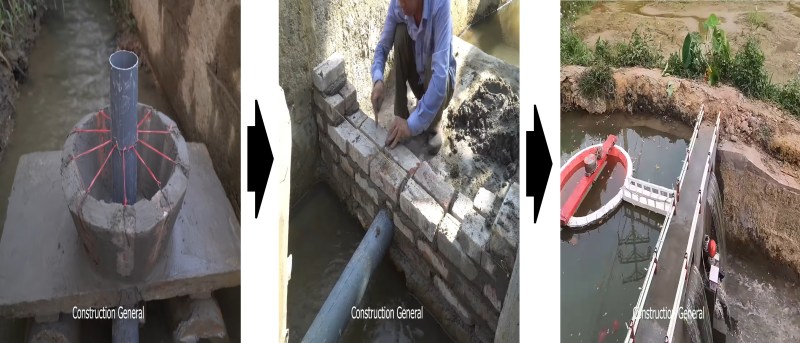
Three stages of the dam construction

Over on his YouTube channel [Construction General] shows us how to convert a drain into a hydropower facility. This type of hydroelectric facility is known as a gravitation water vortex power plant. The central structure is a round basin which includes a central drain. The water feeds into the basin through a series of pipes which help to create the vortex which drives the water turbine before flowing out the drain.

To make the facility [Construction General] starts by laying some slabs as the foundation. One of the slabs has a hole to which the central drain pipe is attached. Bricks and mortar are then used to build the basin around the drain. A temporary central pipe is used for scaffolding along with some strings with hooks attached to hold the bricks and mortar in place for the basin. Integrated into the top half of the basin are fifteen inlet pipes which feed in water at an angle.

The next step is to build the dam wall. This is a bricks and mortar affair which includes the drain in the bottom of the wall and two spillways at the top. The spillways are for letting water flow out of the dam if it gets too full. Around the drainage in the dam wall a valve is installed. This valve is called the low-level outlet or the bottom outlet, and in this case it is a sluice, also known as a slide gate, which can be raised or lowered to control the rate of flow through the turbine.

Once the basin is complete and the low-level outlet is in place the scaffolding is removed. The basin is then painted, pink on the inside and white around the top. A turbine is constructed from various metal pieces and installed into the basin. The turbine is attached to a generator which is fixed atop the basin. The apparatus for operating the low-level outlet is installed and the dam is left to fill.

Hydropower is a topic we’ve covered here at Hackaday before, if you’re interested in the topic you might like to check out A Modest But Well-Assembled Home Hydropower Setup, Hydropower From A Washing Mashine, or Bicycle Hub Hydropower.


From Blog – Hackaday via this RSS feed