I have a novel ¼ written and this is not the setting but it's a foreign country in the world.
Concept
North Atlantic island cultures are actually small and limited.
What if there were 7× as many islands, packed closer together? That would mean more trade, more cultural interaction, a stronger power. The sea becomes less of a barrier and more of a highway.
Stats
Real life: Faroes+Hebrides+Shetlands+Orkneys+Iceland have about 1400 islands, of which about 10% are inhabited, about 550,000 population, about 115,000km² area, so 4.8 people per km²
Multiply by seven: 9800 islands of which 980 are inhabited, population of 3.85 million, area of 805,000km² (comparable in size to Turkey), population density remains 4.8/km²

Landscape
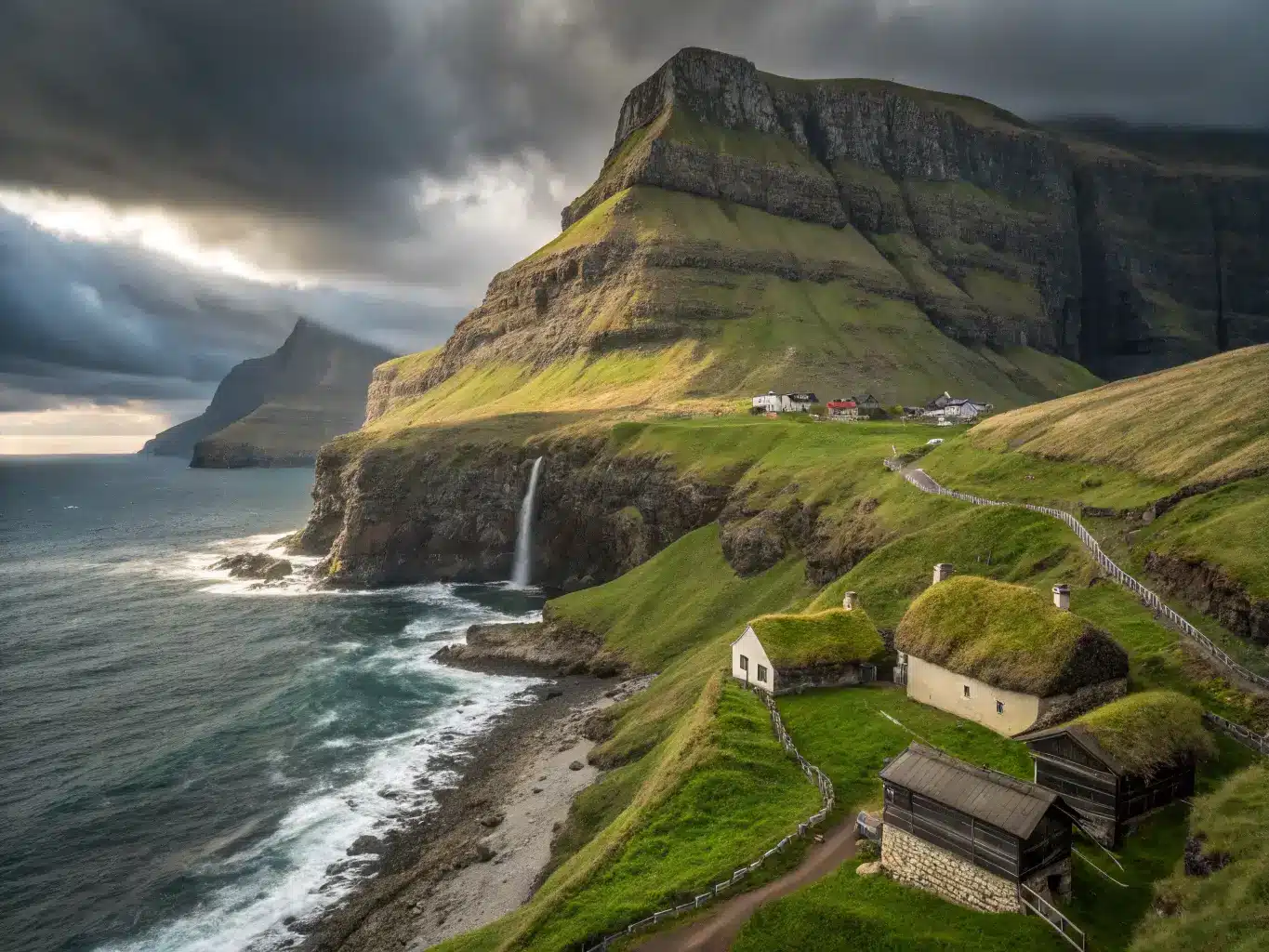
Rugged and rocky with cliffs. Formed by volcanoes 50-60 million years ago and then eroded by glaciers and sea to form dramatic landscapes.
The Faroes have five mountains over 800m which are snow-covered a large part of the year. This proves that pretty big mountains can exist in this geography, and for fiction, we can push this up to 1000m.
Freshwater streams and lakes are rare, most islands do not have them. If you go from an island without freshwater to one with freshwater, it's a different kettle of fish, including trout.
Weather
Generally harsh, windy, cloudy, cold. Excellent wind and tidal power if you're talking about 21st-century tech level. Wind-power can also be harnessed centuries earlier, of course.
If you want to write micro-climates (like Summerisle in The Wicker Man) that is very realistic because of the way currents, mountains, and winds interact.

Un-sunny. The capital of the Faroes, Tórshavn, has 840 hours of sunshine per year (lowest of any city in the world). Reykjavík has 1368.
Turf houses
The blackhouse is a traditional house with double wall dry-stone walls packed with earth, roofed with wooden rafters covered with a turf weighted with stones.
Inside is a central hearth for the fire, largely fed by turf rather than wood, though it depends on which island. No chimney: the smoke blackens the thatch and preserves it.
The turf houses shelter livestock as well as men; the body-heat helps warm the place.
Icelandic turf houses (torfbæir) are made of timber with the walls and roof covered in turf. Similar æsthetically to the blackhouse, but using less stone; it depends on whether wood or stone is more available on the particular island. (The Faroe islands are treeless; Iceland was 30% forested when discovered.)

Means of production
Fishing and whaling are obviously the main ones. A "Faroese speciality is tvøst og removed, made from pilot whale meat and blubber"
Fresh and dried fish are both important. The drying shed, known as a hjallur, is a standard feature in many Faroese homes. Seabirds (puffins, auks, etc.) are caught in nets and eaten, and their eggs are harvested from their nests.
Edible crab and oyster, horse mussel and brittle star.
Seals are eaten and feature in the folklore and heraldry. Grey seal and harbour seal.
Land agriculture
It's not all fish: geese, ponies, sheep (and sheepdogs), cattle, duck, and pig are important.
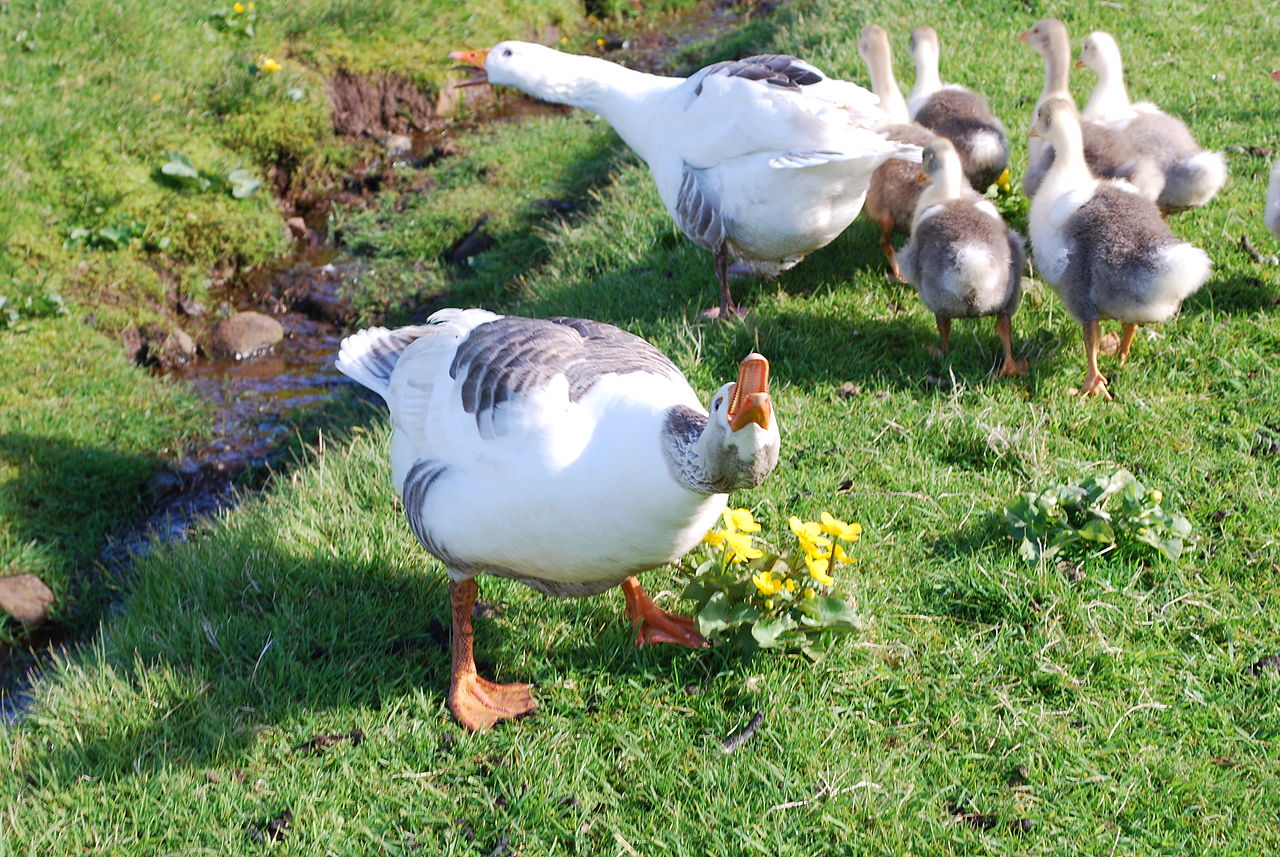
The Shetlands are of course famous for their small strong Shetland Pony. There's a Shetland sheep and a Faroe sheep. There was a boar-like landrace of pig in the Shetlands until 1930. Here's some Faroese geese –
Hardy sheep are basically the best way to turn a yield from marginal rocky land. The islands have heather moors dominated by shrubby heathers (especially calluna vulgaris), with ling, bell-heather, cross-leaved heath, bog myrtle, arctic-alpine plants including alpine pearlwort and mossy cyphal.
Crofting is an agricultural practice in Scottish islands that avoids open-field agriculture and focuses on small (2-5 acre) holdings for vegetables and animal fodder. (Off-topic for worldbuilding: the crofters have applied to the U.N. for indigenous status, so far unsuccessfully. Donald Trump's maternal grandfather was a crofter.)
Sheep + cold means woollen clothes are a key visual signifier of the culture. Look at this beautiful picture of indigenous Greenlandic women:


Those outfits are not precolonial. They are explicitly a product of colonialism. Greenland does not have access to the resources necessary for the production of that garment which made the the inclusion of certain motifs and materials a status symbol, further many of the patterns and symbols involved were based on colonial exchange (And sadly most of the symbolism is dying out)
BUT ALSO, CRUCIALLY. THAT THING ISN'T WOOL. The undershirt tends to be cotton or similar, but the actual shirt is traditionally seal skin. Treated seal skin is the basis for a lot of Inuit clothing, and the traditional treatment process is also dying out because of global warming making it so that the period in which it gets cold enough is shorter and shorter. The skin is coloured in this process and these coloured patches are stitched together to form patterns. The whole thing is then topped off with a bead collar which was originally a status thing where the larger the collar was the higher you were in the social hierarchy but now they all just reach down to the chest. That's the part you're mistaking for a knitting pattern.
If you want to see what being a sheep based economy does to your clothes, look not to the people who only introduced sheep ranching at any scale in 1915, look to England. England was for like hundreds of years a petrostate but for sheep.
Edit: Here is a picture of the "traditional dress" of a north Atlantic Danish colony with sheep.
But it obviously wasn't meant to be about precolonial Greenland....
The claim was that wool producing cultures will use knitwear as a cultural signifier. The picture used as an example was of the (West)Greenlandic national dress.
The culture it is depicting were not native producers of wool until 1915. It is also crucially not a picture of people wearing anything knitted. Not a single person in that picture is visibly wearing anything that is knitted. Not a single visible garment of theirs has wool in it at any stage in the production cycle.
Those pieces of clothing did not develop as a result of a indigenous production of wool, which largely did not exist at the time it came to be, it developed as a result of the influx of exogenously produced goods and still doesn't have any wool in it.
Edit: I am highlighting that not only is this confusing traditional indigenous art forms such as avittat and inuit beadwork for knitting patterns, it is misunderstanding the history of the garment and of Greenland in general.
Edit 2: Incidentally traditional Inuit craftspeople have asked white people to stop mixing up avittat and beadwork and knitting patterns for about a century with no success. I blame no one here for this, I am not saying you are doing anything wrong. I am noting a coincidence about the fact that people just assume based on what they are familiar with (Knit work) rather than what things are (A very unique kind of embroidery)
Not me but k.
I read the post as having almost nothing to do with Greenland. Obviously Greenland has a very different culture (Inuit) to the one described (Norse/Celt/Germanic)
Do you think the words " Look at this beautiful picture of indigenous Greenlandic women:" has no relation to Greenland or Inuit.
seems like a rather woolly issue
You're focusing on one tiny mention rather than the post in its totalitarianism https://www.youtube.com/watch?v=BABL1y5xNxQ&t=49
I found a YouTube link in your comment. Here are links to the same video on alternative frontends that protect your privacy:
he's allowed to criticize as little as one sentence. you're not just (counterfactually) obsessing over that more than he did you're joining forces with someone else doing it with all the grace of a smug piece of shit. it would save more face to confess to some colonial bigotry.
lots of salt spraying around
which one are you again?
I am just a simple lemmy user trying to navigate these rocky waters.
you chuds are so predictable. item#2.5 inevitable response-the innocent average joe act. clockwork.
threads like these can keep you in the dark for months at a time