Viral Magazine
89 readers
2 users here now
If you believe anything you read anymore, that’s on you, because the entire information economy has turned into a warm trough of algorithmic slop and we’re all eating from it whether we admit it or not.
Information doesn’t move because it’s true. It moves because it feels right, strokes an ego, lights a fuse, or gives someone something to point at and say, “Told ya so!”
Rules: Don't be a jerk. I'm a jerk mod, but that doesn't mean you're allowed.
This community exists in the gap between how news is written and how it's consumed. This is how narratives circulate now. Read closely. Or scroll past. Either way, the machine keeps running.
founded 6 months ago
MODERATORS
2
14
Woman Offers Free Foot Care to Homeless, Later Sells Jewelry Made From Toenail Clippings
(reddthat.com)
By Philip Rhoeri, Associated Press, Greendale Press News
PORTLAND, Ore. — Homeless advocates and social service groups are criticizing a local woman’s outreach program after learning that toenail clippings collected during free foot care sessions are later used to make and sell jewelry, a practice they describe as exploitative and deeply troubling.
The woman, a self-described artist and wellness volunteer, has for more than a year offered free toenail trimming and basic foot care to unhoused people in parks and encampments across the city. Promotional materials for the program describe it as a harm-reduction effort aimed at preventing infection and improving mobility.
The controversy surfaced after jewelry items advertised online as “human-derived adornments” were traced back to the same individual. The listings describe necklaces, rings, and earrings made from “sanitized, ethically sourced human keratin,” with prices ranging from $120 to more than $400.
“It feels deceptive,” said Marla Jensen, director of a nonprofit homeless outreach coalition in Portland. “People accepted a medical service in a vulnerable moment. They did not consent to becoming raw material for a product.”
Several advocates said they were particularly disturbed by what they described as a lack of informed consent. Some clients interviewed said they were unaware their toenail clippings were kept at all.
“I thought she threw them away,” said one man who receives services near downtown. He asked not to be named out of fear of losing access to care. “Nobody said anything about jewelry. Sounds wrong.”
The woman behind the program defended her actions in an interview, saying the jewelry is meant to challenge ideas about value, waste, and dignity. She said that a portion of proceeds is donated to homeless-related causes.
“I’m turning something discarded into something meaningful,” she said. “Toenail clippings can be beautiful and sexy. It's a thrill to me. And some of the money goes back into the community.”
She declined to specify what percentage of profits are donated or which organizations receive the funds, citing privacy concerns. Financial records reviewed by the Greendale Press show small donations to at least one mutual aid group, though advocates say the amounts do not align with the revenue suggested by online sales.
“This is not transparency,” Jensen said. “This is branding.”
Medical professionals also raised concerns, noting that even sterilized human biological material raises ethical questions when used commercially.
“There are strict rules around the use of human tissue,” said Dr. Alan Rivera, a podiatrist familiar with outreach medicine. “Even when the health risk is low, consent is non-negotiable.”
City officials said they are reviewing whether the practice violates health codes or consumer protection laws. No charges have been filed, and the foot care sessions continue.
For now, advocates say the issue goes beyond legality.
“This isn’t about art,” Jensen said. “It’s about power, vulnerability, and who gets to profit from whose body.”
The woman said she plans to continue both the outreach and the jewelry line, adding that criticism reflects discomfort with unconventional art rather than wrongdoing.
As scrutiny grows, outreach groups are urging people seeking foot care to ask more questions before accepting services, while city officials weigh whether clearer rules are needed to prevent similar situations.

3
11
Doctors Alarmed as Reports Surface of Affluent Diners Consuming Human Tumor Tissue for Status
(reddthat.com)
By Brett O’Keefe, Associated Press, Wisconsin Daily News
TOKYO and SHANGHAI — Health authorities in Japan and China are investigating reports of a clandestine dining trend among wealthy elites involving the consumption of discarded human tumor tissue obtained from private medical facilities, a practice doctors describe as disturbing, unethical, and medically unjustified.
According to multiple physicians and public health officials, the alleged trend centers on diners seeking out what they believe to be an extreme status symbol. Much like high-risk delicacies such as pufferfish, the appeal lies in proximity to danger, rarity, and taboo rather than any culinary value.
“There is no scientific evidence that eating tumor tissue transmits cancer,” said Dr. Kenji Morimoto, an oncologist at a Tokyo university hospital. “But that does not mean it is safe, sanitary, or acceptable. This is medical waste. It is not food.”
Investigators say the tissue is rumored to originate from private clinics and cosmetic oncology centers, where small benign or malignant tumors are removed during procedures and then illegally diverted before disposal. Officials stressed that no licensed hospital has been shown to be involved.
In Shanghai, the municipal health commission issued a statement acknowledging awareness of “online discussions and unverified reports” related to the practice, adding that any handling of human biological waste outside approved protocols violates Chinese law.
“We are treating this as both a public health issue and a criminal matter,” the statement said.
Several doctors interviewed said the diners appear motivated by exclusivity rather than belief in health benefits. In private chat groups and invitation-only supper clubs, participants allegedly describe the experience in language borrowed from luxury tasting culture, focusing on provenance, preparation, and shock value.
“It’s about bragging rights,” said a Beijing-based physician who requested anonymity due to concerns about professional repercussions. “The risk itself becomes the luxury.”
Medical experts emphasized that while cancer is not contagious through ingestion, consuming human tissue poses risks of bacterial contamination, bloodborne pathogens, and exposure to chemical preservatives or trace medications.
“There is also the ethical dimension,” said Dr. Mei Lin, a bioethicist at Fudan University. “Human tissue is not a commodity. Treating it as one erodes basic norms that protect patients and medical workers alike.”
Authorities in both countries said they have not confirmed any illnesses directly linked to the alleged practice. Still, officials warned that enforcement actions would follow if evidence of trafficking or improper disposal is found.
“This is not cuisine,” Morimoto said. “It is spectacle built on a misunderstanding of medicine and a disregard for human dignity.”
As of now, investigators say the reports remain limited in scope, but they are urging private clinics to review waste handling procedures and urging the public to avoid engaging in what officials called a “dangerous and deeply misguided trend.”

4
By Keith Ridler, Associated Press, Boise, Idaho
BOISE, Idaho — An Idaho entrepreneur is giving new life to hair swept from barbershop and salon floors, collecting discarded clippings and spinning them into yarn he says can help reduce waste and cut down on the use of synthetic fibers.
Mark Ellison, a former mill worker from eastern Idaho, began the project last year after noticing how much hair local shops threw away each week. He now partners with more than a dozen barbershops and salons, picking up sealed bags of hair that would otherwise end up in landfills.
“Hair is a natural fiber. It grows fast, it’s strong, and it breaks down naturally,” Ellison said. “We already have too many plastics and synthetics floating around that never really go away.”
Ellison washes, sterilizes, and processes the hair in a small workshop behind his home before blending it into spinnable fiber. The finished yarn has a coarse but durable texture, similar to wool blends, and can be knitted or woven into clothing and accessories.
He regularly wears the results himself. On a recent afternoon, Ellison showed off a dark knit beanie and a long-sleeve shirt made entirely from the recycled hair yarn. He said the garments hold up well in cold weather and become softer with use.
“It surprises people when I tell them what it’s made of,” he said, noting that he's bald and the beanie keeps his head warm. “But once they feel it, they get it.”
Environmental advocates say projects like Ellison’s highlight alternatives to synthetic fibers such as polyester and acrylic, which are derived from fossil fuels and shed microplastics as they break down.
“Natural fibers that biodegrade are an important part of reducing long-term waste,” said Laura Kim, a sustainability researcher based in Boise. “Hair is unconventional, but it’s renewable and already part of the waste stream.”
Ellison said he hopes to eventually work with a local textile mill to scale up production of the yarn, though the project is still in its early stages. He said the broader goal is to encourage people to rethink everyday waste and reconsider how clothing materials affect the environment.
“We sweep this stuff up without thinking about it,” he said. “But it doesn’t have to be trash. Sometimes the solution is already on the floor, and we just walk right past it.”

5
7
Chinese Space Agency Plans Comet Probe Using Raspberry Pi–Style Boards Developed From Youth Science Project
(reddthat.com)
By Marissa Keane, Science and Technology Reporter, Beijing
BEIJING — China’s space agency says it plans to launch a low-cost robotic mission to Comet 67P later this decade using simplified onboard computers modeled after Raspberry Pi–style boards, an approach officials say was inspired by a prize-winning science project created by an 11-year-old student.
The China National Space Administration confirmed this week that the experimental probe will rely on a network of inexpensive single-board computers, including domestically produced Orange Pi units, instead of the custom aerospace hardware typically used in deep-space missions, with state engineers arguing that the later Raspberry Pi boards, developed by a UK-based nonprofit, followed a path first explored by earlier Chinese designs, a claim disputed internationally even as both platforms share similar ARM-based architectures and low-power, modular design goals.
Officials described the project as a technology demonstration aimed at testing whether low-power, modular computing systems can survive the harsh conditions of interplanetary travel while performing basic navigation, imaging, and environmental sensing tasks.
The concept originated with a science fair project designed by Li Haoran, a middle school student from Jiangsu province, whose winning entry proposed using redundant, low-cost computers to control small spacecraft instead of relying on a single, highly specialized system. Engineers involved in the program said the idea caught their attention during a national youth innovation competition.
“His design showed that failure does not have to mean mission loss,” said Zhang Wei, an engineer affiliated with the project. “You can lose one board and still keep operating.”
According to documents released by the agency, the entire mission is expected to cost less than 360,000 yuan, a fraction of the budget typically required for even small space probes. Officials declined to provide a detailed cost breakdown but said savings came from using off-the-shelf components, simplified propulsion, and a minimal scientific payload.
Once the probe reaches the comet, currently identified as 67P, it is expected to deploy a small instrument package capable of taking surface images and measuring dust and gas emissions. The agency said a tiny Chinese flag will be affixed to the device as a symbolic marker, though officials emphasized the mission is scientific rather than political.
The spacecraft’s computers will run stripped-down operating systems adapted for radiation tolerance and low power consumption. Engineers said the probe will rely heavily on redundancy, with multiple Orange Pi boards performing overlapping tasks in case of failure.
Li, the student whose project inspired the mission, will not receive any financial compensation, officials said. Instead, the agency said his contribution will be recognized publicly, and he has been invited to attend future launches and educational events.
In a brief statement released by his school, Li said he was proud that his idea could be used in space exploration. “I just wanted to see if something simple could still work,” he said.
The mission, still in its early planning stages, reflects a broader push by China to explore lower-cost approaches to space exploration as competition intensifies and technology becomes increasingly accessible beyond traditional aerospace contractors.

6
By Lars Kovennium, Viral Magazine
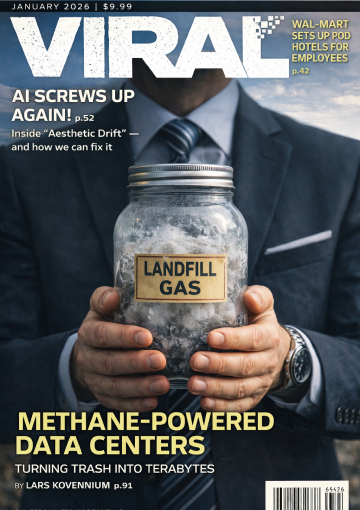
On the edge of a closed landfill outside Des Moines, a low concrete building hums softly behind a chain-link fence. There are no smokestacks, no flares licking at the sky. Instead, a thick pipe snakes out of the trash mound nearby, carrying methane gas that would otherwise seep into the atmosphere. Inside the building, racks of servers blink steadily, processing cloud workloads, video streams, and machine learning jobs.
What started as a few small trials has settled into something more permanent, a business built around capturing landfill methane. It’s a business model, and yes, it literally stinks, which in this case is kind of the point.
Over the past two years, a quiet race has emerged among energy startups and infrastructure companies to build data centers powered directly by captured landfill methane. The pitch is simple. Landfills already produce vast amounts of gas as organic waste decomposes. Instead of burning it off or letting it leak, operators can capture it, clean it, and use it to generate electricity on-site. Data centers, with their constant demand for power, become the perfect customer.
“Landfills are one of the most underused energy assets in the country,” said Aaron Delgado, chief executive of GreenStaX Systems, a company operating three methane-powered data centers in the Midwest. “The gas is there every day. Our servers don’t need sunshine or wind or something that smells good. They just need consistency.”
Methane is a potent greenhouse gas, trapping far more heat than carbon dioxide over shorter timescales. Environmental regulators have long encouraged landfill operators to capture it, often using it to generate electricity for the grid or for nearby industrial facilities. What’s new is the idea of pairing that energy source directly with computing infrastructure.
Data centers are notoriously power-hungry. As demand for cloud services and artificial intelligence grows, so does scrutiny of the industry’s environmental footprint. Hyperscale operators have pledged carbon neutrality, often relying on renewable energy credits and long-distance offsets. Methane-powered data centers offer something more tangible, at least on paper.
“This is one of the rare cases where waste reduction and digital infrastructure actually align,” said Priya Nandakumar, an energy systems researcher at the University of Illinois. “You’re preventing methane emissions and producing useful work at the same time.”
But the model comes with trade-offs.
The amount of methane a landfill produces declines over time. Gas quality can fluctuate. Equipment must be tuned to handle impurities. And critics argue that tying computing infrastructure to landfills risks locking in waste-heavy systems instead of pushing harder on reduction and reuse.
“There’s a danger of creating a perverse incentive,” said Maria Torres, policy director at the Clean Earth Coalition. “If data centers depend on landfill gas, what happens when we succeed at reducing waste?”
Operators counter that the scale remains limited. Even the largest landfill-based installations are tiny compared to hyperscale facilities run by tech giants. Most are designed for edge computing, content delivery, or specialized workloads that benefit from localized infrastructure.
At a site near Fresno, California, GreenStaX engineers walk through a narrow server room where the air smells faintly of metal and ozone. Next door, a bank of generators converts captured methane into electricity, each unit constantly adjusting to shifts in gas flow. Inside the room, the company has leaned hard into reuse. Racks and control stacks are built from refurbished Commodore 64 and Radio Shack TRS-80 machines, stripped down and rewired to handle auxiliary computation, monitoring, and system control tasks.
It’s not the most efficient setup, engineers admit, and it’s more expensive to maintain than modern purpose-built hardware. But with methane power available around the clock, efficiency is less of a constraint. The old machines hum alongside newer servers, part sustainability statement and part practical experiment in seeing how far reclaimed technology can be pushed when energy is cheap and otherwise wasted.
“It’s not glamorous,” said field engineer Luis Ramirez, pausing to take a long drink from a Mountain Dew before setting the bottle down on a workbench. He glanced at it and nodded toward the landfill outside. “That plastic’s going right back into my paycheck sooner or later. Pretty cool, right?”
Ramirez said the appeal is consistency. “I love AI. It’s not going anywhere,” he added, gesturing toward the servers. “If we’re going to keep building bigger models, we’re going to need power sources like this. Trash doesn’t take days off.”
Municipalities have taken notice. Several cities now include data center partnerships in landfill redevelopment plans, seeing them as a way to generate revenue while meeting emissions targets. In some cases, operators pay landfill owners directly for the gas, creating a new income stream for local governments.
The economics are improving, too. Advances in modular data center design allow companies to deploy smaller, standardized units quickly. On-site generation reduces exposure to grid volatility. And as carbon accounting tightens, avoiding methane emissions carries increasing value.
Still, the future of landfill-powered data centers remains uncertain. As renewable energy storage improves and grid infrastructure evolves, methane may lose its appeal. For now, though, the servers keep running, fueled by the slow decay of yesterday’s waste.
“This isn’t a silver bullet,” Nandakumar said. “But it’s a reminder that the infrastructure of the internet is physical. It has to live somewhere. It has to run on something.”
Delgado takes the idea further. He said he envisions methane-powered data centers operating in towns and cities across the country, wherever landfills already exist. The more sites, he argued, the better. As for the smell, he waved it off. “People get used to it,” he said. “You notice it at first, then it just becomes part of the background. Like the internet itself.”
Behind the fence, the landfill sits quietly, doing what it has always done. This time, at least, someone is listening to the gas it gives off, and turning it into computation. And that smells like money.
7
8
9
By Aaron Whitlock, Carnagie Summit Industry Reporter
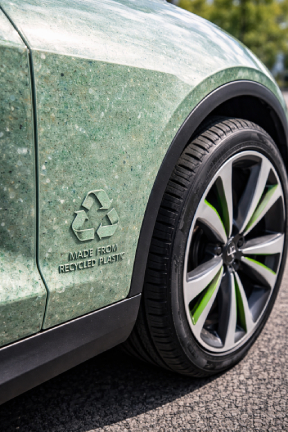
DETROIT. A Midwest startup working with a major beverage recycler has unveiled a prototype electric vehicle whose exterior panels and interior components are made largely from recycled Mountain Dew plastic bottles.
The company, Verdant Motive Systems, says the project began as a materials efficiency study before evolving into a full vehicle prototype. Engineers estimate that roughly 18,000 discarded bottles were processed, cleaned, and reformulated into a reinforced polymer used throughout the car’s body shell, dashboard housing, and wheel well liners.
According to internal testing documents shared with Midston Daily Press, the recycled plastic composite meets current federal safety standards for low speed impact and heat resistance. The material also weighs about 20 percent less than traditional automotive plastics, improving range efficiency for electric vehicles.
Verdant Motive partnered with a regional bottling cooperative to secure a consistent feedstock of post consumer plastics. The bottles were shredded, chemically stabilized, and blended with a binding resin to increase rigidity and reduce odor retention. One engineer confirmed that early test panels “smelled faintly citrusy,” an issue the team says has since been resolved.
Industry analysts note that automakers have quietly explored beverage plastics for years, but branding concerns and supply inconsistencies slowed adoption. This project marks one of the first attempts to publicly tie a recognizable consumer product to vehicle manufacturing.
A spokesperson for the recycling cooperative said the collaboration demonstrates how single use plastics can move beyond clothing fibers and packaging fillers. “Cars last longer than bottles,” she said. “That alone changes the math.”
The prototype vehicle, nicknamed the Verde One, is not slated for commercial release. However, Verdant Motive executives confirmed discussions with larger manufacturers about licensing the material process for use in interior trim and non structural exterior parts.
In a brief technical appendix, engineers note the plastic performed best when molded in the same shade of green as the original bottles. When asked why, one researcher replied that pigment density may play a role, then paused before adding, “Or we just tested that color the most.”
The company plans to publish a full materials study later this year as automakers face increasing pressure to reduce plastic waste without sacrificing durability.