ESP32

402 readers
1 users here now

founded 3 years ago
MODERATORS
1


Components:

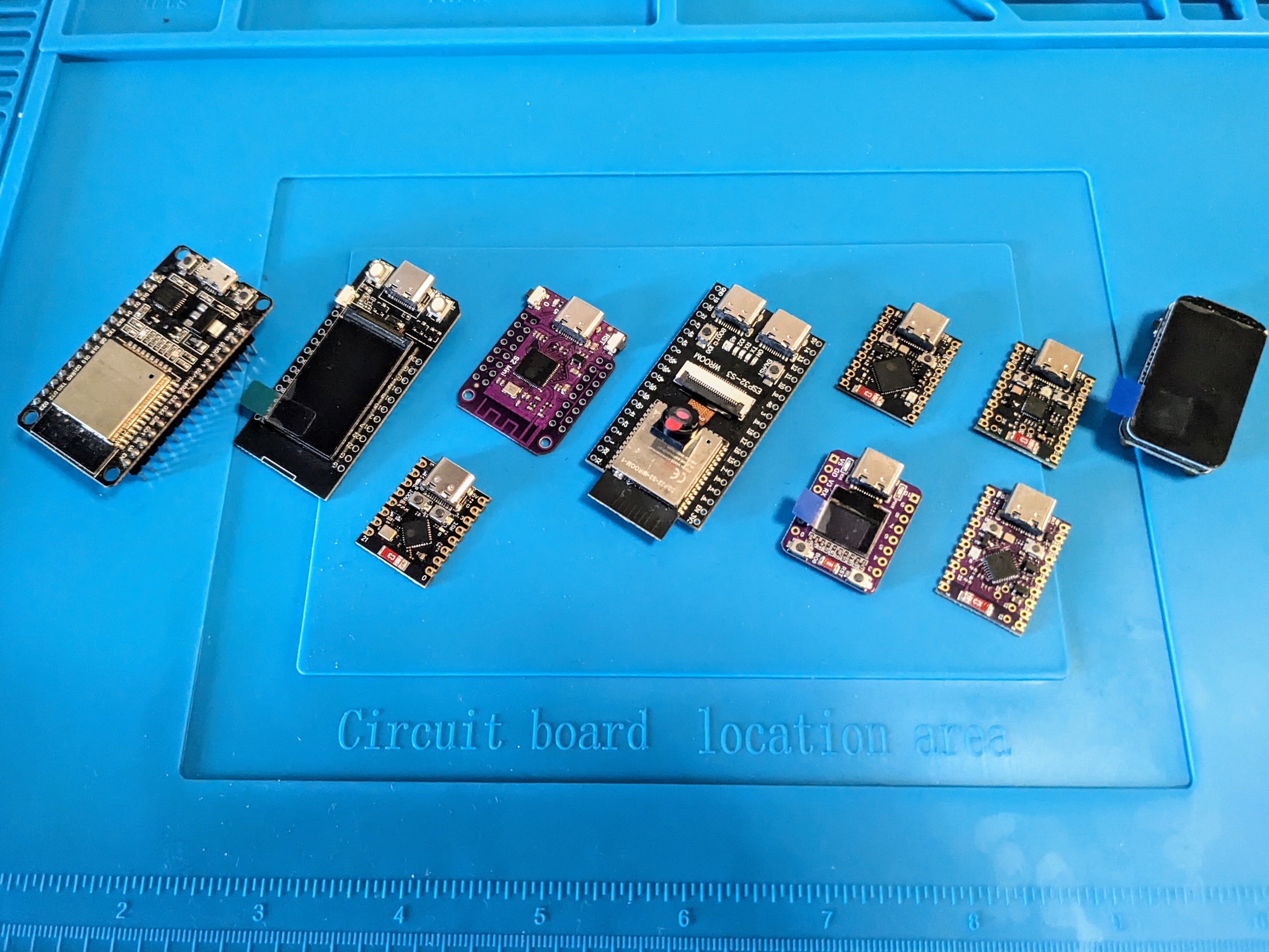
  • ESP32-S3-Zero with RGB LED. I've selected it over more energy efficient ESP32-C6 because bigger chip looks better, and it's placed symmetrically.
  • two CR1220 3V batteries.
  • copper wire from Ethernet cable (single-strand obviously).
  • lead-free solder (it's a ring, don't wear lead on your fingers).
  • hot glue gun, because I could not make a battery holder using just wire.
  • a piece of small diameter heat-shrink tube for copper wire.
  • a jewellery file (optional, only needed if you actually going to wear the thing).

Instructions:

  • flash the firmware first, because batteries will obstruct the USB port.
  • it is recommended to file off all sharp edges on the board before you start soldering, it will be harder to smoothen the edges afterwards without scratching the copper wire.
  • smoothen your wire, wrap it around some finger-size object like a tube of flux, cut the wire spiral into rings.
  • solder wire rings into one side of the board, use every hole except for 5V and GND, and TX/RX on the other side.
  • put the board onto your finger, measure and cut the other side of the wire rings to match your finger size, solder wire rings to the board.
  • Glue two batteries together in sequence, then glue them to the top of the USB connector. Watch out for polarity - CR1220 has positive charge on the body and negative charge on the contact plate, you need to put the negative electrode onto the USB connector.
  • wrap a stripped copper wire around another wire with isolation on it.
  • bend both wires so that the stripped wire will go into 5V hole, and the isolated wire will go into GND and RX holes. The isolated wire is only needed as a mechanical support, because you should not solder another end of 5V wire to the TX or RX hole, or you risk frying the chip.
  • add a piece of heat-shrink tube to the stripped wire. You need to make contact with the battery at the top and prevent the wire from contacting the battery at the bottom. You can try to leave a bit of isolation on the wire, but it's easier to use the tube.
  • solder wires to the board.
  • do not to make a common mistake of connecting 3V3 and GND together, or GND and 5V, like I did. 3V3 wire goes under the board onto the finger, GND wire goes above the board to hold the batteries.
  • keep wire ends from sticking out of the mounting holes when soldering, they are going to scratch you when you wear the ring. You can file them off afterwards, but it's easier to not make them stick out in the first place.

Firmware: https://github.com/pelya/esp32-led-cycle-colors

The only thing it does is cycle LED with random colors. It shuts off power by pressing BOOT button or after 5 minutes. To turn it back on, press RESET button. There's no WiFi, Bluetooth, or LCD screen, but at least the LED is bright.

I did not measure how long will these two batteries last. When they are empty, I'll need to rip off hot glue blobs from the board, which would be pretty easy since I only put hot glue onto metallic surfaces.

And it's absolutely not waterproof, hopefully the finger grease will keep to the underside of the board and won't short the battery.

Full video: https://youtube.com/shorts/QZi4RBir2cE
2


cross-posted from: https://lemmy.ml/post/33469454

(Cross-posting this across several communities in hopes of getting some discussion.)

I'm currently building some indoor climate sensors for my home. My idea is to have temperature, humidity, noise, light, VOC and CO2 readings at a relatively high frequency reporting to my MQTT server.

I am currently setting up some different temperature sensors, and I want to calibrate them (hopefully just a linear offset) and evaluate them on some metrics, such as sensor-to-sensor consistency and accuracy.

To calibrate and evaluate the accuracy, I would need a source of truth, and ideally I would also be able to cycle it through a range of realistic values for the given metric.

What are your strategies to tackling these things? Do you assume the sensors are already well-calibrated and don't bother with this? Do you have a dedicated reader for any sensor value you would want to calibrate?

3


I have a project idea and a bit of reading suggests to me that ESP32 might be the best solution. I have never touched ESP32 or anything similar. I have basic electronics understanding and capability - I built a kit Class D stereo amplifier years ago, do my only electrical work on my motorcycles etc. I'm a retired Unix admin. so am confident I can manage the software and programming aspects.

I have strange voltage issues in my home and want to record voltage over time to see if I can correlate anything that might suggest a cause. I need to be able to measure 0 to about 150VAC. Happy to go into the details of my issues if anyone is curious.

My plan is to go to AliExpress and get a 5 pack of "ESP32 Development Board WiFi+Bluetooth" and a 5 pack of "ZMPT101B AC output voltage sensor".

I'm already running Home Assistant and mqtt so am hoping I can use that as my recording and reporting engine.

My questions:

  • is there anything else I'm likely to need?
  • is there any way to find a good, or avoid a bad, vendor on AliExpress for those components? I don't trust the reviews.
  • there are lots of "getting started" tutorials - any recommendations for a good one appropriate for background?
4


cross-posted from: https://programming.dev/post/24922639

Any of these low-cost ESP32 development boards (ranging from ~$3 to ~$15) can be turned into a fully functional crypto hardware wallet with colibri.diy - ofc fully free and open source

The project is still in the pre-release stage, but if you like tinkering with Arduino & hardware, check out the github repository for the firmware and build instructions.

Please let me know what you think!

5


I recently purchased a WiPhone from wiphone.io and was having fun for about a couple of hours until I accidentally hit the reboot function and now suddenly it seems that the screen is no longer working properly. Now all it seems to do when I power it up is displays the WiPhone logo and flickers a bit and the colours are wrong and then it just displays a white screen. If I press any number keys I can see the dial screen flicker for a second and sometimes I can see the home screen and menu screen flicker once in a while as well. I've successfully flashed the firmware numerous times using the Arduino IDE as well as esptool and it seems as though the firmware of the ESP32 seems to be functioning without any issues that I can tell. The Arduino IDE serial monitor doesn't seem to show any problems when I have it connected via USB while booting up the WiPhone. From what I can tell, it looks to be a screen issue. Any suggestions to how I might be able to fix this issue would be much appreciated. If there is any more information that you would like me to post please let me know.

Thanks

6


cross-posted from: https://feddit.nl/post/26615884

The project is called "Tactility" and its website is https://tactility.one/

You can run ELF binary apps directly from an SD card without restarting or flashing the ROM. There's an SDK for building these apps, but I haven't made an official release yet.

I wrote a blog post with some background information: https://bytewelder.com/posts/2025/01/06/tactility-one-year-later.html

Source code and project files: https://github.com/ByteWelder/Tactility

7
 
 
8


I'm not worried, that the esp is actively powering the USB oort due to an external power source, because I don't use them. But is there a risk that the esp is sorting the power on the USB because of a mistake on my end by for example shorting 5v and Ground? Can it happen for any other reason? For example faulty parts on the esp?

It hasn't happened yet but I am worried that it might happen in the future.

9


I am not much of an EE and I was wondering if there is a place where I can find schematics of popular esp32 dev boards? My hope is that I can do placement and wire routing on a known good schematic. I know that PDF version of the schematic is available and technically it is possible to recreate it in KiCad but I'm hoping to find something in native KiCad format so that I have a good starting point for making custom board shapes.

10


It's a bit sad how deserted this community is, would love to connect more with other makers.

Let's rattle the cage a bit, who of you is here, and what are you working on?

I'll start: A wireless cryptographic keystore & signer. Keys are generated with the hardware RNG and stored AES-encrypted with the user's password, and you can request signatures via BLE.

11
2
submitted 1 year ago* (last edited 1 year ago) by TCB13@lemmy.world to c/esp32@lemmy.ml
12


Howdy, long time lurker!

I was wondering if anyone could give me a hand with trying to pull data from my Harmon Absolute43 pellet stove. Looking at the board, I see an RJ45 connector and thought "seems like a wireshark-like sniffer would do the job".

However, all searches end up looking at networking rather than simple data sniffing. Any ideas as to how to add a "bridge" that also stores the data? From there, I can do the publishing side of things, just the hardware component for me has me scratching my head.

13


cross-posted from: https://lemmy.ml/post/6755708

A micro Erlang VM for embedded devices like ESP32 and Raspberry Pico

14


I am looking for a MicroPython Caldav Package to connect my ESP32 to my Caldav server, e.g. Nextcloud. Did that anybody before?

15


I am looking for an #ESP32 Shield that adds #ZigBee communication to my ESP. Would be great if #MicroPython packages are available. Are there any known projects available, you could reference me?

16
2
pySmartHome (codeberg.org)
submitted 3 years ago by matl@lemmy.ml to c/esp32@lemmy.ml


This is the home of pySmartHome - a MicroPython and ESP32 based private Smart Home under your control.

I use it to read the temperature, humidity and pressure in different rooms.

17


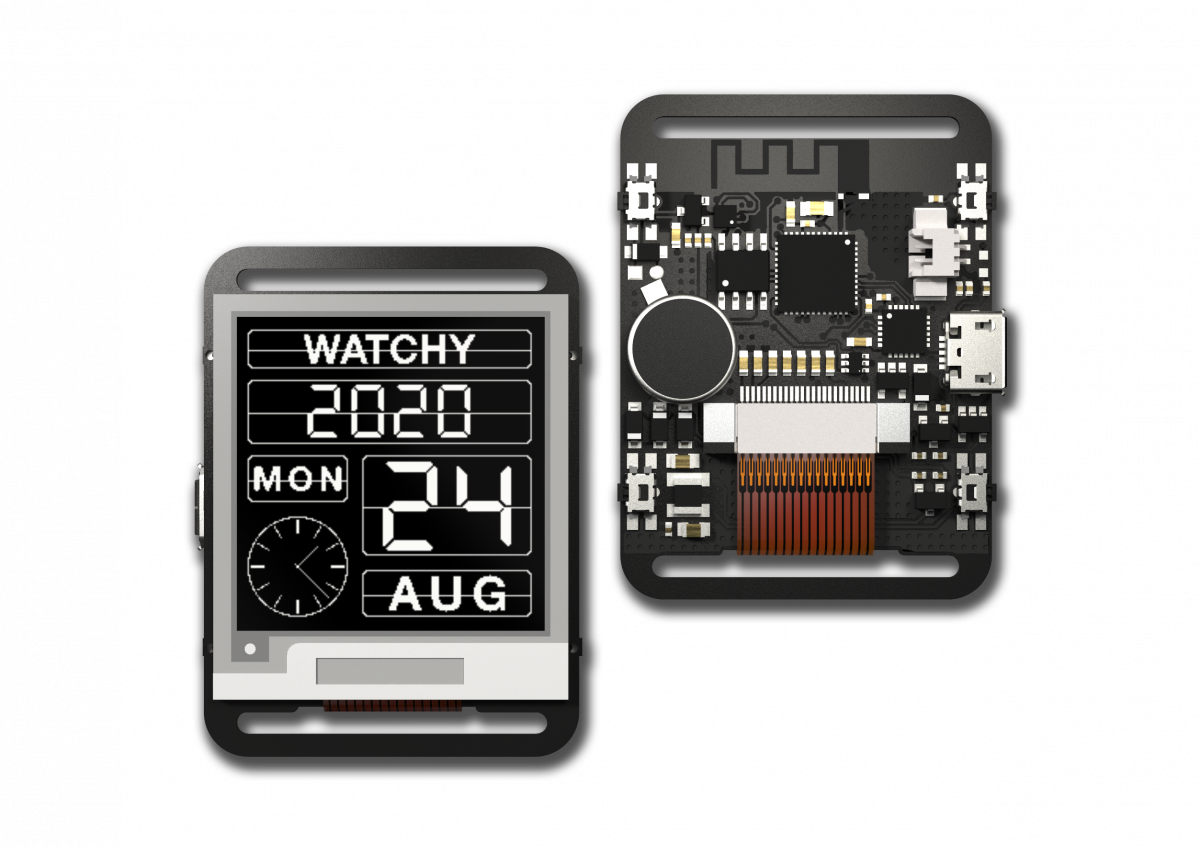
Watchy is an E-Paper watch with open source hardware and software. It has a barebones design utilizing the PCB as the watch body, allowing it to be worn as-is, or further customized with different 3D printed cases and watch straps. It is a unique timepiece that is also a wearable development platform, allowing users to create their own experience. Watchy and sqfmi