Technology

115 readers
33 users here now

Blacklisted SitesList inspired by other community rules.

  • Mac Rumors;
  • Al Jazeera;
  • NBC;
  • CNBC;
  • Tom’s Hardware;
  • ZDNet;
  • TechSpot;
  • Ars Technica;
  • Engadget;
  • TechCrunch;
  • Gizmodo;
  • Futurism;
  • PCWorld;
  • ComputerWorld;
  • Mashable;
  • Fortune;
  • Hackaday;
  • WCCFTECH;
  • Neowin;
  • Jacobin;
  • Yahoo;
  • Freethink;
  • Big Think;
  • Newsweek.

Technology news, blogs and articles.

Forbidden:

founded 3 months ago
MODERATORS
1
2


Conflict of interest note: Windscribe is commercial open source VPN service provider based in Canada.

Why is ProtonVPN lying about running price sensitivity testing on their customers?

Their pricing page gives you one of two prices at random. This is A/B testing, but instead they're saying the price difference is due to remnants of a sale. Their own code says otherwise.

Price sensitivity testing is when a company quotes different people different prices for the same product to see if sales hold steady at the higher price. Not to be confused with adaptive or dynamic pricing which uses your personal data to adjust prices to you.

People on ProtonVPN's subreddit noticed they were being quoted different prices for the same thing. ProtonVPN's General Manager replied that the differences were due to remnants of a recent sale that wasn't "universally refreshed". This was a lie, and we have proof.

That proof is their own code sorting every visitor into a price variant. It's labeled right in the HTML tag:

ab-test:VpnHpAndPricingVpnPlusSensibility300726

Which in plain English is:

VPN Homepage and Pricing for the VPN Plus plan, Sensibility test tagged 30/07/26.

The price continues to flip-flop as of writing this. Expired sales don't do this. Something like a Cloudflare-cached page doesn't add price sensitivity A/B tests to your HTML code. Proton, if you want to run A/B tests, at least don't lie about it to your users.

Source: Windscribe on X/Twitter.

3
 
 
  • The use of chatbots has exploded over the last two years, and people are increasingly turning to them for mental health advice.
  • SB 903 would ban advertising chatbots as therapy and add rules for AI use in formal health spaces.
4


“What’s the reason people connect so much lately?” one user wrote in a Facebook group on July 26, 2026. In these spaces of the social network there were already signs of mobilization and coordination. A day later, the 27th, he made the leap to WhatsApp groups: that day a user shared the first link in a group with almost 200,000 people with the text “WhatsApp’s Group to try to enter / cross to Ceuta”. These posts are part of an ecosystem of messages that increase in the last days of July and represent the first coordinations and organizations of Facebook users to cross to Ceuta.

Maldita.es has monitored 21 groups on Facebook in which the crossing from Ceuta to Morocco was promoted on July 30 and 31, and where, currently, another one is organized for August 15. While the July crossing began to be organized on the social network, the one of mid-August has migrated to the encrypted messaging platform where in Maldita.es we have identified, on August 6, 20 groups that plan an entrance to Ceuta by August 15 (or even before). Facebook groups continue their activity and continue to be used as a coordination showcase.

"What is the plan?": Within WhatsApp, Facebook and Instagram groups that organize a new crossing to Ceuta from Morocco by August 15

5
6
7


Via @GrapheneOS@grapheneos.social on Mastodon.

8
9


Factsheet.

On Thursday, the First Judicial District Court in Santa Fe, New Mexico issued a decision in the remedies phase of State of New Mexico v. Meta Platforms Inc. The court found Meta's platforms created a public nuisance by contributing to the youth mental health crisis and by facilitating child sexual exploitation. It ordered a range of remedies, including the creation of a $567 million abatement fund to finance various measures intended to address the harms to the public.

Why it matters.

10
11
12


Modern processors are fast in part because they guess. Rather than waiting to find out which way a program will branch, a chip predicts the likely path and races ahead. When the guess is right, time is saved. When it's wrong, the work is discarded, but traces of it linger, and since the Spectre vulnerability was disclosed in 2018, attackers have known how to read those traces to pull secrets out of memory they should never see.

13


Meet the Gemma Translator! A fully offline device powered by Gemma 4 E2B built with Antigravity.

Running entirely on a Raspberry Pi 5 with a connected microphone and speaker, this highly portable prototype is housed inside a custom, 3D-printed case.

Source: Google Gemma on X/Twitter.

14
15
16
17
18
19
3
submitted 2 days ago* (last edited 1 day ago) by beep@piefed.world to c/tech@piefed.world


Experts Reaction.

  • Bacteriophages kill bacteria, and scientists hope engineered phages could work as new antibiotics.
  • Researchers applied a generative AI model, called Evo 2, to this challenge. Given a starting place – in this case bacteriophage ΦX174 – Evo 2 suggested new DNA sequences.
  • Based on genomes written by Evo 2, the researchers synthesized and tested nearly 300 phages for effectiveness against E. coli. They ended up with 16 that proved exceptional.
  • Given its potential, the researchers have made Evo 2 openly and freely available. Acknowledging safety concerns, they point to the importance of having tools like Evo 2 to address existing natural pathogens and the ability to build safety checks into AI tools – something that doesn’t happen when pathogens evolve naturally.
20


21
22
23
24
25
 
 
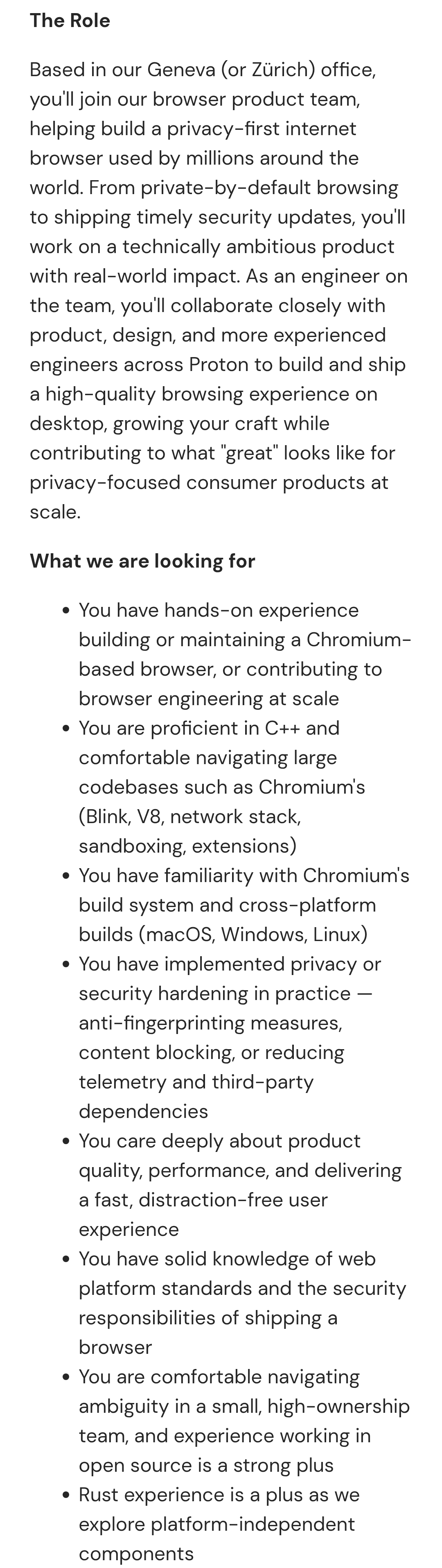
  • Proton is looking for staff to develop their own web browser.
  • The company appears to base that on Chromium, Google's open source browser.

The vacancy, first spotted by the Dutch tech news website Tweakers.
view more: next ›