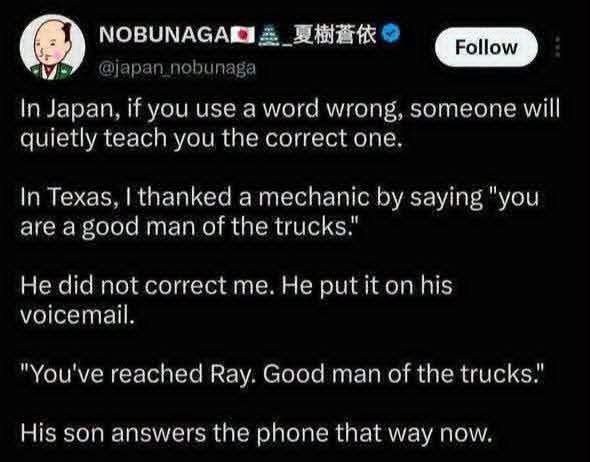
One nice thing about English, it will lexical borrow from you in an instant.
We just love new ways to say old boring stuff.
A place to share screenshots of Microblog posts, whether from Mastodon, tumblr, ~~Twitter~~ X, KBin, Threads or elsewhere.
Created as an evolution of White People Twitter and other tweet-capture subreddits.
RULES:
RELATED COMMUNITIES:
One nice thing about English, it will lexical borrow from you in an instant.
We just love new ways to say old boring stuff.
I have been saying it for years, English is a very informal and open language, have fun with it. Sky water is not technically a wrong way to refer to rain, liquid laundry soup is absolutely a sauce for your laundry, dish bricks, day star, the list goes on
I think this is one of the reasons why English (or it's descendants) will forever be the international language of trade. If it's not your first language, it's damn difficult to make yourself sound like a native speaker, but it's damn easy to make yourself understood.
but it’s damn easy to make yourself understood.
Words ordering with grammar can be unimportant to being known.
On the flip side, a lot of other languages have retained structures which require a detailed knowing of grammar in part because they haven't needed to be learned by amateurs.
Mate we're all amateurs here. Unless you are being paid to learn languages
True, though I would personally count that as a bad thing. Purity of language, to me is irrelevant. That opinion may be coloured by the fact that I'm a native English speaker, and there hasn't been anything resembling purity in this language for thousands of years. To me, the point of language is open communication. Any impediment to that is a negative.
I lik your way of doyng byzness
Here he is, fuckin get em
Whereas English has adopted so many idioms from other languages with different grammar that we're entirely comfortable with the exotic phrasing, or if it's ambiguous we make puns and/or poetry from it.
I speak several languages, most of which are Romance languages (such as French and Italian) which have a specific word order which pretty close to english (though adjective come after nouns rather than before, plus there are some additional verbal times though those are uncommon to use).
Amongst those I also speak Dutch and German, which have quite a different word order (though, curiously, Dutch from Belgium has a similar word order to French) and I constantly fuck it up (especially in German, which is the one of the two I speak worse) and the natives always understand me.
In my experience learning two of those languages just by living there (and with people that are learning my own native language), it's using the wrong words that confuses people, then using the wrong accent (mainly by putting the emphasis in the wrong syllable) and only as a far third is word order and even that only in specific cases such expressions (where it's the whole expression as is that has a meaning, rather the meaning being a composition of the meaning of the individual words in it).
In my experience there really is no special quality of the English language that makes it easier to understand when people use a wrong word order.
I think you're confusing a reasonably short period in recent history with "forever".
In History there were quite a lot of "international languages of trade" other than English. It seems to depend very much on which nations were the top empire of the age and because the last two top empires were English-speaking countries (first Britain, then after that the United States), the English language has been dominant as a second language for a over a century now, but before that the English language already existed in a form very similar to the modern form and yet it wasn't at all an "international language of trade" (in fact, at least in Europe, before English it was French that was the dominant language of trade).
I bet that the next "international language of trade" will be Chinese.
Laundry soup, yumm
I remember an interview with Lisa Kudrow in which she described her French boyfriend's failure to remember the English word for toes, and said they were foot fingers.
English: if the people you're talking to understand what you're saying, you're ok. Even if the people you're talking to don't understand what you're saying, you're still ok. Just be fancy with your words, and everyone will like it.
In french, that's really the name that is given to them, colloquially : doigts de pied (foot fingers)
The real term is orteils (toes)
They're really good at it, too. Sometimes it's even charming. For example, potatoes are "earth apples."
I wonder if the meaning of pomme was broader in Old French, like how meat (from mete) used to mean food in Old English.
Yes it was the case, broadly pomme meant fruit.
Originally tomatoes were called pommes d'amour. There is pommes de terre (potatoes) pommes de pin (pinecones). If we would translate literally pomme de pin it would give us pineapple.
There were also other fruits beginning with pomme originally but I can't seem to recall them.
I knew someone who used the term "bird leaves" which I find hilarious.
Ironically, same with Japanese. They have an entire alphabet dedicated to foreign words, Katakana. You want a hamburger and a beer? That's a "ハンバーガーとビール" (Hanbāgā to Biru). Coffee from Starbucks on your way to work? That's a "ドライブスルーコーヒー" (Doraibusurūkohi - a drive-thru coffee). Better fried chicken than anyone has a right to can be found at the "コンビニ" (Konbini - aka the convenience store). Learning Japanese it's rife with these borrowed words. Half the time it's "you're fucking kidding." The other half the time it's learning some insane formalism that makes saying "thank you" take five minutes.
What's cool is how English then adds those loanwords or portmanteau back into its lexicon like karaoke or, as I'm seeing more recently, egg sando. I really love how languages do that.
Reminder English will happily mug other languages for words, if they are handing new ones out for free? It's gonna take that new word and run with it.
One of my favorite Dogen videos, about how many loanwords can sound normal in a conversation
https://www.youtube.com/watch?v=pW4AiEqKGto
He had another one I think recently about a dentist who kept dropping random English words in sentences while talking with Dogen but he had katakana pronunciation so it was basically impossible to understand (one example was he threw in the word "jaw" but said "jō" instead).
I love the silly things we say!
They mean a slightly different way
but still connect to things I know
and make the silly language grow.
"Found in translation"
Beautifully said.
In Japan, if you use a word wrong, people will almost certainly not tell you so as not to embarrass you unless your mistake is sufficiently more embarrassing or insulting.
Ya, I thought they told you that your Japanese sucked by saying "your japanese is really good." And it's only when they stop commenting on the quality of your Japanese that you know you are near native levels. Even then, if you don't look ethnically Japanese they still might keep saying it, so there's really no way of knowing.
What? Noooo, so this is how I find out!
I studied Japanese for about 11 years. I used to work in the west end, so I'd have Japanese tourists to practise on. They'd always be like, aaah, sugeeee! And tell me how good my Japanese was. I started speaking in Kansai ben just to throw them off and it always made them laugh. But tbh my Japanese was crap, I just thought I was doing a good enough job bluffing. As soon as they started talking in Japanese, I'd have to say kiku koto ikkomo dekehen waaaaaa 😅
My grandmother liked to tell the story of when she visited in Japan in the 60s and greeted a bunch of people by saying "Idaho."
Can confirm, this is basically how it goes in Texas. Almost a decade ago, my best friend and I were browsing this little hole in the wall shop in central TX run by an elderly Japanese couple. They got to chatting with us and at one point, said we were "forever friends". I've been using that phrase to describe us ever since.
It may be just how normalised it is for English speakers to hear people speaking English imperfectly.
There's no shame or judgement in it. But when you find whimsy, oh boy.
I still say "delicious" in the way my Greek coworker did almost a decade ago, because it sounds better
And my dog trainer called my dog's arse his anoos one time and now that's all we call it. Talking about mine? Arse. The dog's? Anoos.
My wife worked with a guy from Korea and when he got upset at work he would say 'I go to mad!'
We randomly say that when we get upset. It's a more fun way of expressing your anger.
I was taking a summer afternoon nap with my girlfriend (now wife) and got up to look out the window for some reason about 8 years ago. She got up in a sleepy haze and said "Are you leave without say goodbye?"
We've been saying that to each other since.
I love how wholesome this is.
English is already a mess. The only people I've ever met who get persnickety about it with non-native speakers are assholes. I'd rather 'correct' them with a swift kick in the kisser.
Don't be embarrassed if your English isn't perfect. It's normal, and it's okay. We're all learning.
I love little expressions and turns of phrase. English is basically the remnants of other languages at this point.
It's the world's pidgin, and the world ain't over yet.
One phrase I have eaten from Joe Abercrombie for anything eloquenty put is simply "those were good words". Even simple words hit hard when meant sincerely.
Would recommend the book series (First Law trilogy)!
In japan don't you just get jouzu'd for any less than native equivalency and/or for looking too gaijin
Once you reach a level of basic competency most people stop jozu-ing you. Basically you know you're improving when people stop telling you you're good haha
In Japan, my experience has been if you use a word wrong, Japanese people will give out a pained laugh. If you ask for advice on the right word to use, the conversation ends.