this post was submitted on 26 Jul 2026
13 points (93.3% liked)

rpg

4890 readers
44 users here now

This community is for meaningful discussions of tabletop/pen & paper RPGs

Rules (wip):

founded 3 years ago
MODERATORS
 

BLUF: Title, basically.

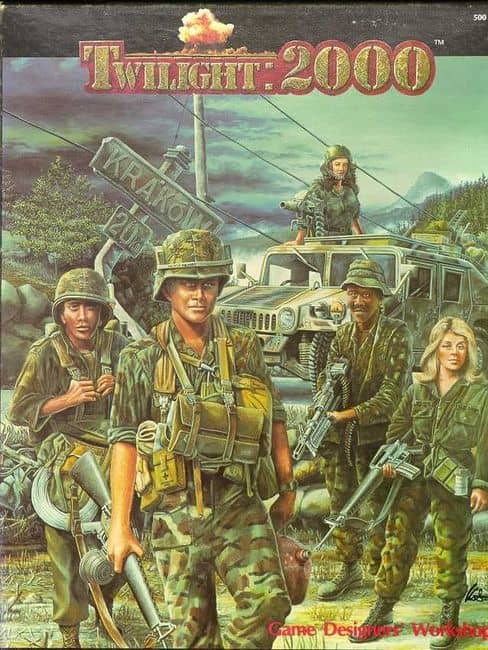
Extra Context: A couple years back, I picked up the 4th edition of Twilight: 2000. For those don't know, this is a post-apocalyptic RPG which was first released during the absolute peak of Reagan-era Cold War saber rattling. Unlike other, more fanciful or escapist takes on life "after the end", Twilight skewed much more simulationist, with Tom Clancy levels of hard-on for NATO and Soviet personnel and equipment statistics. Think This War of Mine meets ARMA 3, moreso than Fallout or Wasteland.

I start with this preamble to communicate how different in tone this system is from the games of 5e DnD I've played and run in the past. While the latest version of the Twilight rules is, to my understanding, significantly less packed with grognard crunch than previous iterations, I still find myself overwhelmed with all of the various mechanics and slight rule variations. As an example I hope is illustrative, to fire a weapon classified as a machine gun, your character uses their "heavy weapons" skill, but they follow the "ranged combat" rules, because heavy weapons typically refers to explosive type weapons. You also have to remember whether the MG you're using is classified as Light, Medium, or Heavy, as there are different requirements/penalties based on your character's stance. In and of itself, not too bad, and it pretty much tracks with the considerations I would put in place if I were designing this system, but it becomes a bit much with the everything else of the system. Case in point: the entry for hand grenades states: "grenades use the same rules as heavy weapons, with these exceptions:" and then goes on to list 6 bullet points, which makes me think that it hardly uses the same rules as heavy weapons at all lol.

To be clear, I don't necessarily want to jettison this level of crunch, as I think it's integral to the tone the system is designed around, but fuck me if it isn't a lot to keep track of, especially since I'll have to shepherd potential players through it efficiently if I have any hope of actually playing a game.

With that being said, any advice from the field? Experience with Twilight would be a bonus (any edition), but if anyone has general tips for tackling new systems, I'm all ears.
top 9 comments
sorted by: hot top controversial new old
[–] deft@lemmy.wtf 1 points 9 hours ago

If I wanna learn it, I usually have to be a player first.

The few times I've had to be the GM it always comes off the cuff. My most hated thing is pausing a game to look up mundane rules about encumbrance or climbing or anything.

Eventually you'll learn, at most just write down what you should look up later.

[–] Ziggurat@jlai.lu 1 points 20 hours ago (1 children)
  1. Read the book

  2. Create a bunch of 'test character"

  3. Use these test character for a "test one shot" with player interested to try, and understanding that the point of the one shot is to learn to GM the system

[–] iamthetot@piefed.ca 1 points 15 hours ago

Read the core rule book. Play a session. Evaluate if I liked it enough to continue playing it.

[–] calamitycastle@lemmy.world 1 points 22 hours ago (1 children)

The glass cannon recently did a campaign of it that's going up on their YouTube channel currently

I always find it helpful to check some actual play to cement my understanding of certain rules. Although there's no way to guarantee the actual play is definitely correct obviously

[–] redhorsejacket@lemmy.world 1 points 14 hours ago (1 children)

Aye, I've been following their uploads and it has been helpful from a general observation perspective. I wish they were a little clearer about the rules they are navigating, but I recognize it's not a teaching cast either. I will say it's been illuminating how free-wheeling the Ref is with the NPC rules, which has helped me conceptualize the flow a bit better.

[–] calamitycastle@lemmy.world 1 points 9 hours ago

Right, a good lesson in and of itself I'd say. Sometimes you wanna modify shit to keep things moving

[–] TribblesBestFriend@startrek.website 6 points 1 day ago (1 children)

I don’t sweat to much with the details. Being a GM is hard as it is.

IIRC the gameplay loop from Twilight 2000 (and other Free League) is pretty simple and that’s the basis for everything else so remember this one and put the rest in your memory maybe it will come back, maybe not 🤷‍♀️ have fun

[–] redhorsejacket@lemmy.world 2 points 14 hours ago (1 children)

Could be I'm just dumb and unfamiliar with crunchier RPG systems, I'll freely allow for that, but man, I feel like you and I have a different definition of "simple" lol. Considering this is a flowchart for adjudicating a single Ranged Combat roll, to say nothing of any other mechanic in the game. Granted, this is particularly egregious, but it's also the main thing most characters will be doing in combat.

I suppose the old adage holds true. How do you get to Carnegie Hall? Practice, practice, practice.

Maybe it’s me that come from SR3 and think that anything not near that is simple 😅

IIRC most of the gameplay loop for T2K is roll Two Dice, count your successes, assess what they do.

I think that when played you mostly need that at least it was my experience in Mutant Year Zero